Common Core Through The Eyes Of A Storyteller
Common Core Through the Eyes of a Storyteller
The first time I looked at the Common Core website, I
remember feeling a little bit overwhelmed. Even looking at the all the
information with a very tight focus—in my case, what the standards say about
reading informational books—it felt like a lot to process.
It took me a little while to understand that there are ten
big standards, the Anchor Standards for Reading, and that each of these
standards then has grade-specific guidelines for implementation.
The Anchor Standards discuss aspects of writing from an
educator’s viewpoint, with educator vocabulary—and I’m a writer, not a teacher.
So understanding what each Standard was asking students to do took a little
processing as well.
But I am coming to understand that many of the Standards
address things I think about all the time as I am working on storytelling.

Take Standard 2, for instance. It asks students to identify
the main theme of a text, and I think about the main theme of every book I
write. The theme is the big picture idea, the ‘so what?’ of every story. Why
the story matters. What we can learn from it. We can enjoy reading about all of Alice Roosevelt’s antics,
but the takeaway is what matters: “eating up the world.” Having a zest for
life. That’s the theme.

Standard 3 asks students to look at how people interact,
something I thought about constantly as I tried to show the development of the
relationship between Adams and Jefferson—how two total opposites could come
together to work for a common purpose.

Standard 4 is all about word choice and figurative
language—a writer’s dream standard, if you will. Finding just the right word to
express an idea is my favorite part of the job, capturing, for example, Walt Whitman’s passion for taking notes everywhere he went in his little notebooks, and
how these notebooks were “fertile ground for the seeds of his poems.”
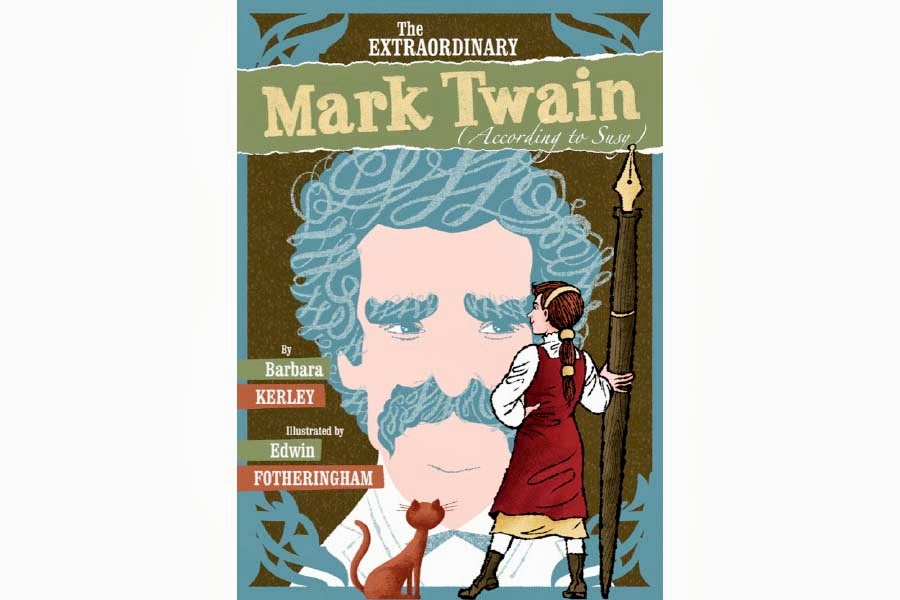
Standard 5 looks at structure, and boy is that a big part of
crafting a story. Every story needs a beginning, middle, and end, and
especially in a picture book, the opening lines are crucial to set the story in
motion and establish the promise to the reader that will be fulfilled by the
story’s end. And so when we learn
that Susy Clemens is “’annoyed’” that everyone is wrong about her famous
father, and that she is “determined to set the record straight,” we’re launched
into the story of how she does this by creating her own biography of Mark
Twain—excerpts of which were eventually published for all to read.
And finally, Standard 6, which asks students to think about
how an author’s purpose shapes the text. This ties into everything I do when
crafting a story. How do I present the facts of a person’s life in a way that
illustrates my theme, shows character development, and gives a satisfying
ending to the story just read? Which events, quotes, and details do I choose to
include, when I’m limited by the fact that a picture book text must be
short—and that every word counts.
When I think about the Standards and how they apply to
nonfiction books, what I understand is that the Standards will change the way
that students interact with nonfiction texts. Students won’t just be reading
nonfiction books to gather information. They’ll be reading books and analyzing
how that information is presented.
And for someone who cares deeply about storytelling, this is
very good news indeed.


No comments have been added yet.