reality in fiction
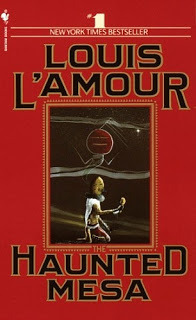 I recently posted a review of Louis L'Amour's
The Haunted Mesa
in GoodReads. I noted in that review that I read the book because I wanted to see what L'Amour's writing style and storytelling were like. You see, where I live (the deep South) most people read the Bible and Louis L'Amour novels (not necessarily in that order) and not much else. So I wanted to confirm my belief that I would find a simplicity of prose and literary technique, or be surprised at my conjecture's repudiation. I found some of both.
I recently posted a review of Louis L'Amour's
The Haunted Mesa
in GoodReads. I noted in that review that I read the book because I wanted to see what L'Amour's writing style and storytelling were like. You see, where I live (the deep South) most people read the Bible and Louis L'Amour novels (not necessarily in that order) and not much else. So I wanted to confirm my belief that I would find a simplicity of prose and literary technique, or be surprised at my conjecture's repudiation. I found some of both.I'm not going to rereview the book here. You can find my review at the link above. I just want to mention some aspects of the story that I feel are outside the context of literary criticism. But first, I do need to repeat a couple of points from the review. The storytelling is very much a "western" formula with a simple, straightforward prose style. I say that not so much as a criticism as an observation. Many people like that style (i.e., L'Amour's huge fanbase) and I think, for L'Amour, it came from writing for a particular market--the descendants of the "dime novel" magazines, contemporary western magazines, and the movies. These markets wanted formula westerns and L'Amour produced them abundantly and successfully.
So the western formula part I expected. The part I didn't expect (but hoped for) was L'Amour's pushing the western story envelope to reach into speculative and even paranormal realms. It wasn't great science fiction or fantasy but I expect it was leap of courage on his part to make the attempt. I really don't know how his fans received it (this was his last published book, I think) but I believe he deserved kudos for trying.
In my review, I listed six literary criticisms of the book that led to my 3-star rating. I have other criticisms that I didn't mention that are more philosophical than literary. In The Haunted Mesa I see them in the story's treatment of American Indians, women, violence, good-and-evil, and it's idea of "progress." I won't talk about them all, only the most glaring, which is his treatment of the Indians.
Since I'm a fan of Daniel Quinn's Ishmael books (see my review links below) the sections that talked about the Indians struck me as prejudicial against them in the sense of "Mother Culture's" bias against tribal peoples. Since the plot of The Haunted Mesa is based on the "disappearance" of the Anasazi ("Ancients Ones"), I read up on them in Jared Diamond's Collapse.
The Haunted Mesa speculates that the "evil world" the Anasazi came from, according to their legends, was another dimension and that they entered ours through "portals." When things got rough here, they returned to their home dimension. The Haunted Mesa paints the Anasazi as a peaceful people who were on the verge of discovering the "progress" of agricultural-based civilization but were impeded by the incessant warring upon them by those other dang tribal people. So they took to living on hard-to-attack cliffs for protection, but were still vulnerable when they came down to tend their fields and so couldn't hang on. They had to return to their home dimension, even though it was an "evil place."
That is the premise The Haunted Mesa's plot is based on, and it's fiction. It contains the idea of a lesser people who were always fighting one another and so could never get ahead. This idea is certainly not unique to L'Amour, but he says it like this:
Several attempts were made to construct a more advanced way of living before the coming of the white man, each of which was destroyed by nomadic invaders. This obviously happened to the Anasazi and a similar thing must have happened to the Mound Builders...What would they (the Anasazi) have become had they remained here and been able to resist the attacks of the wild nomadic Indians who were coming in from the North and West? How would their civilizations have developed?
Actually, according to Jared Diamond, the Anasazi civilization collapsed after about 600 years from resource depletion (some 400 years before Columbus showed up). Their environment was fragile to begin with, but they brilliantly exploited it and populated it to the point they even expanded into surrounding areas. But eventually they used up the pineyot and juniper trees they needed for building, cooking, firing pottery, and warmth. Then a huge drought that their large population couldn't bear did them in. Their "escape" was to a level of less complexity, absorbed by the Hopi and the Pueblo.
As depleting resources put pressure on their numbers and complex society, the Anasazi certainly did fight among themselves. I imagine it was basically a fight for survival--the biggest and meanest taking from those less able to defend themselves, until it was all gone. There is even evidence of cannibalism during this time, but none of "wild invading nomads." The Anasazi were just too isolated from the other North American tribes for that to be a factor (at least during this time period; though that part of the southwest is still pretty isolated today).
Lessons to be learned for our time should be apparent. From the broadest view, our highly complex civilization is facing a fundamental resource depletion no less than did the Anasazi. And the results are the same--starvation and fighting over what's left. Our only escape will be to a level of less complexity.
With regards to fighting, L'Amour goes on to say:
Our Indians warred against each other, just as did the Mongol tribes before Genghis Khan welded them into a single fighting force. Tecumseh tried to do the same thing in America, and so did Quanah Parker, but any chance of uniting them against a common enemy was spoiled by old hatreds and old rivalries...In almost every war the white man fought against Indians, he was aided by other Indians who joined to fight against traditional enemies.
This strikes me as biased towards Indians, coloring them as savages. Why is a hierarchical, exploitative way of life more "advanced" than tribal living? "Technology" is an inadequate answer. The common put-down of saying the Indians were constantly warring with each other, and they couldn't unite because of old hatreds, is an invalid way of seeing them. It sounds a lot like the idea I often hear that "those people in the Middle East have been fighting each other for centuries and always will." In other words, they're just mindless savages. I think a similar argument was made to justify making slaves of Africans.
Daniel Quinn makes the point that American Indians (and other tribal peoples) fought, but never to any tribe's extinction. They didn't conquer and exploit or take slaves as a vital part of their "economy." They didn't understand the difference in the white man's way of warring from their own. They didn't see that for the white man it was to conquer-to-exploit to extinction. By the time they did, it was too late.
In any action story, there is the temptation to have "evil widgets" that are there only to throw against the protagonist, giving him something to fight and so make him look braver and stronger. Note the stormtroopers in Star Wars, the orcs in The Lord of the Rings, the Nazis in old WWII movies, and the Indians in old westerns. It's a plot device but it's simplistic, hack, plot device. It can promote cruelty and racism. Surely, we can strive for a greater depth of understanding, even in our fictional worlds.
In recent years, there has been some attempt to show a more realistic view of who the American Indians were. Dances with Wolves for example (which was basically remade and set in the future as Avatar). What it amounts to is being tolerant of other people, their views and ways of life, and of being more honest in the telling of history, even in fiction.
---------------------
Links:
My review of The Haunted Mesa
My review of Ishmael: An Adventure of the Mind and Spirit
My review of My Ishmael: A Sequel


No comments have been added yet.