THE BOOKBAG INTERVIEW
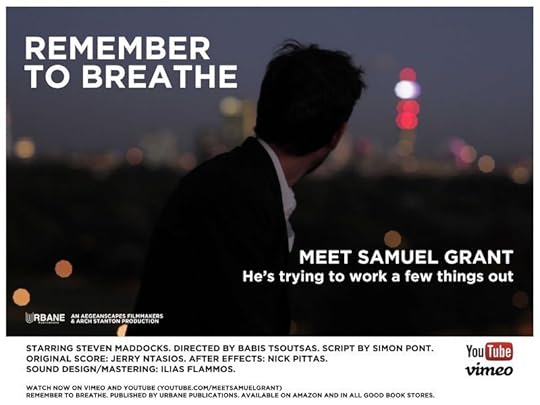
Here's a copy of an interview I did recently with the very lovely people at The Bookbag...
When you close your eyes and imagine your readers,
who do you see?
It’s a lovely question, though the shape and form of
“who” isn’t exact to me. I wrote ‘Remember to Breathe’ for people who love
fiction, who enjoy characters and love the escape and fun they can give;
whether it’s being in the moment when you’re lying on a beach, bending the
pages of a paperback with that smell of warm skin and sun cream in your nose,
or whether it’s being taken out of the moment when you’re riding the District
Line into work on a grizzly day. I know that all might sound a bit lyrical, but
what I’m trying to say, is that when I close my eyes, the images are less of
who and more of where, of where
people are reading. That’s what I see.
I’ve got to ask: how much of your hero, Samuel
Grant, is autobiographical? And if so, do you have any regrets?
You’re not the first to ask. Well, they do say you
should write about what you know... and by extension, who you know. There’s a
lot of people I’ve met and know who provided starting points for the
characters. And I of course include myself in that line-up. But then, it was
just a case of going to town, exaggerating like hell, and letting all of the
characters come to life and show me their stories.
And while, sure, there’s some of me and a whole lot
of other folk I know in Samuel Grant... I think there’s a little bit of Samuel
Grant in all of us. My hope was to try and create an archetypal male character,
someone that reflects his time, an anti-heroic type who’s trying to be heroic.
And I think Sam’s originality stems from his self-awareness, and his ability to
emotionally articulate, and be so honest. Male characters are so often stereotypes.
Think: strong, silent, matinee-idol throwbacks. By contrast, I think Sam holds
his own exploits in ironic disdain... yet he still wants to come out a hero and
a winner and a good guy. It’s in creating these dynamic tensions and contradictions
that hopefully makes Sam feel very real to readers – and then also leaves them a little conflicted as to how they
should feel about him.
And no, no regrets. At least, not yet.
Is Adland really like that?
Adland is no different to any other industry
badlands, in that there are lunatics and rednecks with shotguns, just like
every industry, and maybe some hungry tigers too. But adland is more good than
bad and arguably closer to a Narnia, a place of friendly lions where new
frontiers are forming all the time.
I love advertising, when it’s done right, where
it’s a case of some very creative, intelligent people being intelligent and
creative and achieving brilliant things.
On the flipside, I think “workplace nonsense” is
over-ripe for full-tilt parody and derision. In RTB, the depiction is a thin
slice of the dark side, skewed, Sisyphean – and it is a side that also rings
true for people.
I’ve always associated your name with non-fiction
writing. What persuaded you to move into fiction?
Funnily enough, it’s actually the other way around.
Writing non-fiction was actually a bit of a later-dawning epiphany, that came
after I’d written ‘Remember to Breathe’. The novel predates the non-fiction
titles, and I kind of persuaded myself to write a book on brands and media.
As people would imagine, writing fiction and
non-fiction are very different endeavours. Creatively, they come from a different
place. For me, writing fiction takes up a lot more head and heart space, where
it’s not so easy to switch off - but also, where you don’t necessarily want to
switch off.
Though there are cross-overs too, in that I look to
write non-fiction with a strong authorial voice and writing style, and where
the ideas and themes hang off cultural pegs that people are hopefully familiar
with. I think the challenge with non-fiction is to give it pace, to frame the
subject matter in a way that’s very accessible and page-turning.
Quite a few people have asked if we’re going to
hear more about Sam Grant. Are you planning a sequel?
When I finished Remember to Breathe, I actually,
very genuinely missed the characters. The novel is character-driven, and one of
the greatest pleasures for me, and a kind of proof that it works, is that
people who read it typically ask, “What happened next? What happened to Sam, to
Tam, to Jamie?” When I completed the novel, I remember wondering the same thing.
There is an appetite for a sequel. It would be
fascinating to contemporise what is a nostalgically-set group of people; to
turn pre-Facebook Twenty-somethings into present-day Forty-somethings.
Some have even suggested a prequel, maybe an
early-90s university year’s story. Whether a sequel or prequel, the creative
challenge, I think, would be achieve the right balance of character and
narrative. Because we now know the characters, their core personalities, and so
that initial novelty is gone. So there would have to be more external story,
throw more slings and arrows at Sam. And the trick would be to do it in a way
that was still original, without turning proceedings into a rom-com farce or
faux “on-the-run” thriller. Pitfalls aside, working it all out would be huge
fun.
I was very nearly put off reading the book by the
comparison to Bridget Jones. How do you feel about it?
In all honesty, it kinda worries me. The Bridget
Jones comparison is nothing more than a reference point that’s immediate for people
– a promotional device, to cite a familiar literary character where some
parallels could be drawn. The danger, of course, is that then some may suspect
Sam is some kind of rip-off, or was somehow “inspired by”. Maybe if Bridget
Jones and Patrick Bateman had a love child, you’d net out at somewhere near
Samuel Grant. But again, I’m reaching.
The fact is, Samuel Grant isn’t born from other
literary places. He doesn’t come out of fiction. He comes from life, a creation
I wanted to capture in fiction.
Where and how do you write? With or without
music?
I can write pretty much anywhere. Which is more out
of necessity than anything. I have three young children, so time and time to
write isn’t in abundant supply. But my wife is very supportive and helps me
carve out space. And then, it’s also about being active in the down-time. I’ll
write “emails” to myself on my Blackberry. Smartphones with touchscreens don’t
work for me. I like real, physical, very analogue buttons. I can rattle out
paragraphs on my Blackberry that I then email to myself, where I’ll later throw
it into a Word document and see where it takes me.
But ideally, my lap top, a little peace and quiet
and a second coffee-of-the-day at my side, and I’m a very happy guy.
Though curiously, I find music distracting.
What are you reading at the moment? What’s
your desert island book?
At the moment: William Boyd’s ‘Waiting for Sunrise’.
I’m really enjoying it – I love the historical 1913/14/15 context - though I’d
have loved him to reconsider the title. Personally, ‘Waiting for Sunrise’ is
generically forgettable. But then, his previous, ‘Ordinary Thunderstorms’, was
a great title but I found it a less satisfying read.
And if I was packing for a desert island, I might just have to find room
for two; simply pack fewer shorts. As some sort of record, how about ‘To Kill a
Mockingbird’ and ‘1984’, a kind of companion-set and commentary on human nature
and our potential for good and otherwise. Both novels example fiction at its
most profound and fundamental. I first read both in my teens, and they were
massively influential and informing, part of my reading rites of passage.
Of course, if my other
suitcase washed up on shore, the one with all the books packed in it, then all
sorts of guys would spill out onto the sand: Norman Mailer, Stephen King, Carl
Hiaasen, Luke Rhinehart, Ian Fleming, Stephen Fry, Philip Pullman, Iain Banks.
You’ve got one wish - what’s it to be?
Health and happiness; what else is there?
What’s next for Simon Pont?
Summer
with the children. Sunshine. Family time. New schools and back-to-work in the
Autumn. And, with hope, a clear intention on the next writing project. At
present I’m juggling and torn (makes coordination hard) on which way to go.
Non-fiction or developing a new novel? But I don’t mind admitting, it’s a nice
problem to have.
SP.