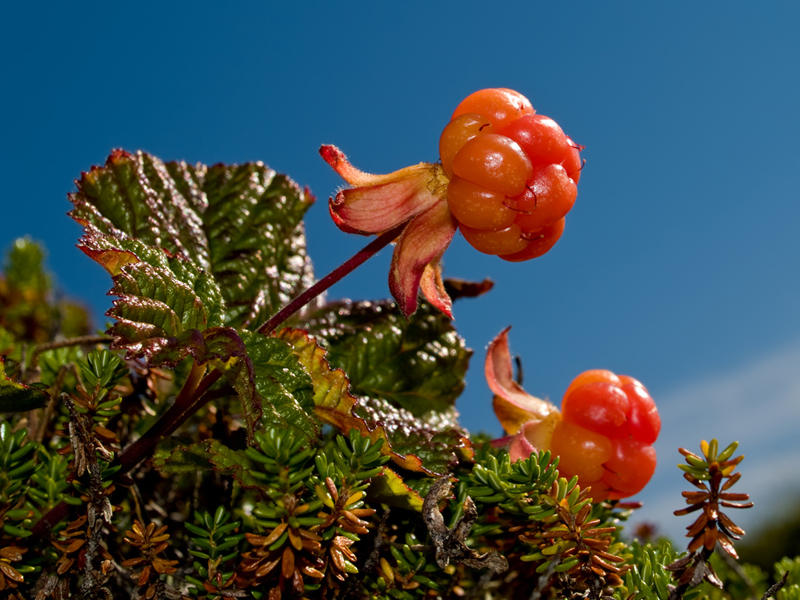
Cloudberry vs Emerald Carpet
A reader e-mailed to say that the plant I featured in my last post as Cloudberry may actually be a very similar looking relative used commonly in landscaping that has the common name “Emerald Carpet,” Rubus hayata-koidzumii, which seems also to be commonly called Rubus pentalobus (though confusingly, this latter Latin name is apparently no longer considered a “legitmate” name — which leads me to wonder, who decides?), which are native to Asia, and not Rubus chamaemoris, which is native to the Pacific Northwest. This makes sense, as I had wondered why, if it was native here, I had never seen it in the wilderness. Turns out true Cloudberries don’t grow south of Canada. So, that explains it. Both kinds of berries are edible and tasty. The distinction is one of classification. This reader added, “Cloudberries need a male and female plant to pollinate, where Emerald Carpet is self pollinating.”
I googled “Cloudberry vs. Emerald Carpet,” trying to distinguish them visually, and it is extremely subtle. It seems like maybe Cloudberries have berries that stick out more, elevated above the leaves, whereas Emerald Carpet seems to have berries closer to the ground. The leaves of Cloudberry also look slightly darker. While Googling, I also found a post Emily Porter had written about this after spotting them on the Lewis & Clark campus back in 2010. It seems the most meaningful distinction is geographical distribution.
My sincerest apologies to you, dear reader, for confusion caused by this error. I always strive for accuracy. Please do weigh in if you have experience with either plant.