
Give Me Plot, or Bore Me To Death
(Originally published February 2, 2012)
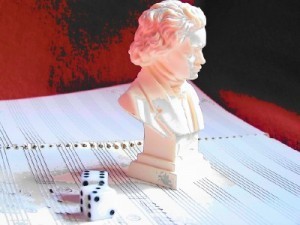
The summer before I started college, I went to a concert by John Cage, an avant-garde American composer. I had read his book and was captivated by his brilliance—his attempts to explode the boundaries of music by incorporating ambient noise and the element of chance into musical performance. He stepped onstage at the Decordova Museum’s outdoor amphitheater, and I leaned forward in the audience, ready to be awed by this iconoclast.
He began his performance, showing random slides and playing equally random notes according to the I Ching. I was excited–I’d never seen anything like it. But after a few minutes, a funny thing happened: I got bored. Really bored.
Sitting through a John Cage performance wasn’t even a tenth as interesting as reading about one. It turned out that no melodies and no structure meant no emotion, no direction, no climax, no resolution, and for me, no reason to keep listening. The sun was setting, the mosquitoes were out, and I was getting chomped. After twenty minutes, I got the general idea, and I left.
In college, I went on to study literature. I had discovered, while writing a high school paper on Edgar Allen Poe, the field of literary theory. Now I majored in the study of it, drawn to its philosophical, analytical nature, and how literature could challenge our assumptions about reading. I read novels with unreliable narrators, or narrators who broke convention by being self-conscious and self-referential, destroying the fictive dream. Plot was never central, or even important, in these books or in our classroom discussions. Concepts were—the concepts of time, story, memory, reality, and “memesis,” a word my department head pronounced repeatedly and very beautifully.
And again a funny thing happened: I started not finishing books. The pages blurred in front of my eyes, endlessly the same. And somewhere between Derrida and a book postulating that the pen was a metaphorical penis I started losing my reverence for theorists who never wrote fiction and fiction writers who thought themselves above plebian concerns like characterization and plot. I wrote my thesis about the most traditionally written, un-experimental book in twentieth century French literature—Les Mandarins, Simone de Beauvoir’s thinly disguised autobiography. And when I graduated, the first thing I read was Shogun, by James Clavell. I loved it. I was enraptured, swept along, kept up several nights in a row. It was the most I’d enjoyed reading in years.
I realized that different folks love reading for different reasons. And while the trappings of a story interest me, it is the story’s emotional experience that I really love, and that kind of experience does require unassaulted “mimesis,” characterization, and plot. I actually emerged from the ivory tower with a higher appreciation of popular fiction than I’d had before. Because now I knew for sure that I would much rather stay up late engrossed in a good thriller or “chick lit” book than prop my eyes open with toothpicks to read some prize-winning, earth-shatteringly beautiful, anti-chronological description of someone’s belly button. I was shocked to hear a prominent author at a writing seminar describe genre writing as “crap.” It didn’t make me want to read her books, at all.
I don’t read for the sake of the words, any more than I listen to music for the sake of the notes. I’m not looking for a solely intellectual or aesthetic experience. Sure, I’d like intellectual stimulation as I go. Open my mind. Shock me. Dazzle me with beauty and originality. But, please–if you want my attention, take me somewhere. I’d rather listen to Lady Gaga than to John Cage. Give me a melody, emotion, direction.
Otherwise, I’m walking out.



Chris Abouzeid's Blog

- Chris Abouzeid's profile
- 21 followers

