
The Joys of Workshops
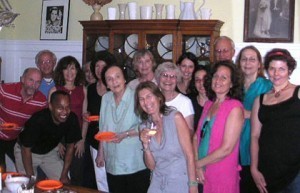
My writing workshop, pictured above, has been a valuable sounding board for all my novels.
Guest Post by Sally Koslow
Writing my first novel was almost an accident. The circumstances were dreary. I’d been booted out after a long run as an editor-in-chief of an iconic magazine just as I was starting to plan a special 125th anniversary issue. Following my dismissal, I retreated, whipped. My termination’s timing was inauspicious, not that there’s an optimal time to be fired: since my youngest son was in college, the statute of limitation on fulltime motherhood had run out, and recession tremors were rumbling in my industry as digital magazines had started to appear and publishers were scratching their heads, wondering how they could monetize them. Print jobs were coming on the market with the frequency of Houseplant Appreciation Day but were far less beguiling. Any opportunities offered to me were also thousands of miles away. Which wasn’t appealing.
Knowing it would take a while to land the right job, more than one friend urged me to augment my search by indulging in a hobby. The carpe diem approach sounded sensible, until I realized that I’d been a wife, mother, and a worker bee who’d dragged home manuscripts every evening and weekend and… had no hobbies. This is how, by default, I joined a writing workshop. Fiddling with words was the interest that had led me to become an intern on my hometown newspaper, and after college graduation to join a magazine staff in an entry level position where I put my English major to use by answering questions such as “Do you file from the front or the back?” Yet the higher I climbed editorial mastheads, the less time I had to devote to write. I missed it.
While the workshop I picked was intended for non-fiction and filled mostly by memoirists, with the teacher’s blessing I knocked out a breezy “chapter” of a “novel” and held my breath. The first time my work was discussed, one attendee seemed aghast that my submission was part of a potential “beach book” and another, who’d been laboring for years retelling the history of her multiple medical crises, hissed aloud about why she was “trying to roll her boulder up a hill” when I, slacker, was submitting this. As if humor and breeze are easy.
For the most part, however, the comments I received were helpful and inspirational.
Week after week, I kept going, and it did not take long to learn the value of a workshop. The group I joined had a few spoilsports—every workshop does, I later learned–who fail to read other people’s manuscripts or if they do, make even one comment, but overwhelmingly, the atmosphere leaned far more toward bonhomie than indifference or spite. Even better, those who commit time to a workshop, even if they may be novice writers, are often close readers. I quickly discovered that when you review another writer’s continuing work, you become invested in his or her intentions and if you’re half- a-mensch, instinctively want to help them succeed.
The payoff for the investment of time and energy in another person’s work is that your own writing improves, almost by osmosis. You learn, for example, to identify common mistakes other writers make that in your own writing fly by unnoticed–that the essay begins after the three paragraphs it took you to clear your throat, or that you use the word really in every third sentence. Really. You get a line on which members give you the most constructive criticism as well as participants’ special talents. One member may be spot-on at suggesting ways to tweak your dialogue while another is the grammarian you are not, if you are anything like me, since in my editing days I had the good fortunate to be tailed by a copyeditor, the equivalent of the sanitation police at the end of the Thanksgiving Day Parade. If you are lucky, at least one writer will have a meticulous memory—he’ll recall and remind you that in an earlier version, the cousin was named Hortense, not Harriet. Another one or two may be engineers of gorgeous sentences. Someone else’s marginal comments might make suggestions that add wit to your work, another might have the gift of sensing what’s left out of your pages, and some are simply warm-hearted cheerleaders. Collectively, the whole is vastly more valuable than the sum of its parts.
Once I became actively engaged in a writing workshop, I began giving birth to characters in my growing manuscript as if they were litters of kittens, developing messy plot lines, inserting too many brand names and metaphors. But I listened to the feedback I got, cut, pasted, read aloud, and rewrote, endlessly. At a friend’s book party, with uncharacteristic hubris, I approached her editor and asked for a meeting. She agreed. When I presented my elevator pitch about my project, a story about a magazine that gets taken over by a celebrity, the editor perked up and suggested agents. After I’d polished a hundred pages, the second agent I approached offered to represent me. A year later, she sold my completed novel.
I’d never expected to write a second novel. I had joined a workshop as a diversion, and thought that within two years I’d be fully employed again. But not only was I still only working here and there for short stints, I loved the workshop so much that to leave it would have left an emotional pothole in my life. Many of the participants had become good friends, people who were refreshingly different from my former magazine colleagues—equally smart, without the stilettoes and attitude. So I said what the hell, and started another book. It sold quickly in a two-book deal. I workshopped both of these novels with the same group, and somewhere along the way, forgot to job-hunt. Soon the leader of our group recommended that I lead writing workshops myself, at the Writing Institute of Sarah Lawrence College and through the New York Writers Workshop at a Manhattan community center. I found that leading a workshop is just a gratifying as belonging to one. I love seeing the week-to-week improvement and camaraderie within the groups.
If there is one thing I’ve learned from being a magazine editor, it’s that everyone needs deadlines. If for no other reason than this, joining a writing workshop offers exactly that—clear, crisp and sometimes non-negotiable terms that make you commit to finishing work every few weeks. Knowing that it’s your turn to submit a manuscript to a workshop may be the exact incentive you need to actually produce twelve pages, double-spaced.
At least it is for me.
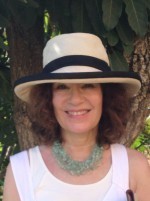
Sally Koslow is the author of five books, including her recently released novel, The Widow Waltz and a work of non-fiction, Slouching Toward Adulthood. Her previous books are With Friends like These and The Late, Lamented Molly Marx, chosen by Target for it Emerging Writer and Book Pick categories, and her debut, Little Pink Slips, inspired by her years as the editor-in-chief of McCall’s Magazine. Her essays have been published in the anthologies Wedding Cake for Breakfast and DIRT: The Quirks, Habits and Passions of Keeping House, as well as magazines including More, O the Oprah Magazine, Real Simple, Psychology Today.com and The Huffington Post. She invites you to read her essays and excerpts from her books on www.sallykoslow.com, to follow her on Twitter (@sallykoslow) and to join her FB fan page xx.



Chris Abouzeid's Blog

- Chris Abouzeid's profile
- 21 followers

