
Metaphornication: Trains
What follows is the oddest thing to bubble out of my brain in a while and that’s saying something: a critical look a trains-as-metaphor in recent SFF, as an effing poem. It was sufficiently strange, I thought I’d share, here goes.
Trains are awesome.
They have size, and speed, and momentum,
They roll right over those who resent them,
And pretty much no matter how you present them,
Trains are, (ironically for beasts built around blazing hot boilers,)
cool.
Trains are cool.
They hit that steampunk sweet-spot between intricacy and eccentricity
They’re magnificently indifferent to electricity,
And so, with a remarkable degree of chronicity,
They pop up as a favourite tale-telling tool.
The Hogwarts Express takes you back to school
And, not to harp on a theme,
but it’s an ‘Art-deco dream’, powered by steam,
That returns the Sandman to the land he used to rule.
So, trains are cool.
But
They don’t get quite a perfect score,
‘Cause for those of us vulnerable to metaphor
There’s just one thing we can’t ignore.
A fact that gets up any number of backs:
We might love the engines, but we hate the tracks.
Tracks are metaphorical manacles:
metal constraints that taint the very possibilities we want to array
Because, whatever train apologists say
A set of metal rails runs only one way
And, hard as it may be to define,
there’s something so baleful in that long, lonely line.
And it won’t lie down, no it won’t go to ground,
Not unless you hit it with a very big stick,
And in a sense, that’s just the narrative trick,
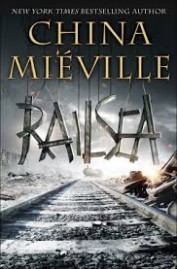
China Miéville employs, with his conceptual toys,
To give the Moletrain Medes the latitude it enjoys.
Railsea’s arithmetical,
To multiply the problem is to solve it.
The premise around which this whole world revolves is:
‘A single pair of rails makes up a prison,
but an sea of them enables any decision.’
Add to this a drop of Brechtian voice
And your image of perfect freedom of choice,
Becomes a symbol for narrative, for reading, for text,
Where what you read now won’t limit what you read… afterwards.
Still, if you’re of a mind to see it,
There’s more you can do with a trapped train than free it.
Cats like Felix, like to remix,
And when Gilman recasts the American west, it
would be a Half-Made World without a villain to test it.
And so he invests it with a power malign
A sinister armour-plated engine-agent of the Line:
A Black Knight train, crossing the border,
Bearing a Totalitrainian order.
It’s Carnegie-carnage, Snaffleburger Capitalism,
Its edicts: CONFORM, CONSUME, OBEY,
But… it’s a little extreme, wouldn’t you say?
Surely there must be some middle way,
And so we turn, at last, to Nick Harkaway.
Not really sure this counts as criticism
But a clockmaker remaking his father’s decision?
Doesn’t that smack a bit of determinism?
And Angelmaker’s train follows only one path,
But alongside her boiler, she makes room for a hearth.
Because whilst the Ada Lovelace computes, and commutes,
Her clan-destined passengers down pre-defined routes,
Her philsophy’s built around Ruskinite mores,
Where our greatest assets are our human flaws.
And that turns the metaphor in a surprising direction:
(like the waste-train that turbo-boosts Joe Spork’s erection)
Whatever limits are set on our human election,
Whatever insects alter our moral perception,
As we steam down the line to our final connection
We must dodge the tyranny of total perfection.
Trains are cool.
(With heartfelt apologies to JK Rowling, Neil Gaiman, China Miéville, Felix Gilman, Nick Harkaway, and of course, W.H. Auden.)


![[image error]](http://tompollock.com/files/2013/06/Angelmaker.jpg)
![[image error]](http://tompollock.com/files/2013/06/HMW.jpg)