300 covered, 700 to go..
300 covered, 700 to go..
Posted on: Sunday, June 16th, 2013 at 3:55pm
Hello from Rwanda, the most densely populated country in Africa based on its size. I’m sure there would be much more if it wasn’t for the many hills that limit movement, agriculture, and fall victim to erosion. At a population of over 12 million it’s exploded since some of it’s darker moments. I knew this was coming all along that I’m starting to head into areas which has seen massive conflict, lives lost, and political dissent. I said a fond farewell to my friends in Uganda one last time and rode the fairly flat 26km to the Rwandan border, where I had already been granted a visa through a painful process in Kampala a few weeks before. The website was broken which would have made it easier and allowed to save a page in my rapidly filling passport for future countries – 4 days of returning to the embassy armed with photos, letters on intent, $30 USD that needed to be deposited to a bank across the city, I was issued it. Rwanda is trying to become the Eastern African technology hub, they might want to work on getting their technical infrastructure sorted that’s facing the world sorted first.

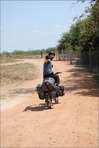
There were some huge changes I noticed upon crossing into the country – The first was the cheering, yelling, and smiling from all the people around – Usually borders are grim places where people try to shake you down for your last bit of money, to change it into their own counterfeit currency, general chaos, traffic, uzi’s and machine guns, cattle and goats running everywhere. Instead I was politely asked to show my entry stamp at the gate and I found myself climbing a hill, my first in Rwanda – They call this the land of 1000 hills, hence the title of this post. Upon that climb of the first hill is when the next surprise came – a man on a bicycle coming towards me at high speed pointing to the other side of the road.. Yes, right side driving again – Such a foreign concept to me since 2011. The next came 5 minutes later when I found a bank, and walking my bicycle over to the AK47 wielding security guard (askari) he asked me if I looked tired, in french (tu est fatigue?) to which I replied fluently in return without even thinking of it. So I guess that French Immersion schooling I opted for back in the 80s and 90s did some usage after all. Getting money wasn’t a hassle at all, compared to what everyone said it would be, and I continued the cycle through tarmac and dirt roads that were graded and ready to be paved, riding quite fast, weaving in between the traffic lines on this quiet road waving and saying hello to all of the locals that were in the small villages, shops, tea fields, and schools. What a friendly bunch of people I found, as I even made it a day ahead of schedule into the capital city of Kigali (Chee-gally) watching its large towers in the distance become closer. Sure there are some skyscrapers but what I didn’t realize is that the whole city is on many different mountains, and all of the roads wind in spiral around each other creating an intricate maze, often frustrating to get where you need to go. You can assure yourself that there’s a hill to be climbed, and in some cases it might be of grades 18% or higher, on cobblestone.

One of the many humps of the capital city of Kigali, Rwanda
I was quite pleased to arrive in the city early, as I’ve been in talks with another cyclist for the past few years, and we were finally able to cross paths. Peter Gostelow is well known in the cycling community for riding from Japan to England for three years before spending another three years travelling from Scotland to Cape Town, a legend in my books for sticking with it after taking a few machetes to the arms in Senegal, getting completely robbed clean in Kenya, and then losing his testicle in Zimbabwe. In fact, he’s the reason why I ended up over here – with the “Well, if he can do it, so can I’ mentality. It didn’t take more than 2 minutes for us t find our groove, and plan on doing some city exploring, and touring for the next few weeks. He’s back here after completing his 3 year journey, now taking up residency in nearby Tanzania teaching English for the next two years. We get along well, it’s nice to ride with experienced cyclists with all their own gear, knowledge of how to deal with the many situations that may arise, and to share some stories over some of the beers here. There’s been a lot of that. We both went and picked up our Burundian Visa at the chest tightening cost of $90 for 30 days entry with little to no run around in the capital city before exploring, meeting other friends and taking advantage of what bigger cities have to offer by means of food, nightlife, and Rwanda’s best kept secret – the coffee. I even went as far as getting rid of my Ugandan coffee as the difference was so extreme.

Peter Gostelow descending down one of the many steep hills in Kigali. I’m slightly jealous he’s only packing half the gear I am..

This was 18% grade, struggling to get up with a huge crowd of onlookers. There was no way out of it – either climb it or stay at the bottom.
The next differences of Rwanda started to become apparent as well – This is the cleanest country I’ve ever visited. No garbage on the sides of the roads, no one is burning large piles of trash, and you even see garbage cans nailed to trees in communities. In fact, on the last Thursday of every month each resident of Rwanda is required to clean up their neighbourhood for hours. A very much progressive way of thinking to which the president even banned the usage of plastic bags – where they search belongings at border for their existence. It’s punishable by a large fine and even jail time, so having one out in the open is sure to be found by one of the many police officers standing on every corner dressed in bright neon yellow jackets with stern faces. If it’s not that, it’s the parading military combatants marching with assault rifles and machine guns in random places. Apparently if you cross their path is also punishable. It’s also the quietest country I’ve visited in Africa, no loud bars running until 5am, the public transport no longer blare reggae music at high volumes, and everything looks in order with no cars on the roads requiring maintenance. I would think they would have to be pretty maintained to try to make it up one of these hills that start immediately after you descent from the prior one.
I clocked 69.8km on one of them one day, and nearly all have been hitting the mid 60’s since then. Slightly dangerous as I ride without a helmet, but whatever. I’m not sure I even got into that I made that decision a few months ago to ride without – my reasoning was that the foam on the inside had melted away and the Styrofoam was causing irritation to my forehead. I snapped it on the back of my bike one day and rode with it that was for 30 days until leaving it in Kampala by accident. I’m getting a wee bit sunburnt on my head but otherwise it’s fine. One less thing to worry about – and if I was to meet my maker from a high speed collision with something It’s probably best to say I’d rather call it quits right there as opposed to having a perfectly working head and everything else unusable, confined to a chair or bed for the rest of my life. It’s a highly contested issue around the world isn’t it. The only downside is that I keep losing Bandana’s on a regular basis. I’ve lost 3 in one week, some of them gifts. Sorry.
I managed to take a video of the descent where I reached the speed, and thankful to the low cost of internet in Rwanda (7GB for $7 USD) I’m able to upload it at an amazing 42 megabits a second. This has been the fastest and most cost effective internet yet. Let’s hope for other future advancements! Mom, Dad, don’t watch the part where I nearly get creamed by the Semi Truck.

Primus Beer is everywhere – At $1.20 for a 720ml bottle its the best deal on beer in Africa so far..

These young boys were carrying their goats back from their feeding pasture for the day
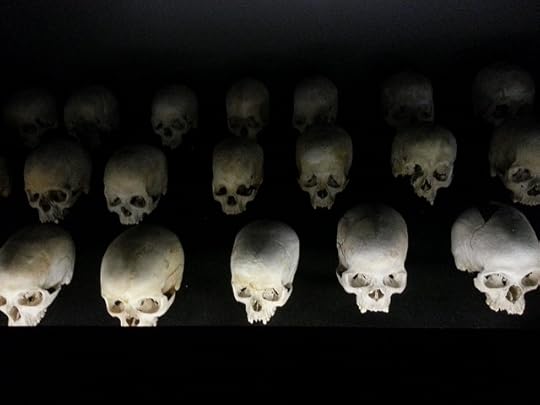
Rwanda is a police state, let’s face it. There’s a weird sense of fear among the residents, but also extreme generosity received from everyone I meet, that I’ve never seen before. I’m not sure if it is just the way the people are (It’s true every Rwandan I’ve met outside the country has been fantastic), or if it’s a way of saying thanks, as many of the western world countries poured an abnormally large amount of money into the country after what happened here in the 1990s when over 1 million lives were lost in a genocide. The fallout is apparent everywhere you go, with signs speaking of it being the 19th anniversary of it happening, mass grave sites everywhere and a huge education campaign to educate locals and foreigners alike. I had the opportunity to visit one of the many memorial centres present in the country – mine being the largest where 250,000 bodies were uncovered in mass graves near the capital of Kigali by the Hutu tribe in an attempt to destroy the (what they said) inferior Tutsi tribe. This is tribalism gone out of control. It didn’t just happen over night, it dates back to the early 1900s when it was under German rule, and Christian teachings brought with them ideology that a superior tribe should only exist. This continued throughout the years causing discontent among the residents and locals before bubbling over in the late ‘80s, with random acts of violence occurring, 300 killings in a village occurring as a precursor common, as state run newspapers and radio stations began broadcasting hate messages. Many people began fleeing to nearby D.R. Congo, Tanzania, Uganda while the United Nations stepped in – creating something known as the “Arusha Accord” to bring peace talks to the table in 1990.
Too little too late, as when I say the UN stepped in, they stepped in, and walked right back out letting things reach their boiling point until April 6th, 1994 when upon arrival to the Kigali Airport the plane carrying both the president to Rwanda and neighbouring country Burundi was shot down at 8:27pm in the evening. By 10:15 roadblocks had appeared around the capital city, and thousands of trained militants armed with machetes, sticks, grenades and guns (seemingly supplied by the French Government) went from door to door following their list of who was belonged ot what tribe, setting houses ablaze, hacking off their arms, forcing victims to kill their loved ones before themselves being caught, chained together and set on fire, herded into a church for the solace of safety before being ambushed, locked in and having grenades and fire bombs thrown inside, children being placed in burlap sacks, tied shut and thrown into rivers, women being taunted and raped before being killed, and for those ones who were HIV+, left to live to suffer a longer lasting nightmare in a country where ARV’s were not yet available do to a patent agreement spat between major drug companies. It didn’t matter if you were best friends for 20 years with your neighbour. If you were a Tutsi (which in itself is not clearly defined, at some point the switch between tribes occurred when one had 10 cows in their possession), you were to die.
Piles of bodies lie in the street while dogs snacked on the remains causing huge disease outbreaks, and those sent to the hills ran in fear without stable sources of water or food for days on end, often perishing before being able to find refuge. Luckily not everyone was against each other – there are stories of traditional doctors housing dozens of fleeing Tutsi’s in a room on her land playing on the fear that the locals had of her thinking she was possessed by demons, and other humanitarians realizing that the hate propaganda that was being spread for decades was wrong. The rest of the world heard bits of fragments of the “civil war” occurring, choosing to sit on their hands for three months before order being restored by the Rwandan Patriotic Front, an army of Tutsi’s who had been amassing in Uganda. Similar killings followed before the international community stepped in and commenced restoration of peace. It’s a complicated story, and I’m likely not the best person to explain it. Do some reading, and shake your head at the tragic loss of lives that occurred due to ignorance, hate, and hierarchy. I’ve shared private talks with both Hutu’s and Tutsi’s and it still exists – hate that is programmed from a young age is hard to displace, yet all the persons I have talked to have stated they are not supposed to talk about which side they belong to – a sort of fear that is common throughout the country. It’s a sad way to see the landscape as I cycle through this wonderful country, with an overlay of dead bodies piled in ditches, displaced family and sites of torture when all I’d really like to see is the greenery.
This wasn’t the first as I travelled tthrough Canada and USA where the planned extermination of aboriginal occurred in many regions, and also through various colonial rules in South Africa, Namibia, Zambia, Zimbabwe – oh screw it, every country i’ve visited has seen something happen in its past. One’s I haven’t seen involving the extermination of Jewish people in Europe, the German led genocide in Namibia, the Islamic led attacks militant attacks on places like Somalia, Djibouti are just around the corner for me, but it seems that the damage has been far greater with little attempt to sweep it under the carpet like other places. Tribalism isn’t just for old times, today it’s happening in Kenya, apparent between the most populous Kikuyu tribe and the Luo happening in Kenya, where even their newly elected president is standing trial for crimes against humanity for sparking rounds of violence and riots in 2007. I thought we learned all of these when we were younger – no side wins when someone decides they are greater than the other. Still, It’s happening right now in Mali, D.R. Congo, Syria, Israel, Egypt, Afghanistan, and even happening in your own country, probably just under a different guise – lives may not be lost but the constant barrage of information detailing what’s better for you than the other competing product/policy/thought process is doing a damn good job at etching its propaganda into your mind. We aren’t born with it – it has to come from somewhere. I wonder, am I doing it too? Are you?

A collection of skulls found from the hundreds of mass graves situated from around the country.

Many memorial sites line the roads as you pass making sure that everyone is aware of what our fellow human beings have done to each other.
The plan it seems now is to head west towards the southern tip of Lake Kivu in Rwanda, as the locals go out of their way to show welcome, with highly intelligent conversation either in French, English Kiswahili, or Kirwandan, bordering the D.R. Congo before descending into yet another country faced with problems (I’ve actually received 3 warnings from various embassies in the past couple weeks), Burundi where apparently the capital of Bujumbura offers some of the most stunning beaches and quality of life in this part of the world. I’ve got a partner with me to offset the lonely days, and keeping in good spirits, and the gear just keeps getting lighter – as planned my clothes are tearing into shreds and I’m finally able to use the spares that were brought over during my extended stays in Zambia and Kenya last year..
You’ve gotta be pretty hardcore to ride Rwanda with its steep climbs, but the reward is beautiful landscapes, smiling people, and a wonderful opportunity to watch a nation rebuild itself and do what’s right for everyone. Certainly a model country for Africa, and the whole world as a whole. Recommended, and I will be back.

Water seems to be an issue here – women often carry these 20 litre containers for kilometres before finding a source from a river, stream or spring

A steep countryside with major erosion problems.
 [image error]You're reading the RSS feed for Tired of I.T! Did you know that the website contains much more information such as articles, gear list, daily statistics, videos and photos and more! You can also get real time micro-updates by following on Twitter and Facebook!
The post 300 covered, 700 to go.. appeared first on Tired of I.T!.