
What do you do when a student swears at you?
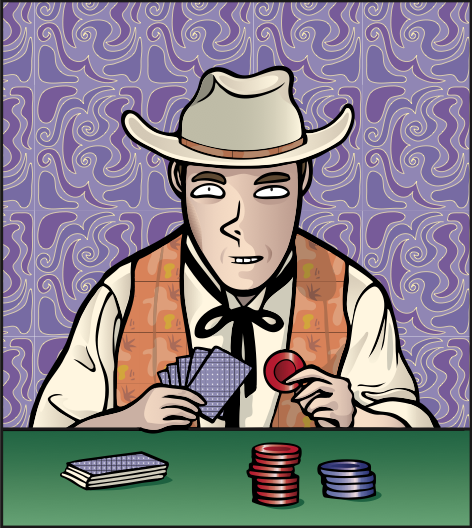
Staying calm in the face of whiny backtalk is a piece of cake compared to staying calm in the face of nasty backtalk. If we can think of discipline management as a poker game in which the student raises the dealer (you) with increasing levels of provocation, then nasty backtalk is going “all in.” The student is risking it all for the sake of power and control.
What separates nasty backtalk from whiny backtalk is not so much the words, but rather, the fact that it is personal. The backtalker is probing for a nerve ending.
Experienced teachers understand the following rule:
Never take anything a student says personally
If you take what was said personally, you are very likely to be wounded and respond emotionally. If you do, the student has succeeded.
There are two major types of nasty backtalk: insult and profanity.
Insult
There are a limited number of topics that students can use for insults. The main ones are:
• Dress
Say, where did you get that tie, Mr. Jones? Goodwill?
Hey, Mr. Mickelson, is that the only sport coat you own?
• Grooming
Hey, Mr. Gibson, you have hairs growing out of your nose. Did you know that? Whoa, Mrs. Wilson! You have dark roots! I didn’t know you bleached your hair. Hahaha.
• Hygiene
Hey, don’t get so close. You smell like garlic.
Hey, Mrs. Phillips, your breath is worse than my dog’s!
Are you ready to wring the kid’s neck yet? That is the point, after all.
Take two relaxing breaths. When the sniggering dies down, the kid is still on the hook. If you are in your cortex, you can make a plan. Right now, I am not so much concerned with your plan as I am with the fact that you are in your cortex.
Profanity
There are a limited number of swear words that students can use in the classroom. Chances are, you are familiar with all of them. There are your everyday vulgarisms, and then there are your biggies.
Now, ask yourself, what is the real agenda underlying vulgarity? As always, it has to do with power. The question of power boils down to a question of control. Who controls the classroom? This in turn boils down to the question of who controls you.
Can a four-letter monosyllable control you and determine your emotions and your behavior? If so, then the student possesses a great deal of power packaged in the form of a single word.
If you give a high roller this much power, he will use it. And, if such power comes quickly and predictably, he will use it again and again.
To understand the management of backtalk, and especially nasty backtalk, you must conceptualize your response in terms of two time frames, short-term and long-term. As described in last month’s segment, the short-term time frame is very short — two or three seconds.
Short-Term Response
To review, the correct short-term response has to do with the fight-flight reflex. Take two relaxing breaths, remain quiet, and deliver some withering boredom.
If you are in your cortex, you can use good judgment and choose a long-term response that fits the situation. If, however, you are in your brainstem, judgment is out of the question. Consequently, if you succeed in the short-term, you will probably succeed in the long-term.
Your lack of an immediate response is very powerful body language. It tells the student, among other things, that you are no rookie. You have heard it all a thousand times.
If the student runs out of gas and takes refuge in getting back to work, count your blessings, and consider getting on with the lesson. You can always talk to the student after class.
Do not worry that students will think, “Mr. Jones didn’t do anything about Larry’s profanity.” Give them some credit for social intelligence. They just saw Larry try the big one and fail. They saw you handle it like an old pro. And they learned that profanity is useless in this classroom as a tool for getting the best of the teacher.
Long-Term Response
Your short-term response does not foreclose any management options. It simply gives you time to think while avoiding the Cardinal Error.
In the long-term, you can do whatever you think is appropriate. You know your options. If, in your opinion, the student should be sent to the office or suspended, then do it. Just do it calmly.
If you are calm, your actions come across with an air of cool professionalism. You are above the storm.
This calm helps students accept responsibility for their own actions. Of course, that is the last thing they want to do. They would love to have a nail upon which to hang responsibility so it is not their fault. If you are the least bit out of line by becoming upset, you have just provided that nail. However, it is hard for students to blame someone else when they are the only ones acting badly.
If you want to expand upon this information and learn more about the pieces of the puzzle that comprise classroom management skills, read about it in chapter 18 of Fred Jones’ Tools for Teaching. Now available through Amazon in ebook form! www.fredjones.com


