
The Sibling Dynamic
Recently I’ve been having conversations with parents about siblings – what they need, why they act certain ways, why they can’t just get along! I sat down and wrote out some hopefully relevant and impactful information. Ready? Deep breath. Go!
So, you’ve got little people in your house and they’re growing leaps and bounds crazy fast. And they’re using your energy as a parent to stay balanced, to be in the human part of their brain, which they’re not going to be in all the time. They will slip. And if they’re out of the house for any period of time away from each other, they’re going to come home even more spent and in more need of filling up.
Siblings might enjoy playing and being together, and then there are these combustions that happen. They just start to get at each other. And you’re thinking, “What happened, you were just doing fine!” And the reason is, they’re playing and having fun, and then their system goes, “Too much!”
And as an adult, you can, on a very deep level, tune into that “disregulation” — the times when they are fine one minute and then acting crazy the next — and catch it and help them re-regulate. You do this when you notice them getting wound up or out of sorts and you say, “Hey, let me give you a little hug here,” or, “Let’s shift gears.” But as a sibling, if someone starts to feel disregulated, the other sibling can’t get their lid on; they’re going to have a reaction too, and then they’re both, BOOM! Disregulated, lower-brained beings. And that’s why the yelling and grabbing and hitting happens. They’re just overwhelmed little people in their reptile brains.
Parents needs to understand that this is normal. It’s also important to understand that every child is different. You want to figure out how long the siblings can go before they disregulate each other. What I recommend is to take a few days, put on your observer’s hat and watch to see how long they can typically play together before they blow. Once you have a sense of that, experiment with bringing your energy into the mix 5 or 10 minutes before that so you can help them re-regulate their systems and avoid the blow ups.
You can re-regulate them with eye contact, sweet words, and loving physical contact. You might also get their bodies moving. By doing this you are emotionally filling them back up—you’re charging their little batteries so they can run a little bit longer in their human brains before they explode again.
If you’ve got a lot of sibling stuff going on in your home, you want to clear as much of the decks as you can: no extra friends, no extra people around. You just want to sink in and slow life down and do some slow family time. One thing that works really well is to split up and do one-on-one with each child and then you come back together. And if you can’t do it in that moment, put it on the calendar and make a point to do that in the future. Schedule one-on-one time with each child.
column_break
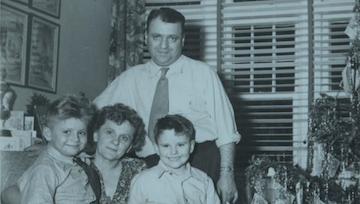
My Pops is the little guy on the right.
It’s easy (because you are exhausted and you just want a little break) to wait too long before checking in. However, if you catch the signs of when they’re going over, it will save you a lot of aggravation. When siblings are at each other they are most likely doing their best to unconsciously communicate that they’re overwhelmed, and they might be hungry, angry, lonely, tired, but no matter what it is, it’s putting them in a part of their brain that can’t stay in relationship with somebody who can’t regulate them.
And so little ones are doing their best to communicate, “I need you; I need help; I need an adult.” And they’re not capable for a very long time of saying, “Can somebody give me this? I need this.” So they’re going to behave in ways that get your full attention.
With siblings, I feel like those patterns get set up in the beginning. So if a child really feels like it’s hard to get mom or dad’s attention when the second baby comes along, they can establish this dynamic where they have to do something kind of unsavory because they know that’s the thing that’s going to get their parents’ full attention. So that’s when you want to help shift them. Give them tools and language to help them move in different directions.
But first, you have to be tuning. Set it up almost like a little case study where for a week you just pay attention. Ask yourself, “When do they combust? Is it when they haven’t eaten for a few hours, is it right before bed, right after school?” I promise doing this work up front with save you time and energy in the long-run. As you start to read the signs and you preventively filling them up, you’re buying yourself more time and more space and more peace. I guarantee it.
Phew! You read all of that – give yourself a pat on the back! And feel free to let me know your thoughts below.
Also, if you want more info and have children between 1 and 4 years old, check out my newest program On Toddlerhood. I promise you’ll get a ton out of the information I provide!


Carrie Contey's Blog

- Carrie Contey's profile
- 2 followers

