Tonight we’re going to party like it’s 1565!
Busy week, friends, busy week—not so much with work (shh, don’t tell my clients or my editor. Oh, hi, clients and editor!) but because we’re having some friends over on Saturday. Now, this is not a particularly huge or involved event, so it shouldn’t take a full week to prep for it, except that I spent that last several months writing a book. During that time, I let certain things slide. Like the utility room, which was rapidly becoming hard to walk through. Or the yard, which remained mowed thanks to my yard guy (That would be my dad. My dad is my yard guy. He works cheap.) but untrimmed, unweeded, and generally unloved.
Entertaining is a great reason to generally spiffy up, put away, declutter, and vacuum all the crumbs out of the sofa cushions. And then there’s the fact my husband is turning 42, and as any fan of Douglas Adams knows, 42 is the most important number in the universe. Seems like as good as an excuse as any to invent people over. (Said husband has promised there will be Pan Galactic Gargle Blasters. I’m not sure how, as Ol’ Janx Spirit is unavailable in this solar system, but he will contrive.)
This got me thinking about parties in art, and there are many to choose from. Toulouse-Lautrec at the Moulin Rouge. The luscious riverboat parties of Renior. But the best parties for my money are those depicted by Pieter Breughel the Elder. There ain’t no party like a Breughel party. Those people knew how to get down.
I’ve looked at the work of Breughel before, in particular his Netherlandish Proverbs. He made a name for himself painting marvelously crowded and detailed paintings of peasants in his native Netherlands.
We’ll start out with a relatively restrained dinner celebration:
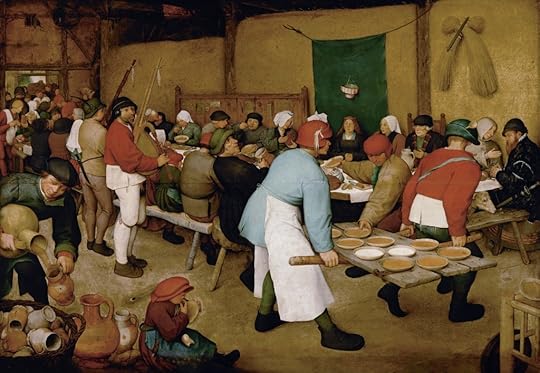
Pieter Breughel, “The Peasant Wedding,” 1567 (Click image to enlarge.)
What a wonderful composition. That long angle of the table, zig-zagging and extending to the door covered with plates, draws you into the work. The colors are wonderful–notice how he scatters red and green against the brown-gold floor and walls. The light yellow of the man in the foreground pops against the man in black and the green banner behind him.
The bride is sitting under that green banner. She looks quite satisfied with the festivities.
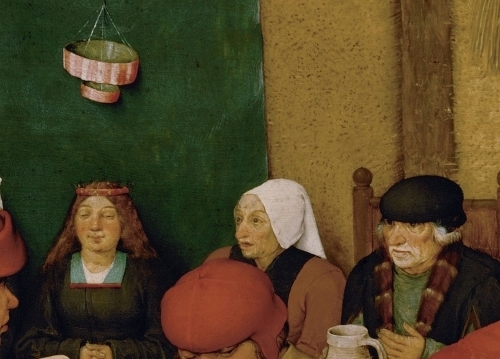
Pieter Breughel, Detail from “The Peasant Wedding,” 1567
Those are probably her parents sitting next to her. The question, of course, is where’s the groom? No one is quite sure, although some experts think he’s the man pouring out beef in the front:
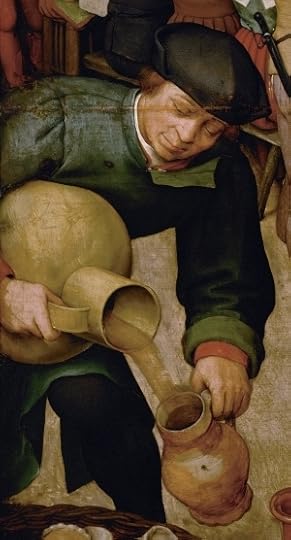
Pieter Breughel, Detail from “The Peasant Wedding,” 1567
It’s important to note the poverty apparent in the event. They’re in a barn, hopefully well-cleaned for the evening. A door taken off its hinges is used to carry food. The food is incredibly simple—bread, porridge, and soup. There might have been a little meat in the soup, but not much.
But they’re having a good time. They’ve even got music from the two men playing pijpzaks, an early form of bagpipe:
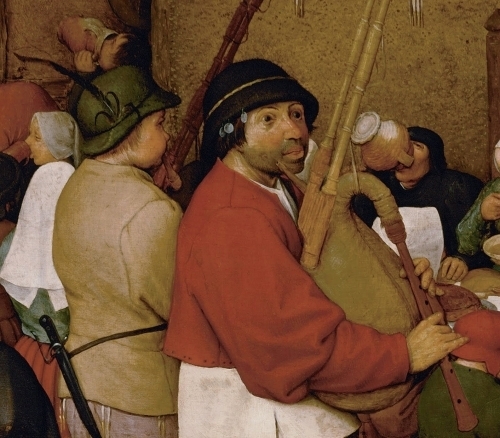
Pieter Breughel, Detail from “The Peasant Wedding,” 1567
After the feast, the party got more raucous when the dancing started. Here’s another work by Breughel, The Wedding Dance, one of several versions he did on this subject.
[image error]
Pieter Breughel, “The Wedding Dance,” ca. 1566 (Click on image to enlarge.)
Now folks are really starting to loosen up. The entire village must be there, and maybe the village up the road as well.
The bride in this work is dressed in black, which was apparently popular at the time:
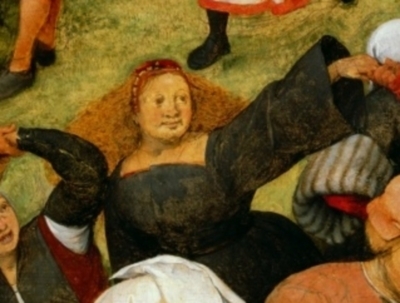
Pieter Breughel, Detail from “The Wedding Dance,” ca 1566
She’s not what you call svelte, is she? Neither am I, so I’m not judging her, just noting that there’s no attempt to make the bride conventionally (even conventionally for 1566) pretty.
And then there are the men. Oh, the men.
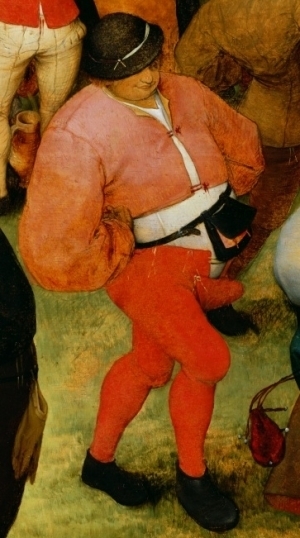
Pieter Breughel, Detail from “The Wedding Dance,” ca. 1566
And hello to you, too, sir!
Codpieces were essential fashion, even for peasants. You’ll notice all the men have them, and it’s just incredibly silly. Of course, so were acid-washed jeans.
A great deal of criticism of this piece focuses on the unrestrained dancing on display, which was the sort of thing that the authorities of this era frowned upon—even tried to outlaw. People weren’t supposed to swing their arms to widely or laugh too loudly. They were supposed to be restrained and modest. The upper classes would never have let themselves go like this (unless they were slumming it, I suppose, although that could result in many unfortunate diseases). The sort of people who could have afforded to buy this painting from Breughel would have tut-tutted and used the work as an example of the rowdy, unruly behavior of those damn peasants.
No one’s quite sure how Breughel felt, though. I don’t see either this painting or the one above as critical. I think they’re celebratory. Breughel seems like the kind of guy who would have jumped right in.
One last detail from this work—I love the background:
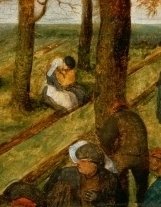
Pieter Breughel, Detail from “The Wedding Dance,” ca. 1566
There’s a couple making out at some distance from the party—and as best as I can tell, that’s a guy relieving himself on the tree in front of them. Love it.
Now, if you think the wedding party was wild, you ain’t seen nothing. Here’s what went down on St. Martin’s Day:
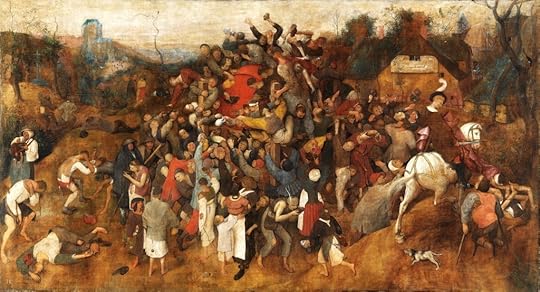
Pieter Breughel, Detail from “The Wine of St. Martin’s Day,” ca. 1565-68
St. Martin’s Day was a festival celebrated on November 11. It officially marked the saint’s day of St. Martin of Tours, but really it was a party. By this time, the harvest was in, and it was time to kill the pigs and enjoy the first wine of the season. Traditionally, a barrel of wine was distributed free to the people outside of the city gates.
So we’re seeing people who have worked and slaved all summer long and now are finally able to enjoy the fruits of their labor and relax a bit. They may not have had wine in a long time—they might not have been able to afford wine most of the time. Peasants drank beer.
Some of them are enjoying the wine a bit too much.
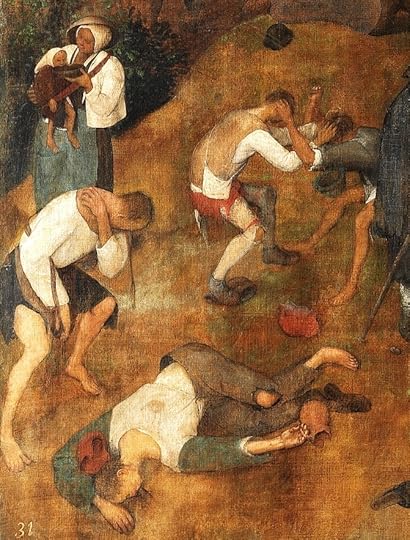
Pieter Breughel, Detail from “The Wine of St. Martin’s Day,” ca. 1565-68
They are imploring a rich man on a horse for alms. His response at first seems antagonistic:
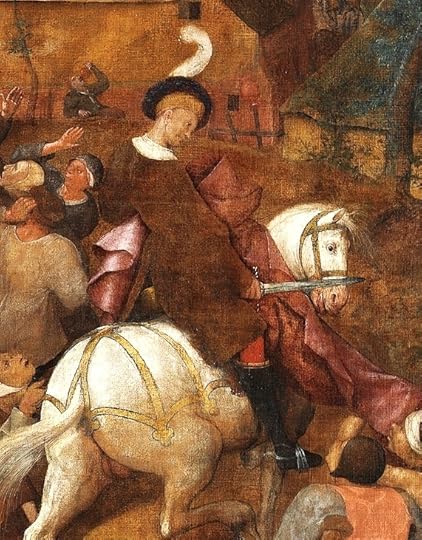
Pieter Breughel, Detail from “The Wine of St. Martin’s Day,” ca. 1565-68
At first glance, it looks like he’s drawn his sword to threaten the beggars. But you need to know some background.
St. Martin of Tours was supposedly a soldier in the Roman army. One day while riding into a city, he encountered a scantily-clad beggar. Impulsively, he pulled his sword and cut his cloak in half to share with the beggar. That night, he dreamed he saw Jesus before him wearing the cut half of the cloak. When he woke the next morning, the cloak had been miraculously restored.
So that’s what we’re seeing: St. Martin about to cut his cloak—the rippling rose-colored cloth—and share it with the beggars. And no one is paying attention.
Critics of the era would have condemned the secular celebration of St. Martin’s Day even more harshly than the dancing at the wedding. It was essentially a drunken party that had nothing to do with religion, and upper classes would have been disgusted by the sort of behavior on display in this painting. It’s certainly a less-sympathetic portrayal of the peasantry. But I’m not entirely convinced Breughel doesn’t understand and empathize with these people. Notice how torn and ripped their clothing is–notice the broken potted and cracked pitchers they are using to get the wine. These were people who lived on the permanent edge of starvation and utter destitution. One bad harvest, one sickness, one accident, and you were among the beggars, or you were dead. I think Breughel understood that.
(BTW, this painting has an interesting history. It was part of the collection of the Prado Museum in Madrid for years and no one had any idea it was a Breughel. It was rediscovered, cleaned up, and now is hailed as a masterpiece. You can read about it and related issues here.)
I need to get back to party prep now—I need to go buy a bowl of petunias. (Readers of Hitchhikers will understand.) I hope our party is more along the lines of the wedding party or the feast. We are not starving peasants desperate for alcohol, so there will be no passing out and no hair-pulling.
And, um, no codpieces. OK, guys?