
It’s A Small World After All: Audience & Reach In The E-book Age
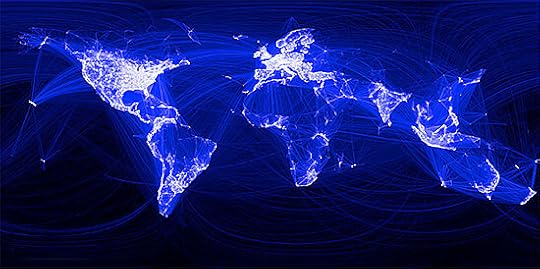 [Cross-post with Storytellers Unplugged]
We forget the length of our reach sometimes.
We underestimate the universality of our experience — of the truth as we know and tell it — and the potential for others to tap into it.
And the more we remember the potential of stories to leap cultural chasms in a single bound, the closer we are to being writers not just for a region, for a particular demographic, for our country of residence or for the fellow native-born speakers of our tongue, but for the world.
It Came From Mumbai
I got an inquiry about optioning the film rights to one of my novels the other day. It happens sometimes. Never like this, though. Until now, the farthest afield these inquiries have ever come from is Canada. And Canada, to me, feels pretty much like the U.S., just with a lot more hockey and things with antlers.
This time the inquiry, about my crime novel Mad Dogs, came from a writer-director in the Indian film industry.
Not Indian as in Native American. Indian as in 12 time zones between Mumbai and the Rocky Mountains. Literally on the other side of the world.
One paragraph into the e-mail, my initial thought was that, okay, this is someone from a thriving foreign film industry — you’ve probably heard the term Bollywood — looking to expand into the U.S. market. Which I based on nothing other than intimate knowledge of the book in question:
Mad Dogs follows not quite two weeks in the life of a struggling actor who gets mistaken for the real-life fugitive he’s recently portrayed on an America’s Most Wanted-style TV show. A mistake like that isn’t going to hold up for long, but it sets into motion multiple chains of dominos that, once they’ve started falling, can’t be stopped. Including the actor and his situation suddenly becoming a Hollywood hot property, a status which is better served by his continuing to remain a fugitive in his own right. Then there’s the matter of the real criminal deciding that he has to meet this guy who’s just played him on TV…
It’s harsh and comic and violent and satirical, and, because I wrote the thing, I can state with 100% certainty that it was written as an allergic reaction to what I considered to be uniquely American cultural craziness.
But hardly uniquely American in the view of the man from Bollywood:
“I see great potential in it to be adapted into a ‘Hindi’ language film. Great characters and plot, very suitable to the Indian milieu and context, as the celebrity culture and the so-called associated subculture is just about bursting at its seams here.”
…And This Floored Me
I’ve never been to India. My image of it has been shaped by such personalities as Gandhi and Mother Teresa, and its longtime status as a destination for seekers of enlightenment. My closest direct contact with India has been the occasional customer service call routed to Bangalore, speaking with someone whose accent leads me to suspect he/she was not, at birth, named Suzy or Steve … so no, they’re not fooling me, but because they’re so polite, so unfailingly earnest and guileless, and so committed to a positive outcome, I excuse this tiny falsehood and want to believe them anyway.
Plus I really like the food.
Contrast this with the kind of can’t-be-bothered stateside help who, if you dare walk in and ask for assistance, look at you like you’ve just chundered on their shoes, and want nothing more than for you to leave so they can resume parsing the complexities of Jersey Shore.
So … India. I know they have nukes, and the long, ugly legacy of the caste system. It still didn’t seem like the kind of place where Mad Dogs could happen.
Now, if I hadn’t had the blinders screwed so tightly to my head, I’d’ve already recognized that modern Indian society has ample capacity to be every bit as epically vapid and shallow as ours can be.
Just a couple weeks ago, via BBC News, I saw an article on the Indian trend of vaginal bleaching. I wish I were making this up. If you believe the commercial — and when would a commercial ever lie? — beautiful Indian women are being shunned by their mates until they, quite literally, lighten up.
Whether or not men this thick-headed should even risk passing their genes down to the next generation is another matter, but there’s probably a cool story in that, too.
Think Globally, Act Locally
To boil it down: What we have here is a situation in which a writer-director in Mumbai downloads one of my novels in e-book format, reads it on his Kindle, and despite its thoroughly American DNA, feels it has a significant resonance in his own world. And feels strongly that there’s a large audience who will resonate along with it.
I have no idea, of course, where this will lead, if anywhere. But I do know it couldn’t have happened even 5 years ago, when Mad Dogs was first published in hardback. Not like this. Not with this kind of rapidity, nor this kind of fluidity, in which borders and distance mean nothing.
Yet there’s something timeless going on here, as well. It’s a testament to the power of story, its ability to transcend surface differences and cut deeper, to the heart of shared experience and the bridge of unexpected parallels.
With story in hand, your reach can be longer than you think.
It’s hard, if not impossible, to engineer a thing like this. It happens if and when it happens. But there are a few things to remember and apply when trying to extend the length of your own reach.
You already have a home field advantage. If you’re reading this, odds are that you write in English. This is a huge advantage. English is the world’s dominant language, the language of international business, finance, and technology. And it’s only going to continue to spread, through all levels of global society.
Write as deeply from the heart as you can. Beyond the words, even, emotion is the true universal language. Content and context may differ, but our joys, sorrows, and yearnings … everybody speaks these. Very often, the things that seem most personal end up being the most widely relatable. Bullets and black comedy aside, Mad Dogs was as heartfelt as anything I’ve ever written, replete with overarching themes of brotherhood, betrayal, family strife, and the hunger for success.
Study Joseph Campbell and his legacy. If you don’t know Campbell’s work, suffice to say he spent a lifetime immersed in world mythology and identifying the core elements that universally connect to the human psyche. For a look at how this feeds into modern storytelling, check out The Writer’s Journey, by Christopher Vogler. This book takes Campbell’s classic, The Hero With A Thousand Faces, extracts the core elements that underlie countless myths and fables from around the world and throughout the human timeline, and shows how they work together to form a kind of master storyteller’s template that nevertheless remains endlessly malleable.
Study Shakespeare. If ever there was a writer for all time, William Shakespeare has to be the one. There’s a good reason his plays can so readily be adapted to and reimagined for periods and places far beyond their origins: The depth and breadth of his understanding of the human heart is unsurpassed.
With story in hand, your reach is longer than you think.
And so, it must follow, is your grasp.
[Photo by dullhunk]
Enjoy it? Get some good out of it, or know someone who could?
Then please, share it … tweet it … like it on Facebook … and subscribe!


