Visualising Story
In many ways the written word is the most visual way to tell a story.
The images you can create inside a person’s head can be the most arresting and
memorable they’ll ever experience. In high definition and fully 3D without the
need for glasses.
For many aspiring writers, the use of language to create pictures you
can literally see, people whose faces are in your memory even though they don’t
exist, places that are real as any place that you’ve actually been, is what
being a writer is all about.
That’s why they spend so much time trying to paint a picture with their
words. But a lot of the time it doesn’t work. It feels stolid and longwinded,
and a chore to read. Why?
I’m not one of those people who believe any kind of detailed
description is bad or old fashioned. The idea that Victorian writers were
allowed to be florid and sweeping but times have changed, is not one I believe.
There are plenty of modern writers who can create a stunning vista inside your
head by using lots and lots of words.
However, if I asked most aspiring writers to sit in front of tree and
to write a description of the tree in their notebook, even though what I might
get would probably be immediately recognisable—maybe with evocative adjectives
that allowed me to sense the tree, its sounds and smells and the way the
sunlight etc. etc.—what I would also probably
get is a long, boring description of a tree.
But there are many times you will read a passage in a story that is the
metaphorical equivalent of that tree. And yet it is engrossing and interesting
and seems to be a vital part of the story . But technically speaking, it’s
still just a description of a tree.
What’s easy to miss is that in those cases of great writing, the writer
isn’t describing what it first appears they’re describing.
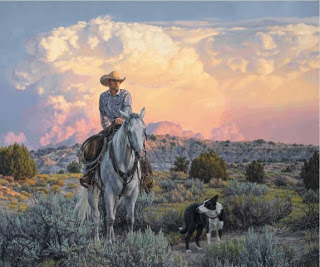
He rode easily, relaxed in the
saddle, leaning his weight lazily into the stirrups. Yet even in this easiness
was a suggestion of tension. It was the easiness of a coiled spring, of a trap
set.
The above is the introduction of the titular character from a Western
called Shane by Jack Schaefer.
It comes at the end a page of description of what he looks like. A boy
is watching a man on a horse approaching. We get a detailed description of his
clothing (His shirt was finespun linen,
rich brown in colour), his hat, his face, his eyes.
It’s all pretty simple and exhaustive, but within this bland list there
is something else.
He was not much above medium
height, almost slight in build. He would have looked frail alongside father’s
square solid bulk.
There are little observational details sprinkled throughout. The boy
compares this stranger to his father, a comparison the story is built on; the hard-working
farmer and the tired gunslinger. His father is the more solid man, but Shane is
something else under the surface.
So why not just keep the more
pertinent, meaningful bits and lose the rest? Who cares how dusty this guy’s boots
are?
Many writers do just that. They find a way to capture a character or a
setting in a single line. Fitzgerald describes Jay Gatsby as: His tanned skin was drawn attractively tight
on his face and his short hair looked as though it were trimmed every day.
That little detail about his hair tells you volumes.
Asimov describes the planet Trantor as “the densest and richest clot of humanity” in the galaxy. The choice
of the word ‘clot’ is enough to give you a feeling of something congealed and
unwieldy.
But writing that way should be a choice. If Schaefer had only included
the more revelatory lines, it would have been very obvious what was going to
happen. If he just made you sit through lines and lines of description before getting
to the point, it would send you to sleep.
Combining the vivid imagery and the sense of more than meets the eye—is
what pulls the reader in. It’s the words that put the image in your head, it’s
the purpose behind the image that makes it stick there.
Going back to our tree, if I told you three men had been hanged from
that large bough. In fact, if you look closely you can still see the rope marks.
Now describe the tree...
I’m not saying you will suddenly have a whole new vocabulary at your
disposal. The words may be very much the same. But now you’re not trying to
tell me what a tree looks like. I know what a tree is. Now you have something
more to tell me.
Similarly you don’t really need to tell me what a person looks like or
what a town looks like, not beyond very basic details. But that isn’t why you’re
describing them. Once you figure out
what it is you really have to tell me, you will find the words not only flow
easier, they mean much, much more.

If you found this post useful, please give it a retweet. Cheers
*
Check out my latest stories for free on Wattpad.


No comments have been added yet.