Feed Your Brain: Eat Your Math! (A guest blog by Ann McCallum)
As a kid, I thought that
math was bland—unappetizing worksheets and heaps of boring word problems. Those
were the worst, the word problems: Disjointed scenarios that you had to sit
with until you were done.
I fell in love with math
after college. Not a case of love at first taste, it was more an awakening of
the senses. A realization that there was pattern and meaning to all those seemingly
random numbers. Like a well-made dish, the ingredients aligned so perfectly
when I finally understood. The steps were meaningful, too—not a series of
machinations to memorize, but a logical process of creating. With my new-found appetite
for math, I knew I had to share.
Pairing food with math was
a fluke, really. It started with a math project for my students (I was teaching
5th grade at the time). It was nearly winter break, and I had my
students make mathematical gingerbread houses. I didn’t provide many
instructions—just, you know, make one of those graham cracker houses glued
together with icing and be prepared to talk about how you used math. The
results were far richer than I had anticipated. Students shared innovations
such as polygon windows and doors, candy tessellations, the perimeter of roofs,
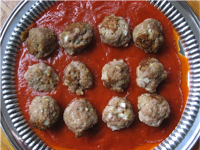
and the length of icing pathways. I was so excited, I went home and made multiplication
meatballs! Okay, maybe not right away, but the idea was there. Food, I figured,
was a perfect medium for getting kids to love math.
What
followed was a series of yummy experiments: Estimation Cookies, Fibonacci Snack
Sticks, Variable Pizza Pi . . . Fun, oh fun! Finally, here was a connection to
some of math’s tough concepts, but with a delicious new twist. It made so much
sense to learn math by using food.
Eager to share this idea beyond my students, I sent
a book proposal to an editor and was accepted—but not for a math cookbook. Instead, I was engaged to
write “The Secret Life of Math” which is a history/project book about math for
kids (I was allowed one recipe:
Mayan
Number Cookies). I went on to write two math fairy tales, but I still kept
coming back to the math cookbook idea. I
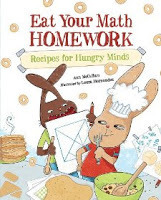
tried again. This time, a second editor accepted my proposal for “Eat Your Math
Homework: Recipes for Hungry Minds” and I was thrilled. I went back to the
kitchen to perfect my math recipes.
One
of my favorite math authors, Theoni Pappas, says it best: “The joy of
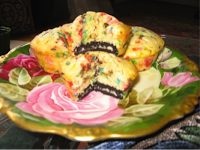
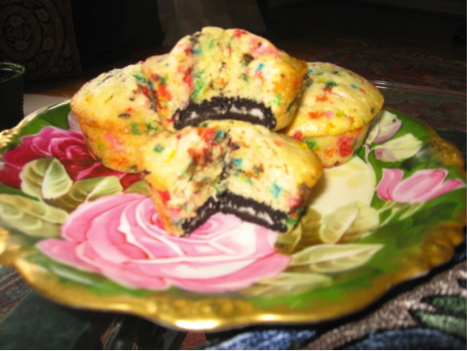
mathematics is that it is everywhere.” I’ll add to that: Even in cupcakes!
What you need:
½ cups butter
1
¼ cups white sugar
2 large eggs
1 cup milk
1 teaspoon vanilla
2 cups flour
1 teaspoon baking powder
½ teaspoon baking soda
½ cup rainbow sprinkles
Oreos (one for every muffin cup)
What you do:
1. Cream butter, sugar, vanilla, and
eggs.
2. Mix in flour, baking powder and
baking soda, alternating with milk.
3. Stir in the colored sprinkles.
4. Grease a muffin tin (or use cupcake
papers) and place one oreo cookie in every muffin cup. Pour dough on top so
that each muffin cup is ¾ of the way full.
5. Bake for about 30 minutes in a 350° F
oven.

math was bland—unappetizing worksheets and heaps of boring word problems. Those
were the worst, the word problems: Disjointed scenarios that you had to sit
with until you were done.
I fell in love with math
after college. Not a case of love at first taste, it was more an awakening of
the senses. A realization that there was pattern and meaning to all those seemingly
random numbers. Like a well-made dish, the ingredients aligned so perfectly
when I finally understood. The steps were meaningful, too—not a series of
machinations to memorize, but a logical process of creating. With my new-found appetite
for math, I knew I had to share.
Pairing food with math was
a fluke, really. It started with a math project for my students (I was teaching
5th grade at the time). It was nearly winter break, and I had my
students make mathematical gingerbread houses. I didn’t provide many
instructions—just, you know, make one of those graham cracker houses glued
together with icing and be prepared to talk about how you used math. The
results were far richer than I had anticipated. Students shared innovations
such as polygon windows and doors, candy tessellations, the perimeter of roofs,
and the length of icing pathways. I was so excited, I went home and made multiplication
meatballs! Okay, maybe not right away, but the idea was there. Food, I figured,
was a perfect medium for getting kids to love math.

What
followed was a series of yummy experiments: Estimation Cookies, Fibonacci Snack
Sticks, Variable Pizza Pi . . . Fun, oh fun! Finally, here was a connection to
some of math’s tough concepts, but with a delicious new twist. It made so much
sense to learn math by using food.
Eager to share this idea beyond my students, I sent
a book proposal to an editor and was accepted—but not for a math cookbook. Instead, I was engaged to
write “The Secret Life of Math” which is a history/project book about math for
kids (I was allowed one recipe:

Mayan
Number Cookies). I went on to write two math fairy tales, but I still kept
coming back to the math cookbook idea. I
tried again. This time, a second editor accepted my proposal for “Eat Your Math
Homework: Recipes for Hungry Minds” and I was thrilled. I went back to the
kitchen to perfect my math recipes.
One
of my favorite math authors, Theoni Pappas, says it best: “The joy of
mathematics is that it is everywhere.” I’ll add to that: Even in cupcakes!
What you need:
½ cups butter
1
¼ cups white sugar
2 large eggs
1 cup milk
1 teaspoon vanilla
2 cups flour
1 teaspoon baking powder
½ teaspoon baking soda
½ cup rainbow sprinkles
Oreos (one for every muffin cup)
What you do:
1. Cream butter, sugar, vanilla, and
eggs.
2. Mix in flour, baking powder and
baking soda, alternating with milk.
3. Stir in the colored sprinkles.
4. Grease a muffin tin (or use cupcake
papers) and place one oreo cookie in every muffin cup. Pour dough on top so
that each muffin cup is ¾ of the way full.
5. Bake for about 30 minutes in a 350° F
oven.


No comments have been added yet.