
Another Reference Post: Marc and Jasmine
After Marc’s story for the archive, I figured I better do some shoddy family tree drawings. I did some for Jasmine/Hunter, too, since these two have some pretty complicated family scenarios. I have hopefully cleared it up with these. Click for larger image and excuse my microsoft paint lack of skills. :)
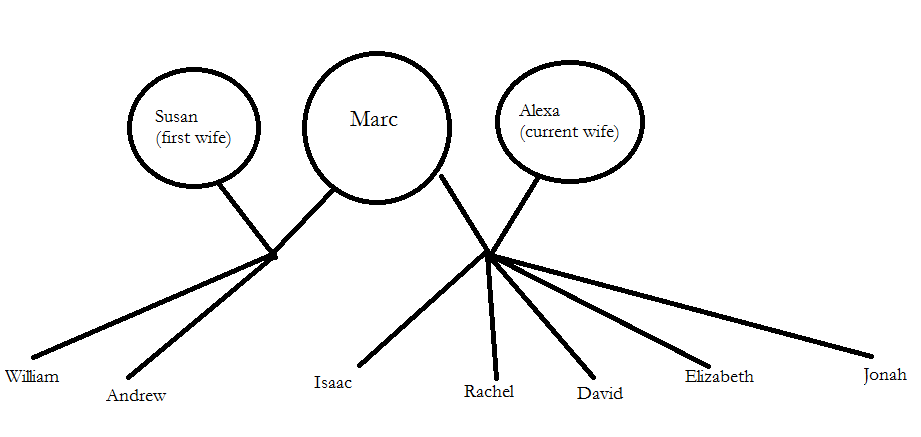
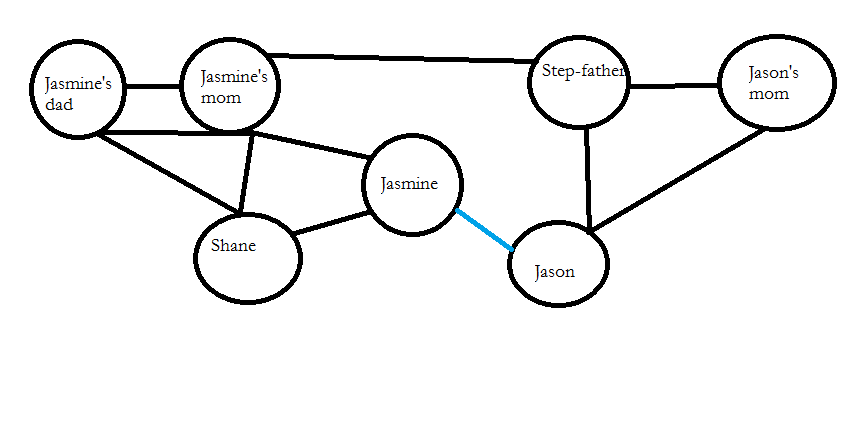
The blue line is to distinguish that this is not a blood relation, but they are step-siblings. Although Jason does not appear at all in this story aside from Jasmine mentioning him, he plays a large role in her life. He gives her the jazz CD that ends up sparking her fascinating with the music, and then she takes Thomas to a jazz club to tell him that she’s pregnant. She also mentions him enlisting in the army and that he is supportive of her pregnancy. Although these are two very small times where he enters the story, I feel as if there is this large presence around him. In the first book, he was kind of a jerk and a typical high school jock. But in this one, he provides solace for his step-sister in strange instances, something that she doesn’t really get from many other people in her family. She values Jason so much, and he is not a blood relative and was not always this supportive. His story is something that I wish I had more time for, and if I ever get around to writing a book of short stories that involve the characters from this, he will definitely be featured. Since another reason for me setting the story when I did was because of the war in Iraq and the distinct political climate of the time, Jason is definitely someone who I want to spend more time with because he is important. While Thomas deals with his own version of what it is to be masculine in his work environment, there is Jason in the military.
But back to family: something that I’ve noticed in my writing, and many others that involve gay characters, are how the fathers end up becoming the antagonists of the plot. This was seen in TDK, and while I think I managed to include a bit more humanity for Anthony near the end, there are many more stories happening in this sequel. There are many more families, too, and I wanted to have far more dynamic with how the father figures were portrayed.
All of this comes down to masculinity, I think, and it’s one of the reasons why I do bring Jason up. He was the stereotypical jock and now he is enlisting in the army – another very masculine thing. But Jasmine sees something in him, and latches onto him. He sends her jazz, something that’s not exactly macho. I think there is a tendency within feminism to view men (especially, cis straight white men) as the enemy. Patriarchy tends to get aligned with men and masculinity, but these are very different things. Femininity has been seen as a construct and something that is very damaging to young women; there have been a lot of books and articles written on that. But what about masculinity? It is as equally constructed and damaging, but there has not been nearly enough written on it.
Jackson Katz came out with his film Tough Guise years ago where he discusses how many feminist issues were really men’s issues. Even better than the gender distinction, these issues are interconnected and affect everyone equally. Spousal abuse, while it can appear that women are holding the “victim” position in these types of scenarios, I always ask myself what is influencing the man to act the way he is. We cannot just account that his sex is what is at fault entirely. That is an equally essentialist claim that women belong in the kitchen because they are women. So if we reject that model of thought, then we can’t just see men as being inherently more violent. What it really is, I think, that like with the rigours of femininity being weight loss, commodification of their bodies, etc, there are also the rigours of masculinity which make men focus on the “tough guise” as Jackson Katz puts it. It places ideas like self-reliance, independence, and violence on a pedestal where the failure to adhere to these strict codes means that one is no longer a man. So what is at fault in cases of domestic violence is masculinity and femininity and how they are portrayed in culture, and not men or women as a whole.
So for someone like Jason, it was very easy for me to cast him aside as something that would not fit into the neat little world of the story where gay men and women seem to fill the dominant part of the narrative. It has been described as a “queer” story but I reject that label because I find that so much queer rhetoric still wishes to blame the cis straight white man for a lot of issues. The fact is that the cis straight white man does not exist and I don’t ever think he really has. Even for a guy that is straight in his own identity and practices does not mean that he is forever protected from being called gay or immune to gay bashing. The code of masculinity, strict and often violent masculinity, is in place and those who do not follow it are kept in line. But unlike the success made with a lot of feminist studies in women being critical of what they see in the media, I do not see the same questioning going on with men. I don’t see the same advancement that I see with women’s studies and this is what is really concerning. All of these issues are interconnected and you cannot make any progress without helping both sides. Having Jason come to Jasmine and give her jazz while being in the military, and having this alliance between the two of them, is something that I hope shows how the polarity of the two sides of the spectrum are separating. Jasmine has been a bit of an over-the-top character in regards to feminist issues. I have done this deliberately, because over time, she is going to change her opinion. I also wanted to show the complexity of a lot of these issues that are targeted as strictly women’s issues. Such as Jasmine and her pregnancy. As much as that is her own choice to terminate or not and any type of government should treat that as a woman’s choice over her own body, it is also a deeply private issue. The privacy and personal nature of that issue Jasmine does not always translate well. Even though Thomas has no authority over her body and he understands that, he is still devastated when she is not allowing him to come to appointments. In legal and governmental proceedings, the her body = her choice equation works. But there is not such thing as a “women’s” issue, not if you accept the premise that we are all irrevocably linked. Everything we do or don’t do trickles out and affects everyone else.
Even if my intent with Jason does not come across, I do hope it does with the two father figures in this story: Anthony and Marc. I have tried to break down the negative father archetype that crops up in queer/gay stories and give them more of a personality behind the anger, hostility, or just bad choices. Anthony, growing up during the same time period as Bernard in the story, had to deal with a lot of crap about masculinity and what was permissible. Even though Anthony is straight, has a wife and a kid, I make mention that he has lost his job and has struggled with alcohol. This was in times of perceived weakness, where he was not upholding that “tough guise” that is needed in order to be a man. Although he cannot relate to his son on his sexuality, when he comes to him drunk that one night, he does not react the way that he did in the first story. Seeing something that he could connect with (fallible in the tough guise, and using alcohol to deal with it) he swoops in to try and fix it. He slowly begins to understand, though he is not perfect.
Marc has merely made some very poor decisions from the beginning. This is the dead-beat dad narrative all over again, but I didn’t want him to be one of those fathers who has two families and a younger wife and a million kids because he’s a jerk. I wanted his story to have more emotion to it, so that the audience could sympathize with him. There is always going to be another side to the story; what looks really terrible from one angle may look completely better from another side. He may not have been as much of a slave to the upholding of masculinity through violence, but he was bound by too much sense of responsibility. He thought he had to do everything and that led him to feel utterly terrible when he did fail. But when he followed his heart, he could turn out to be the “bad dad.” But he’s not a bad dad. Sometimes the stereotypes just don’t work. No one here is the “bad dad” or bad cis white male. Everyone is just human.
Now, having said all this about masculinity and Jason’s role, and considering what happens to Jasmine in this section, I really want to write about their relationship even more. Maybe someday soon. :)



Evelyn Deshane's Blog

- Evelyn Deshane's profile
- 46 followers

