What’s More Important: Your Journey or Final Destination?
Today in Australia, it is Melbourne Cup Day. It is one of those odd Aussie ways we have down here. It had my husband shaking his head when he first encountered it… while trying to actually do some work! At 3pm, no matter where you are, the nation stops as people stop and turn on the television or radio to catch this race. It’s the centrepiece of the Spring Racing Carnival. As this post is about the joy of running, not just the finish line, I thought it was an appropriate blog post for today! Update: “Green Moon” won the cup, and possibly a prize for a name that is creative. It does stand out.
One of the mistakes people make with creativity is focussing on the success or failure of the final creation. While the product is important, the greatest aspect of creativity, and often the most enjoyable is the process of discovery. The value doesn’t just lie there. The journey matters… The process is how you get where you want to go: the problem solving skills you apply, the multiple drafts or experimental types or models you work with in trying to perfect and identify what you want; the mental processes of figuring out exactly what direction to take. Creative people can find that aspect the most empowering part of working on a project. Once the project is finished, if ever, the challenge and need to stretch your capabilities is no longer present. That termination can be disappointing.
Pablo Picasso is a vivid example of creative genius. Not only did he paint, he produced many kinds of sculptures, facial masks, costumes, dresses, logos, posters, theatre sets, numerous objects and art works in canvas, stone, ceramics, metal and mixed media. Picasso would paint a completed work every morning, then move onto another project in the afternoon. He didn’t stop and reflect on his ideas or progress, he created his works in a matter of hours. It has been debated how much care or sustained effort he put into his artistic works as they were, almost churned out of a one-man production line. Consider though, did they need the same sort of planning and time taken over them that other artists needed? Perhaps Picasso was simply sure of what he was doing? In total, he bought over 30,000 works of art and physical objects into being.
If you take the time to read about his personal and business life, Picassoʼs egocentricity and extreme narcissism is another example of his creative ability that generated the results and atmosphere he wanted, and achieved his goals. Love or hate what he did, and how he did it, you can argue that his ability to focus solely on himself, may have been what enabled him to tap so astutely into his creative impulses. Picassoʼs choice of artistic subjects are also said to reflect his total self absorption. He chose not to represent nature or landscape, despite fashions at the time, as nature was outside of his mind and his control, holding no interest for him.
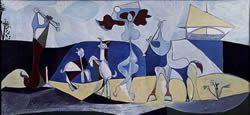
Picassoʼs effect on the world of art is a legacy that holds great value for many generations past and to come. His work was groundbreaking, freeing many artists to pursue their own vision, rather than remain trapped in the clutches of what was acceptable and in fashion. You may like to read more about Picassoʼs life and make up your own mind as to whether or not he was really an untamable megalomanic, or simply a genius, whose drive to create and survive spurned him on.

This post is an excerpt from Cate’s e-book “Unleashing Your Creative Spirit” which has just been officially released. If you have an interest in enhancing your creative potential, the e-book will be of inspiration to you.
Unleashing Your Creative Spirit was written to help you turn your dreams into reality! It explores the process and practical aspects of creativity; and has been written for artists, writers, musicians, dancers, gardeners, cooks, craft lovers: anyone trying to tap into their creative potential. It looks at the mental processing behind creativity; philosophies that drive how we think about and assess our creative worth; creative character traits; historical role models; an extensive bibliography and web link list plus more. The content is practical, not just analytical. It will give you ideas on how to move forward in your creative life.
Topics covered include:
Capturing the Muse
Quieting the Internal Censor
Building A Creative Space
Working With Failure
Finding Direction
Techniques To Use
The abridged ebook is available now on Amazon Kindle. The full illustrated e-course version with additional resources and exercises is only available from me, as e-book formats cannot handle it. You can order it directly from http://www.virtual-desk.com.au/trainer.html. Please scroll down the the course list and the select the buy button.
This article / blog post is Copyright Cate Russell-Cole 2012. All rights are reserved Internationally. You may not reproduce it in any form, in part of whole, without Cate’s prior written permission. That includes usage in forms such as print, audio and digital imaging including pdf, jpg, png etc. A fee may be requested for re-using her work if it is for a commercial venture. Link sharing and Pinterest pins are most welcome as long as Cate is the attributed Author.
No images on this blog may be copied, captured, or altered for your own purpose without the consent of the originating owner. Where images are marked as being iStockphoto.com images, they are paid for and licenced to Cate for use on this blog. If you take them, iStockphoto.com has the right to take legal action against you for Copyright Infringement.
Please see the Blog Content and Image Copyright page of this blog for further information in regards to Guest Posts, other images, Cate’s checks on infringements and Liability.
Filed under: Creativity Tagged: challenge, creativity, discovery, failure, genius, Pablo Picasso, passion, Picasso, problem solving, restless, success, thinking, writing