
NaNoWriMo Prep: Thematic Image Systems
I couldn't send you all off to do NaNo without taking you through one of my all-time favorite writing exercises, the one I get the most raves about when I do my workshops.
But first, we need to talk about theme. I’m not here to define theme, today...
Oh, is that cheating?
Well, okay, if you insist. Theme is what the story is about. On a deeper level than the plot details. The big meaning. Usually a moral meaning.
Hmm. See why I don’t want to define it?
Well, how about defining by example?
I’ve heard, often, “Huck Finn is about the inhumanity of racism.”
Uh...
I don't know about you, but for me, that's too soft and vague. You
could write about five billion different stories on that.
Also
have heard a lot that the theme of Romeo and Juliet is “Great love
defies even death.” Except that – in the end, they’re dead, right? So
how exactly is the love defying death? Risking death and losing,
maybe. Inspiring people after death, maybe.
Okay, how
about this? “A man is never truly alone who has friends” is a great
statement of the theme of It’s A Wonderful Life. (And stated overtly
in the end of that movie.)
The trouble is, I personally
think it’s closer to the soul of that movie to say that it’s the
little, ordinary actions we do every day that add up to true heroism.
So
defining theme has always seemed like a slippery process to me.
Different people can pull vastly different interpretations of the theme
of a story from the same story. And even if you can cleverly distill
the meaning of a story into one sentence… admit it, you’re not REALLY
covering everything that the story is about, are you?
I
think it’s more useful to think of theme as layers of meaning. To
think of theme not as a sentence, but as a whole image system.
And
that’s where it gets really fun to start working with theme – when it’s
not just some pedantic sentence, but a whole world of interrelated
meanings, that resonate on levels that you’re not even aware of,
sometimes, but that stay with you and bring you back to certain stories
over and over and over again.
(Think of some of the
dreams you have - maybe – where there will be double and triple puns,
visual and verbal. I had a dream last night, in fact, that had just
about every possible act, object, setting and word variation on
"counter").
There are all kinds of ways to work theme
into a story. The most obvious is the PLOT. Every plot is also a
statement of theme.
It’s A Wonderful Life is a great,
great example of plot reflecting theme. George Bailey’s desire in the
beginning of the film is to be a hero, to do big, important things.
Throughout the story, that desire seems to be thwarted at every turn by
the ordinariness of his life. And yet, every single encounter George
Bailey has is an example of a small, ordinary goodness, a right choice
that George makes, that in the end, when we and he see the town as it
would have been if he had never existed, lets us understand that it IS
those little things that make for true heroism.
Presumed
Innocent is an interesting book for plot reflecting theme. I love how
that book (and the very good film made of it) depicts the horrifying
randomness of the legal system – that justice can turn on the assignment
of a judge, on the outcome of a political race, on the loyalties of a
witness – or on the very, very clever defendant himself. To me it’s a
brilliant exploration of what justice really is, or isn’t, or can never
be.
And here's a brilliant example of a plot twist
conveying theme: with Lecter’s escape, The Silence of the Lambs drives
home the point that we can win a battle with evil, but never the entire
war.
DIALOGUE is another way to reflect theme.
I
rewatched The Matrix a couple of times this year and was very amused to
note this blatantly thematic dialogue in Sequence 1. I’ve bolded all
the thematic references:
----------------
From The Matrix, written by Larry & Andy Wachowski
In Neo's apartment. He is asleep at his computer, with headphones on. On his computer screen, we see he is running a search on a man named Morpheus. Suddenly on his computer screen appear the words 'Wake up, Neo.' He sits up, and stares at his computer screen.
Neo : What?
On the computer, now appears 'The Matrix has you...'
Neo : What the hell?
On the computer, now appears 'Follow the white rabbit...'
Neo : Follow the white rabbit?
He presses the 'esc' key
repeatedly, no effect. the computer comes up with one last message :
'Knock knock, Neo.' There is a loud knock at his door, and he jumps. He
stares at the door, and then back at his computer screen. it's now
blank.
Neo : .....Who is it?
Choi : It's Choi.
Neo : Yeah...yeah...you're two hours late.
Choi : I know, it's her fault.
Choi gestures towards DuJour.
Neo : You got the money?
Choi : Two grand.
Neo :Hold on.
Neo
goes into his apartment, shuts the door, and opens a book, takes out a
CD rom and goes back to the door, handing the CD to Choi.
Choi : Hallelujah. You're my saviour, man. My own personal Jesus Christ.
Neo :You get caught using that...
Choi : Yeah, I know. This never happened, you don't exist.
Neo : Right.
Choi : Something wrong, man? You look a little whiter than usual.
Neo : My computer....it..you ever have that feeling where you don't know if you're awake or still dreaming?
Choi : Mm, all the time. It's called Mescaline. It's the only way
to fly. Hey, it sounds to me like you need to unplug, man.
------------
The
Matrix is all about waking up (enlightenment), about what reality is,
and about Neo as the potential savior of the world, which has been
enslaved by a virtual reality program. And escaping. And going down
the rabbit hole.
Well, that above is maybe a four
minute scene, and look how blatant the themes are. It spells out the
entire story. And yet it works on the surface level as well, an
audience isn’t stopping to think, "Oh, there’s a theme, and there’s a
theme, and yet another theme."
(If there’s anything I
learned from screenwriting it’s that you can JUST SAY IT. And it
generally works better if you just do.)
Another hugely
effective and important way to convey theme is through VISUAL
STORYTELLING. Whether you’re writing a book or a film, it’s useful to
do specific passes through your story, thinking of yourself as a
production designer whose specific function is to create the look of the
story – AND – reflect the themes of the story in those visuals.
As
I've said here before, no one does image systems better than Thomas
Harris. The Silence of the Lambs and Red Dragon are serial killer
novels, but Harris elevates that overworked genre to art, in no small
part due to his image systems.
In Silence, Harris
borrows heavily from myth and especially fairy tales, choosing elements
that create a deeper meaning for his plots, and achieves the sense of a
mythic battle between good and evil. You’ve got the
labyrinth/Minotaur. You’ve got a monster in a cage, a troll holding a
girl in a pit (and that girl is a princess, remember – her mother is
American royalty, a senator). You’ve got a twist on the “lowly peasant
boy rescues the princess with the help of supernatural allies” fairy
tale – Clarice is the lowly peasant who enlists the help of (one might
also say apprentices to) Lecter’s wizardlike perceptions to rescue the
princess. You have a twisted wizard in his cave who is trying to turn
himself into a woman.
There’s a theme running through
Silence of monstrousness. Before Harris got all Freudian with Lecter,
to the detriment of the character, IMO, he presented this character as a
living embodiment of evil – an aberration of nature, right down to the
six fingers on his left hand. In fact, Harris virtually created the
Serial Killer as Monster.
So to reflect this
inhumanness (and also just creep us out) Harris works the animal
imagery, especially insect imagery, with the moths, the spiders and
mice in the storage unit, and the entomologists with their insect
collections in the museum, the theme of change, larva to butterfly.
In
Red Dragon Harris also works the animal imagery to powerful effect. The
killer is not a mere man, he’s a beast. When he’s born he’s compared to
a bat because of his cleft palate. He kills on a moon cycle, like a
werewolf. He uses his grandmother’s false teeth, like a vampire. And
let’s not forget – he’s trying to turn into a dragon.
LOCATION
is another huge, huge factor in conveying theme. Places have specific
meanings, or you the author can create a specific meaning for a place.
I’ve said this before, but basements are used so often in horror
stories because basements symbolize our subconscious, and all the fears
and childhood damage that we hide from ourselves. Characters’ houses
or apartments reflect themselves. The way you describe a city gives
it a particular meaning – you can emphasize particular qualities that
help you tell your story.
So how do you create a visual/thematic image system in your books?
Well,
start by becoming more conscious of what thematic systems authors are
working with in books and films that YOU love. As I am always saying –
make yourself a list
(ten is good) of books and films that have particularly effective image
systems. Then reread and rewatch some of your favorites, paying
close attention to how theme is conveyed, in plot, in dialogue, in
visuals, in location.
What I do when I start a project,
along with outlining, is to keep a list of thematic words that convey
what my story is about, to me. For The Harrowing it was words like:
Creation, chaos, abyss, fire, forsaken, shattered, shattering, portal,
door, gateway, vessel, empty, void, rage, fury, cast off, forgotten,
abandoned, alone, rejected, neglected, shards, discarded… pages and
pages like that.
For The Price – bargain, price, deal,
winter, ice, buried, dormant, resurrection, apple, temptation, tree,
garden, labyrinth, Sleeping Beauty, castle, queen, princess, prince,
king, wish, grant, deal, contract, task, hell, purgatory, descent,
mirror, Rumpelstiltskin, spiral…
Some words I’ll have
from the very beginning because they’re part of my own thematic DNA. But
as the word lists grow, so does my understanding of the inherent themes
of each particular story.
Do you see how that might
start to work? Not only do you get a sense of how the story can look to
convey your themes, but you also have a growing list of specific words
that you can work with in your prose and dialogue so that you’re
constantly hitting those themes on different levels.
At
the same time that I’m doing my word lists, I start a collage book, and
try to spend some time every week flipping through magazines and
pulling photos that resonate with my story. I find Vogue, the Italian
fashion mags, Vanity Fair, Premiere, Rolling Stone and of course,
National Geographic, particularly good for me. I tape those photos
together in a blank artists’ sketchbook (I use tape so I can move the
photos around when I feel like it. If you’re more – well, if you’re
neater than I am, you can also use plastic sleeves in a three-ring
binder). You can create a slideshow of images or a collage in
Photoshop (just don't ask me how to do it.) It’s another way of growing
an image system. Also, it doesn’t feel like writing so you think you’re
getting away with something.
And these days Pinterest is a great way of collecting thematic images; you can see some of mine, here.
Also, know your world
myths and fairy tales! Why make up your own backstory and characters
when you can tap into universally powerful archetypes? Remember, there’s
no new story under the sun, so being conscious of your antecedents can
help you bring out the archetypal power of the characters and themes
you’re working with.
And maybe most importantly: Know what your PERSONAL themes are. And that means - yes - Make a list.
So th NANOWRIMO ASSIGNMENTS for today are:
- Make a thematic words list for you book.
- Make
a list of your personal THEMES - the ones you vibrate to in other
people's stories, and the ones you keep coming back to in your own
stories, over and over again.
- And - What particular themes do you see working in your WIP?
I'd
love to hear some examples of books and films that to you have
particularly striking thematic image systems, and your own favorite
images to work with.
And by the way - what are some ways of conveying theme that I’ve left out?
- Alex
=====================================================
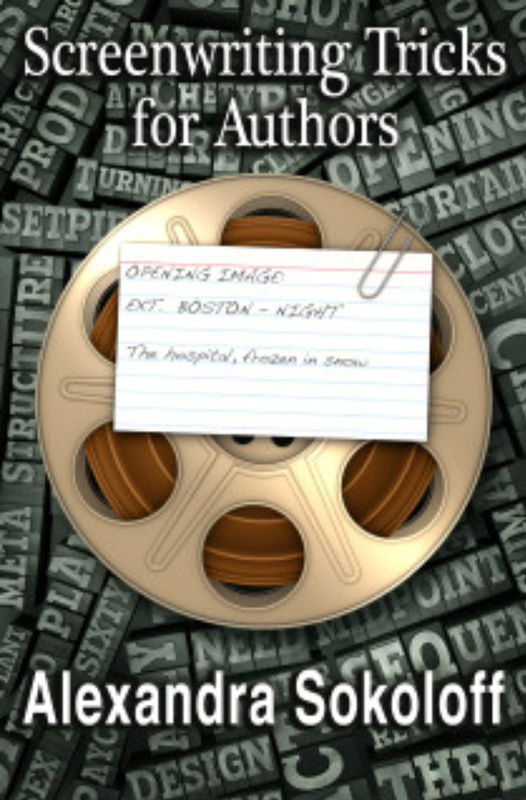
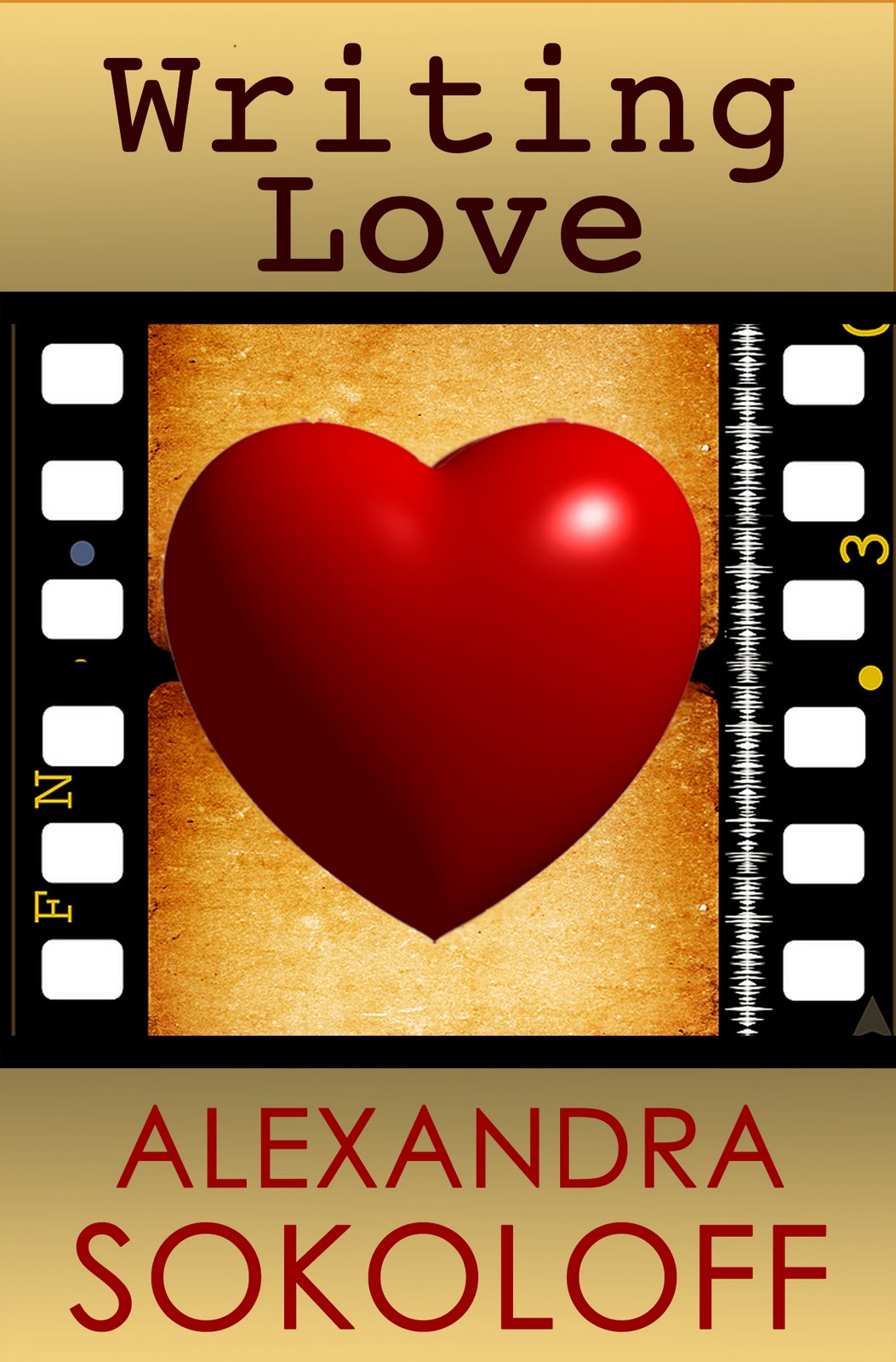
Screenwriting Tricks for Authors and Writing Love, Screenwriting Tricks for Authors, II, are now available in all e formats and as pdf files. Either book, any format, just $2.99.
- Kindle
- Amazon UK
- Amaxon DE (Eur. 2.40)
 - Smashwords (includes online viewing and pdf file)
- Amazon/Kindle
- Barnes & Noble/Nook
- Amazon UK
- Amazon DE
=====================================================
HALLOWEEN GIVEAWAY
It's
October, my favorite month, and you-know-what is coming, so I'm giving
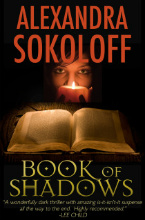
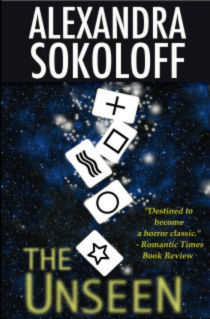
away 31 signed hardcover copies of my spooky thrillers Book of Shadows . and The Unseen .
Enter here to win!
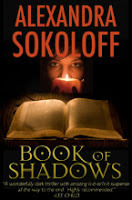
Book of Shadows .
An
ambitious Boston homicide detective must join forces with a beautiful,
mysterious witch from Salem in a race to solve a series of satanic
killings.
Amazon Bestseller in Horror and Police Procedurals
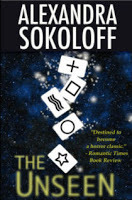
The Unseen
A team of research psychologists and two psychically gifted students
move into an abandoned Southern mansion to duplicate a controversial
poltergeist experiment, unaware that the entire original research team
ended up insane... or dead.
Inspired by the real-life paranormal
studies conducted by the world-famous Rhine parapsychology lab at Duke
University.

But first, we need to talk about theme. I’m not here to define theme, today...
Oh, is that cheating?
Well, okay, if you insist. Theme is what the story is about. On a deeper level than the plot details. The big meaning. Usually a moral meaning.
Hmm. See why I don’t want to define it?
Well, how about defining by example?
I’ve heard, often, “Huck Finn is about the inhumanity of racism.”
Uh...
I don't know about you, but for me, that's too soft and vague. You
could write about five billion different stories on that.
Also
have heard a lot that the theme of Romeo and Juliet is “Great love
defies even death.” Except that – in the end, they’re dead, right? So
how exactly is the love defying death? Risking death and losing,
maybe. Inspiring people after death, maybe.
Okay, how
about this? “A man is never truly alone who has friends” is a great
statement of the theme of It’s A Wonderful Life. (And stated overtly
in the end of that movie.)
The trouble is, I personally
think it’s closer to the soul of that movie to say that it’s the
little, ordinary actions we do every day that add up to true heroism.
So
defining theme has always seemed like a slippery process to me.
Different people can pull vastly different interpretations of the theme
of a story from the same story. And even if you can cleverly distill
the meaning of a story into one sentence… admit it, you’re not REALLY
covering everything that the story is about, are you?
I
think it’s more useful to think of theme as layers of meaning. To
think of theme not as a sentence, but as a whole image system.
And
that’s where it gets really fun to start working with theme – when it’s
not just some pedantic sentence, but a whole world of interrelated
meanings, that resonate on levels that you’re not even aware of,
sometimes, but that stay with you and bring you back to certain stories
over and over and over again.
(Think of some of the
dreams you have - maybe – where there will be double and triple puns,
visual and verbal. I had a dream last night, in fact, that had just
about every possible act, object, setting and word variation on
"counter").
There are all kinds of ways to work theme
into a story. The most obvious is the PLOT. Every plot is also a
statement of theme.
It’s A Wonderful Life is a great,
great example of plot reflecting theme. George Bailey’s desire in the
beginning of the film is to be a hero, to do big, important things.
Throughout the story, that desire seems to be thwarted at every turn by
the ordinariness of his life. And yet, every single encounter George
Bailey has is an example of a small, ordinary goodness, a right choice
that George makes, that in the end, when we and he see the town as it
would have been if he had never existed, lets us understand that it IS
those little things that make for true heroism.
Presumed
Innocent is an interesting book for plot reflecting theme. I love how
that book (and the very good film made of it) depicts the horrifying
randomness of the legal system – that justice can turn on the assignment
of a judge, on the outcome of a political race, on the loyalties of a
witness – or on the very, very clever defendant himself. To me it’s a
brilliant exploration of what justice really is, or isn’t, or can never
be.
And here's a brilliant example of a plot twist
conveying theme: with Lecter’s escape, The Silence of the Lambs drives
home the point that we can win a battle with evil, but never the entire
war.
DIALOGUE is another way to reflect theme.
I
rewatched The Matrix a couple of times this year and was very amused to
note this blatantly thematic dialogue in Sequence 1. I’ve bolded all
the thematic references:
----------------
From The Matrix, written by Larry & Andy Wachowski
In Neo's apartment. He is asleep at his computer, with headphones on. On his computer screen, we see he is running a search on a man named Morpheus. Suddenly on his computer screen appear the words 'Wake up, Neo.' He sits up, and stares at his computer screen.
Neo : What?
On the computer, now appears 'The Matrix has you...'
Neo : What the hell?
On the computer, now appears 'Follow the white rabbit...'
Neo : Follow the white rabbit?
He presses the 'esc' key
repeatedly, no effect. the computer comes up with one last message :
'Knock knock, Neo.' There is a loud knock at his door, and he jumps. He
stares at the door, and then back at his computer screen. it's now
blank.
Neo : .....Who is it?
Choi : It's Choi.
Neo : Yeah...yeah...you're two hours late.
Choi : I know, it's her fault.
Choi gestures towards DuJour.
Neo : You got the money?
Choi : Two grand.
Neo :Hold on.
Neo
goes into his apartment, shuts the door, and opens a book, takes out a
CD rom and goes back to the door, handing the CD to Choi.
Choi : Hallelujah. You're my saviour, man. My own personal Jesus Christ.
Neo :You get caught using that...
Choi : Yeah, I know. This never happened, you don't exist.
Neo : Right.
Choi : Something wrong, man? You look a little whiter than usual.
Neo : My computer....it..you ever have that feeling where you don't know if you're awake or still dreaming?
Choi : Mm, all the time. It's called Mescaline. It's the only way
to fly. Hey, it sounds to me like you need to unplug, man.
------------
The
Matrix is all about waking up (enlightenment), about what reality is,
and about Neo as the potential savior of the world, which has been
enslaved by a virtual reality program. And escaping. And going down
the rabbit hole.
Well, that above is maybe a four
minute scene, and look how blatant the themes are. It spells out the
entire story. And yet it works on the surface level as well, an
audience isn’t stopping to think, "Oh, there’s a theme, and there’s a
theme, and yet another theme."
(If there’s anything I
learned from screenwriting it’s that you can JUST SAY IT. And it
generally works better if you just do.)
Another hugely
effective and important way to convey theme is through VISUAL
STORYTELLING. Whether you’re writing a book or a film, it’s useful to
do specific passes through your story, thinking of yourself as a
production designer whose specific function is to create the look of the
story – AND – reflect the themes of the story in those visuals.
As
I've said here before, no one does image systems better than Thomas
Harris. The Silence of the Lambs and Red Dragon are serial killer
novels, but Harris elevates that overworked genre to art, in no small
part due to his image systems.
In Silence, Harris
borrows heavily from myth and especially fairy tales, choosing elements
that create a deeper meaning for his plots, and achieves the sense of a
mythic battle between good and evil. You’ve got the
labyrinth/Minotaur. You’ve got a monster in a cage, a troll holding a
girl in a pit (and that girl is a princess, remember – her mother is
American royalty, a senator). You’ve got a twist on the “lowly peasant
boy rescues the princess with the help of supernatural allies” fairy
tale – Clarice is the lowly peasant who enlists the help of (one might
also say apprentices to) Lecter’s wizardlike perceptions to rescue the
princess. You have a twisted wizard in his cave who is trying to turn
himself into a woman.
There’s a theme running through
Silence of monstrousness. Before Harris got all Freudian with Lecter,
to the detriment of the character, IMO, he presented this character as a
living embodiment of evil – an aberration of nature, right down to the
six fingers on his left hand. In fact, Harris virtually created the
Serial Killer as Monster.
So to reflect this
inhumanness (and also just creep us out) Harris works the animal
imagery, especially insect imagery, with the moths, the spiders and
mice in the storage unit, and the entomologists with their insect
collections in the museum, the theme of change, larva to butterfly.
In
Red Dragon Harris also works the animal imagery to powerful effect. The
killer is not a mere man, he’s a beast. When he’s born he’s compared to
a bat because of his cleft palate. He kills on a moon cycle, like a
werewolf. He uses his grandmother’s false teeth, like a vampire. And
let’s not forget – he’s trying to turn into a dragon.
LOCATION
is another huge, huge factor in conveying theme. Places have specific
meanings, or you the author can create a specific meaning for a place.
I’ve said this before, but basements are used so often in horror
stories because basements symbolize our subconscious, and all the fears
and childhood damage that we hide from ourselves. Characters’ houses
or apartments reflect themselves. The way you describe a city gives
it a particular meaning – you can emphasize particular qualities that
help you tell your story.
So how do you create a visual/thematic image system in your books?
Well,
start by becoming more conscious of what thematic systems authors are
working with in books and films that YOU love. As I am always saying –
make yourself a list
(ten is good) of books and films that have particularly effective image
systems. Then reread and rewatch some of your favorites, paying
close attention to how theme is conveyed, in plot, in dialogue, in
visuals, in location.
What I do when I start a project,
along with outlining, is to keep a list of thematic words that convey
what my story is about, to me. For The Harrowing it was words like:
Creation, chaos, abyss, fire, forsaken, shattered, shattering, portal,
door, gateway, vessel, empty, void, rage, fury, cast off, forgotten,
abandoned, alone, rejected, neglected, shards, discarded… pages and
pages like that.
For The Price – bargain, price, deal,
winter, ice, buried, dormant, resurrection, apple, temptation, tree,
garden, labyrinth, Sleeping Beauty, castle, queen, princess, prince,
king, wish, grant, deal, contract, task, hell, purgatory, descent,
mirror, Rumpelstiltskin, spiral…
Some words I’ll have
from the very beginning because they’re part of my own thematic DNA. But
as the word lists grow, so does my understanding of the inherent themes
of each particular story.
Do you see how that might
start to work? Not only do you get a sense of how the story can look to
convey your themes, but you also have a growing list of specific words
that you can work with in your prose and dialogue so that you’re
constantly hitting those themes on different levels.
At
the same time that I’m doing my word lists, I start a collage book, and
try to spend some time every week flipping through magazines and
pulling photos that resonate with my story. I find Vogue, the Italian
fashion mags, Vanity Fair, Premiere, Rolling Stone and of course,
National Geographic, particularly good for me. I tape those photos
together in a blank artists’ sketchbook (I use tape so I can move the
photos around when I feel like it. If you’re more – well, if you’re
neater than I am, you can also use plastic sleeves in a three-ring
binder). You can create a slideshow of images or a collage in
Photoshop (just don't ask me how to do it.) It’s another way of growing
an image system. Also, it doesn’t feel like writing so you think you’re
getting away with something.
And these days Pinterest is a great way of collecting thematic images; you can see some of mine, here.
Also, know your world
myths and fairy tales! Why make up your own backstory and characters
when you can tap into universally powerful archetypes? Remember, there’s
no new story under the sun, so being conscious of your antecedents can
help you bring out the archetypal power of the characters and themes
you’re working with.
And maybe most importantly: Know what your PERSONAL themes are. And that means - yes - Make a list.
So th NANOWRIMO ASSIGNMENTS for today are:
- Make a thematic words list for you book.
- Make
a list of your personal THEMES - the ones you vibrate to in other
people's stories, and the ones you keep coming back to in your own
stories, over and over again.
- And - What particular themes do you see working in your WIP?
I'd
love to hear some examples of books and films that to you have
particularly striking thematic image systems, and your own favorite
images to work with.
And by the way - what are some ways of conveying theme that I’ve left out?
- Alex
=====================================================
Screenwriting Tricks for Authors and Writing Love, Screenwriting Tricks for Authors, II, are now available in all e formats and as pdf files. Either book, any format, just $2.99.
- Kindle
- Amazon UK
- Amaxon DE (Eur. 2.40)
 - Smashwords (includes online viewing and pdf file)
- Amazon/Kindle
- Barnes & Noble/Nook
- Amazon UK
- Amazon DE
=====================================================
HALLOWEEN GIVEAWAY
It's
October, my favorite month, and you-know-what is coming, so I'm giving
away 31 signed hardcover copies of my spooky thrillers Book of Shadows . and The Unseen .
Enter here to win!
Book of Shadows .
An
ambitious Boston homicide detective must join forces with a beautiful,
mysterious witch from Salem in a race to solve a series of satanic
killings.
Amazon Bestseller in Horror and Police Procedurals
The Unseen
A team of research psychologists and two psychically gifted students
move into an abandoned Southern mansion to duplicate a controversial
poltergeist experiment, unaware that the entire original research team
ended up insane... or dead.
Inspired by the real-life paranormal
studies conducted by the world-famous Rhine parapsychology lab at Duke
University.


No comments have been added yet.


