Amazing journeys in ancient times
Oof! It’s busy, busy days around here, my friends. Things should actually settle down once I start writing the actual book. Right now I’m juggling several other projects, trying to wrap them up as best as possible. I’m making progress, but it’s been wacky.
But I saw the most fascinating thing last night that I wanted to share.
Check out this little gem:
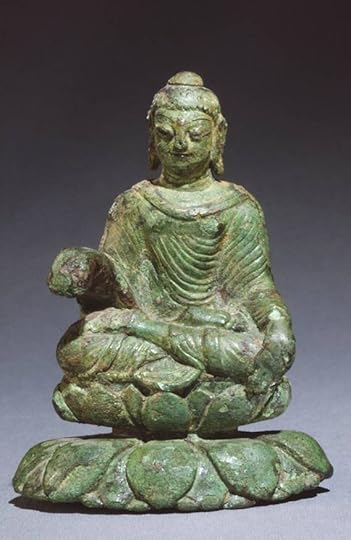
Helgo Buddha, 6th century A.D.
It’s a tiny–10 centimeter tall–bronze Buddha dating from the 700s. And it was found in Sweden.
Here’s the background: I was watching Nova on PBS (while paying bills–no time for leisure TV right now)–a show on Viking swords. I wasn’t honestly that interested, never having a particular interest in swords, Viking or otherwise. It seemed like perfect bill-paying background TV.
But these swords—known as Ulfberht—were made from remarkable steel that, as best anyone can tell, no one in Western Europe knew how to make. Europeans wouldn’t have this technology for nearly a thousand years. The high-grade steel made these blades particularly strong and sharp and far less prone to shattering in battle. The blades were so prized that they were, in effect, trademarked with the name Ulfberht, although today no one knows if Ulfberht was a family, a place or something else entirely. Of course, trademarking has its own risks, and numerous fake Ulfberhts have been discovered, usually broken to bits. Medieval blacksmiths could probably get a lot of money selling counterfeit swords, although I wouldn’t like to be the guy who fooled a Viking.
The question, of course, is where did the steel come from, if not Europe. The answer is surprising: Central Asia, possibly what is today Afghanistan. Which, you’ll note, is a long way from Sweden. Particularly if the only way you can get there doesn’t involve jet engines.
We tend to think about the Vikings heading out to rampage and pillage to the south and west. I associate the Vikings with the British Isles–with Lindisfarne and Dublin. With France and Belgium. With Iceland, Greenland and the far edge of North America.
But the Vikings traveled East as well as West. They conquered the hell out of Russia–the “Rus’,” likely meaning “men who row,” were Vikings. They sailed down rivers all the way to the Black Sea and then out to the Mediterranean. They made it all the way to Baghdad and brought back silver coins that have turned up from Gdansk to Greenland.
They also brought back this Buddha. Somehow it made it from Northwestern Indian to Helgo, Sweden, where it was excavated in the 1950s along with a Christian crozier from Ireland and an baptismal basin from Egypt.
So many questions! Did the owner know who the Buddha was? What he taught? It’s hard to image a way of life more at odds with the teachings of Buddhism than that of the Vikings. Was it just a pretty statue, valuable for its rarity? Or was it sacred? What was the story? Because you know there was a story. The story was essential to its worth.
Today I sit surrounded by objects made all around the world. I picked up a few things more or less at random and saw China, Taiwan, India, Malaysia, U.S.A. (huh!), China again, Japan, Mexico. We give it little thought.
But here is an object that traveled far fewer miles that most of the stuff in my office and yet was so rare and unique we still marvel at it 1400 years later. Amazing.
Oh, and just so you know, I didn’t finish the bill-paying. I’ll have to find something more boring to watch tonight.
(Curious about this story? You can read more at the PBS website and even—for now—watch the entire Nova episode online: http://www.pbs.org/wgbh/nova/ancient/secrets-viking-sword.html.)