
Science Sundays: Human Mating Systems

Welcome back to Science Sundays! (I feel like that should have some theme music or something.) Today, I thought I'd go a little more anthropological and talk about mating systems and the different ways they are represented in human societies. Basically, the way humans form bonds and pairings to raise a family. But before I do that, I am going to share a tiiiiny little bit of promo, okay?
My novel, Colors Like Memories, is currently on promotion for $1.99 because this next week I'm doing all kinds of promo stuff with a Bewitching Book Tour. Personally, I think it makes for a great fall read, especially with all the leaves turning colors. The other cool thing is that if you pick up a copy at my publisher's site (MuseItUp) you can get a second book ($1.99 or less) for FREE. Nice, right?
Check it out on Amazon, MuseItUp, or Smashwords!
Okay, back to mating systems :) When most people think about this, the pair-bond that is most common in Western society is what often comes to mind, but there is actually quite a bit of variety. When primates are studied, this becomes even clearer (especially as primates are so closely related to us evolutionarily). The main reason for the variety that exists is that environments are not all created equal. It is much easier to make a living in a rich valley than the desert. And because primates, and humans, especially in the past (pre-agriculture) are so reliant on how much food we can obtain to survive, this makes it a big deal.
So what kind of mating systems are there? Well the most commonly known is monogamy. This is where there is a pair-bond between two individuals (usually male and female, but we'll get into homosexuality another day--it's a huge topic that totally deserves its own Science Sunday). There are actually two main categories within this:
 Serial monogamy: our Western version of polygamy?-Ecologically imposed monogamy: this is where monogamy is the main form of marriage/pairing/etc. because the environment doesn't allow for any one male to obtain the necessary resources to care for an additional wife and kids. The couple have enough trouble feeding themselves (see what I mean about the environment playing a role?).
-Socially imposed monogamy: this is where a society for whatever reason (usually religion) has laws against taking more than one wife. So, while there may be part of the society that wants to practice another form of marriage or social structure, it is against the law (with varying forms of punishment). In the States, I'm sure everyone can think of a few groups that have had run-ins with the law over taking multiple wives.
 Not modern Mormons, or LDS people,
contrary to dumb TV shows and
popular culture. Other forms of mating systems? Polygyny, which when there's a single male and multiple females. This is actually the most common kind of mating system in humans, at least when looking at different societies world-wide (and not just population). 83% of populations (our of 800+ that have been studied) allow and have instances of a single man taking multiple wives. A lot of the time polygyny is sororal, where sisters wed the same guy. The statistics on this one always make me think, ya know? It's pretty amazing!
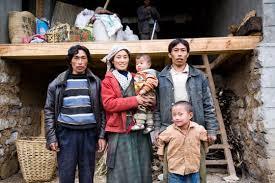 Polyandry in Tibet.The last one I'm going to talk about here is the most interesting, I think: polyandry. This is where a woman has multiple husbands. It is the least common system in humans (only found in 4 societies) and primates. However, in terms of resources and protection for the female, it's the best deal for her. For males, on the other hand, it's generally pretty unpalatable. In a few instances where this occurs (such as among the Yanomamo in New Guinea), low status males will form these kinds of matings as they don't have a chance at getting a bride on their own. It's also found in conjunction with polygyny (the male/female split is still around 50/50 and the extra people want mates too). In Nepal, one of the other places this occurs, a family of brothers will marry a single woman, and it's been argued that this is a means of keeping the precious arable land in the family.
There are quite a few different situations where these kinds of mating systems can play into stories. A dystopian novel with a dramatic shift in sex ratio might lead to all kinds of interesting situations. Or, what about exploring a different population with a different type of system? What do you think? Any good story ideas?


No comments have been added yet.


