
Interview With Moonlight Dancer Author Deb Atwood
I’m back from vacation a ready to get back into the swing of things. I have a great interview for you from author Deb Atwood. I reviewed her book Moonlight Dancer which is now available for purchase. You can read the review here.
1. Where did the idea for Moonlight Dancer come from?
The idea grew out of my first (as-yet-to-be-published) novel The Circle Line. The protagonist Kendra is the child of the main characters in that book. When I decided I wanted to try my hand at paranormal romance, I found myself really drawn to Kendra, and I wanted to explore her story. I also wanted to highlight a strong Korean woman.
2. Your novel has Korean history as a part of its plot. I’m a fan of Asian culture myself. What drew you to it and what kind of research did you need to do?
My husband was born in Busan, and I’ve been interested in Korean culture and history for as long as I’ve known him (a really long time). My research was quite extensive. First, I studied Korean for five years. It’s amazing how much culture you can learn through language alone. For instance, in English we have one word for brother, but Koreans have a separate word specifically for older brother, hyung-nim, which speaks to their respect for age and maleness. I have consulted numerous books, traveled throughout the southwestern Korean countryside, visited historic sites and museums, and talked with local experts. Once, I was taking notes in the Folk Museum in Seoul, and a docent approached me and took me on a guided tour of the entire department. I was exceedingly grateful and made use of much of his information.
3. What about an outline? Do you map your way through a story or go by the seat of your pants?
As I began Moonlight Dancer, I had the good fortune to attend one of Martha Alderson’s plotting workshops. We used 6 foot lengths of butcher paper and drew in rising action, crisis, climax, resolution as well as character growth and thematic significance. I highly recommend her workshops, phone consultations, Blockbuster Plots books, and her blog: http://plotwhisperer.blogspot.com/.
4. What was the most important thing you learned while writing Moonlight Dancer? What have you learned in general about writing?
The most important thing I learned is to trust the work. I set out to write a paranormal romance, but the manuscript kept straying outside the boundaries until Moonlight Dancer emerged as a hybrid time-travel/ghost/romance/literary narrative. No matter how I tried to shove it into the romance slot, the result is a novel too literary to be romance, and too romantic to be literary. I finally trusted that the novel would find its own home in the genre known as women’s fiction. And I hope some readers (like me) enjoy literary style with a happy ending.
What I’ve learned about writing in general is that listening to feedback from a writers group is crucial, even better is to find a writing buddy who “gets” your stuff and then meet regularly for critiques.
5. Is anything in your story based on real life experiences or purely all imagination?
Small details—both my daughters were runners as is Kendra. I did once live in a wooden cottage (shack, really) in the middle of a field in an unincorporated area called Cherryland as Hiro does, and one night in bed I looked up to see three mice gazing down at me from the light fixture. When Hiro had this same experience, he adopted the big black cat Nitro.
6. Did you try traditional publishing before self-publishing? What happened? What made you decide to self-publish?
I did. I set a goal of 100 agent rejections before turning to indie publishing. I had racked up 25 when my husband convinced me to go out on my own. The query process takes so long both in drafting individualized letters and waiting for responses, and the odds of landing an agent seemed so small that self-publishing became an attractive option. After all, one wants to write.
7. How do you market Moonlight Dancer? What avenues have you found to work best for your genre?
I just released the novel a couple of days ago, so I have no track record to share. My marketing plans include garnering reviews, participating in author interviews, chatting on forums such as Goodreads and the Stainless Steel Droppings R.I.P. challenge, and hosting giveaways.
8. Are there any other self-published authors that have grasped your interest or inspired you to self-publish?
I take inspiration from Roz Morris. I read her book My Memories of a Future Life, and I follow her blog www.nailyournovel.wordpress.com. I also like the accessible tips in Bob Baker’s self-published book 55 Ways to Promote & Sell Your Book on the Internet.
9. Would you take a publishing deal if you were offered one? Why?
I would certainly consider a traditional deal. I don’t like the divisiveness I see these days about the “evil” publishing empire vs. the “desperate” indie authors. Instead, we should celebrate the fact that authors have choices and understand that each choice carries advantages and disadvantages—sort of the difference between Aunt Vera making your wedding gown and Vera Wang doing it. Both are good for different reasons.
The mentoring aspect of a good author/agent relationship has great appeal for me, as does the expert team approach to publishing.
10. What new projects are you working on now?
I am working on a ya novel Poseidon and Me about a teen with a life-threatening allergy who acquires a service dog (Poseidon) and is thus able to attend high school. All does not go as planned…
I am also working on The Circle Line, a prequel to Moonlight Dancer that follows Kendra’s biracial father from a Korean orphanage to an American suburb where he struggles with issues of adoption and identity.
11. Is there anything about writing you find particularly challenging?
The vision I have for a piece vs. the reality of the finished product. I saw an interview with Dave Eggers in which he said he hated to read his work to an audience because he always wanted to rewrite stuff in the middle of his reading. Sigh. I get that.
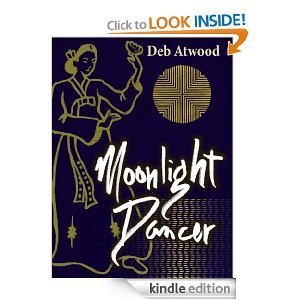
12. Who came up with the cover design and where did the art come from?
Matt Hinrichs (designer@scrubbles.net) did the artwork. Joel Friedlander puts on a monthly e-cover contest (http://www.thebookdesigner.com). I viewed some fantastic covers and found a few that reflected my vision including one submitted by Matt, and we hooked up from there.
13. Did you hire anyone to help you edit? Why?
Yes, for about a third of the book. I wanted the benefit of expertise from someone in the industry.
14. What has been the toughest criticism given to you as an author? Your best compliment?
I entered the first 30 pages of Moonlight Dancer in a romance contest. The judges said that Hiro was not a hero. That made me sad but also gave me my first hint that my novel did not conform exactly to the romance genre. Of course, it would take a few more “hints” before I finally admitted that Moonlight Dancer actually belonged in women’s fiction.
My best compliment was from poet Alejandro Murguia about an excerpt of The Circle Line: “A finely crafted story of subtle grace…details heightened to luminous clarity, an ending that resonates like a Buddhist bell.”
15. Do you have any advice for other writers?
Give the work as much time as it takes. This probably means one more re-write than you planned on, one more conference to attend to practice craft or learn industry guidelines, etc. Don’t rush to publication because you want it to be ready if the manuscript or your beta readers tell you otherwise.
16. Do you have anything specific that you want to say to your readers?
Thank you for reading! As they say in the airline industry, you have a lot of choices when it comes to (in this case) reading. And if you love ghost fiction as much as I do, I hope you check out my blog www.peninherhand.wordpress.com where I review ghost novels.
17. How can fans who enjoyed Moonlight Dancer find out more about you and what you have coming out in the future?
I would love people to visit me in these places:
www.peninherhand.wordpress.com
@deb_atwood (twitter)


