
the waves
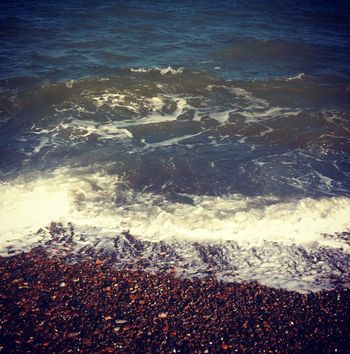
[waves, Aldeburgh]
I started The Waves to the sound of waves in Portugal, and finished The Waves by the waves in Suffolk. Between times, I tried to read it in land-locked Berkshire but found it difficult to pick up the ryhthms, the trails, and the voices again because too much was going on. It's a book that requires calm, careful, immersive reading; it's always described as a 'difficult' novel, and it's true that you need to escape into it fully in order to have any chance of grasping it (although it's hardly an 'escapist' read).
I found I needed to let the language to wash over my brain, to let it create the same type of hypnotic effect that watching waves can have. All the monologues are spoken internally, not aloud, and run into each other without clear breaks to create a work for voices (I can imagine listening to it on the radio) which builds up into an ebbing and flowing drama, but requires enormous concentration. The Waves feels intensely modern, even post-modern, like some kind of experimental theatre mixed up with elements of Chekhovian emptiness and absence, and the classical unities of Greek tragedy. It has sections and passages which hold you spellbound until, inexplicably, you lose the thread or your mind wanders (or perhaps the text does - it's hard to know when you can't always distinguish the speaker) and then, all of a sudden, it becomes brilliant and sparkling and clever again. Like waves, the prose rises and fall, sometimes lapping gently and sometimes crashing dramatically.
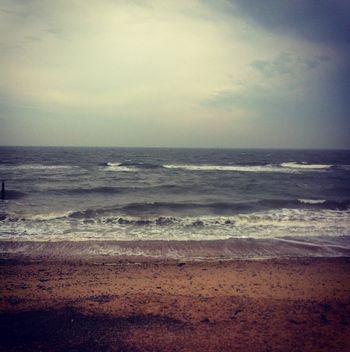
[waves, Southwold]
If I am honest, I don't think I would have finished the book if I hadn't already decided to read VW's novels instead of just reading about her and her life. Yet this is the one that needs to be read in order to understand her breakthrough style, her modernism, and just what what it was she was trying to do. Although it contains so many of her usual themes and motifs and words, it's more an exercise in control of material that is undoubtedly both part of, and ahead of, its time (think James Joyce and TS Eliot), than a conventional novel.
With its many repeats and refrains, The Waves often feels like very intense prose poetry. I was amazed by the way VW cleverly sustains the inner monologues to demonstrate how separate we all are and how our stories cannot be told in a linear, chronological, orderly fashion. She proves herself to be the high artist of the inner life, and her writing has a fragility and a delicacy, but also a hard, sometimes lurid, raw and hallucinatory style. It's as though the six characters who speak have been disemboided, flayed, exposed, and as a result are hyper-sensitive to all external stimuli. And all the way through there is water and death, waves and death, life and death, with several chilling, shivery moments about dying and drowning.
The Waves is about the 'incomprehensible nature of this our life', how we struggle to hold our personalities together, to make sense of life and our lives as we battle with the fragmentation of consciousness and our fractured perceptions of reality. As such, it's not a book I'd rush back to, but at least now that I have read it, I am no longer afraid of Virginia Woolf.


Jane Brocket's Blog

- Jane Brocket's profile
- 27 followers

