Found Bleeding
This winter, I’m skating with my 20-year-old grandson. As a young man now, skating is one of the few things he’s still willing to do with his grandma.
And I’m thrilled.
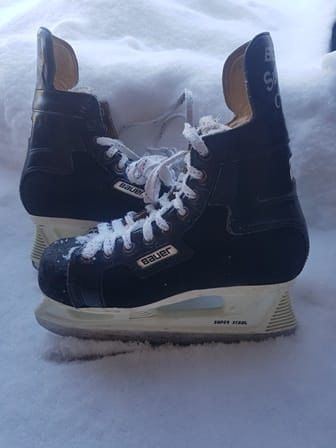 My feet are only ever warm in hockey skates.
Once a week, we put our blades onto the ice for seventy-five minutes. Sometimes his mom (my daughter) joins us, sometime his Nonno (my husband). His brother, age eighteen, doesn’t participate. I suspect ice skating with grandma is not cool, although his 10-year-old cousin says I am “six-seven”…which could mean cool or mediocre or nothing at all.
(The Guardian says six-seven means “nothing beyond the average 13-year-old’s capacity for being annoying and a corresponding willingness to flog a dead horse.”)
Although I have been skating since I was a child, I really only do the basics—balance, move forward, glide, and a weak snowplow stop.
I learned to skate on the farm where I grew up. Can you visualize an idyllic rural landscape with blue skies and a charming pond rink surrounded by trees and tall perennial grasses laden with snow, sparkling in the sunshine?
That wasn’t my reality.
Picture instead a patch of ice in an open field. Clods of dirt from the plowed earth popping through the surface like angry teenage zits condemning you to no social life. Wheat stubble that didn’t get plowed under also mars the flat surface. There are no trees to act as a windbreak. And those tall perennial grasses you were imagining? Those are phragmites—non-native, destructive, invasive species.
The wind was bitterly cold.
My skates were hand-me-downs, either too big or too small, passed to me from my friend and neighbor. They were, at least, white figure skates. I would have been so embarrassed had I been forced to wear, gasp, boy’s hockey skates handed down from my brothers.
My feet were always cold.
I suppose cold feet were to be expected after walking from the house to the ‘rink’ through fields of snow drifts. Alternatively, we would wear boots to the site, then sit on a snow bank in the freezing wind to change into our skates. Toes and fingers would be frozen before our blades hit the ice.
I never enjoyed ice skating back then. Cold feet and clods of dirt and wheat stubble that tripped my beginner strides allowed only rudimentary tip-toes through the furrows and crushed any illusions of performances of twirls and pirouettes.
Years later when I had children of my own, we skated on outdoor rinks—with actual plywood side boards, icy smooth surfaces maintained by volunteers, and a heated shack where we changed into our skates. While encouraging my children forward in their tentative baby skate-steps, I learned to skate backwards. I discovered forward crossovers and would skate in circles, right over left, until dizzy. Then I would go the opposite direction, left over right, always more challenging. One day when I couldn’t find my figure skates, or maybe my blades were dull, I donned a pair of hockey skates. And for the first time while skating, my feet were warm.
I vowed never to wear figure skates again.
Two years ago after not skating for several years, I was re-familiarizing myself with crossovers when I had a fall. I was knocked out, briefly, and assisted off the ice by two teen attendants. My glasses were broken at the hinge, my brow at the temple split, bleeding, with a cut that should have had stitches. (Shoulda, coulda, didn’t.)
As a result of that fall, my skating skills have regressed to childhood levels. No crossovers, no backward skating. Just the fear of tripping over clods of dirt, wheat stubble, and my own two feet.
So now when my grandson and I go skating, I step gingerly onto the ice, holding the board as I set off. PUSH PUSH PUSH glide. PUSH PUSH PUSH glide. The push, I hope, hides my sense of panic that I might fall. I PUSH PUSH PUSH again and the glide becomes merely a moment to catch my breath.
PUSH PUSH PUSH glide. HIDE HIDE HIDE glide.
No matter how fast I skate, I can’t escape my own fear. My skating is frenzied. I am desperate to avoid falling flat on my face. Anxious not to be seen bleeding, vulnerable, weak. Frantic to avoid crashing into others, taking them down with me. (Children skate so much faster and are so unpredictable!)
This alternation between the panicky HIDE-PUSH and the catch-my-breath glide is exhausting. I must take frequent breaks in the penalty box, an opportunity my childhood self would have relished, but my adult self fails to appreciate.
Then last week, something changed.
Instead of pushing hard and fast, I began pushing stronger. And longer. I kept my mouth shut—Is there a message in that?—breathing instead through my nose. I let myself enjoy the glide. Instead of fear making me hurry to get ahead of the clusters of skaters to avoid crashing, I slowed down.
When I slowed down, I had more control.
My pace slowed.
My breathing slowed.
I didn’t feel exhausted. I didn’t need as many breaks. I was better able to skate around and between those speedy children. I was relaxed and having fun, even noticing the songs on the speaker.
I found my stride.
For the first time, I understood that overused phrase. It’s a feeling, a state of calm, a sense of expansiveness. You feel hyper-aware. Not in a tense way, but in an alert-yet-relaxed way.
As I marvelled at finding my stride, I considered the metaphor. (I am an author, after all.) Did it apply to my work? To my life? Could I live life from this state of equilibrium, of stasis?
Would living life from stasis change things for you?
I haven’t figured out all the answers. I do know that I can return to that feeling simply by remembering how I felt that day.
And next time I go skating, I may even try practicing my crossovers. While wearing a helmet, of course.
(I am six-seven, after all.)
Thanks for reading Unhiding: My Writerly Life! This post is public so feel free to share it.