Language!
This post is going to ramble like a holiday dinner that failed to come out of the oven on time. It’s about language, holidays, and asking for help. There is even a little bonus insight about me and my ennegram type.
Let’s start with that dinner. Christmas dinner as an example. To time everything you not only have to start with how much food to make, but how long it cooks, what temperature it cooks at, what ingredients everything needs, and the kicker that trips people up, where do you put it in the oven? Because, as you know, things take up space. Especially roasted stuff with their honkingly huge pan.
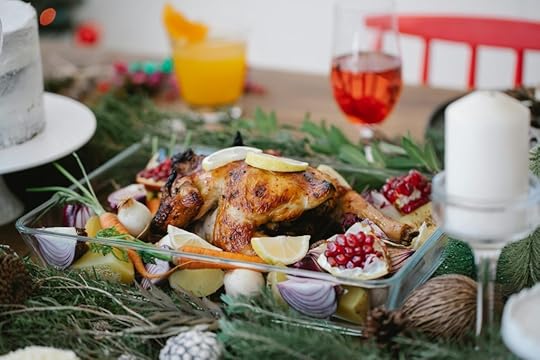 Photo by Tim Douglas : https://www.pexels.com/photo/roasted-...
A good chef googles more than just one recipe. Why? Because you begin to see where one recipe may have leeway, or better yet, where the commonalities lie so you can cheat a little and make everything magically come out on time and delicious.
But there’s always the “board” of goodies to tide your guests over. That’s this post. A little niblet of what goes on behind the curtain of this writer’s life. And yes, I cook, google multiple recipes, and try to juggle things so they magically get ready on time.
Like books.
EVEN IF IT HURTS.
(Side note: not a great approach… Tip: enlist help.)
Anyways, what does this have to do with language?
I’m glad you asked. My latest release, “Valentine’s Code” (which as of the writing of this post is available for preorder at: https://books2read.com/Valentines-Code) contains little snippets of Italian to enhance the authenticity. And who doesn’t just LOVE a main character whispering sweet nothings in another language?
I blame my playlist (see: Valentine’s Code Playlist) with all of its Italian love songs.
The investigatorAnd I also blame my ennegram type. I’m a 5, or in plainer language, an investigator. Sometimes I look more up than the book calls for.
Scratch that, sometimes? Try always.
For example: While researching this book, I looked up “famous” Italian mobsters, mobsters who worked with the allies, Chicago mobsters, and more. Well, that led to discovery.
Did you know that there was a guy named Graziano Mesina who was known as the “Sardinian Scarlet Pimpernel?” True stuff. It’s fascinating reading for those who like to dig a bit.
But finding him changed the book. No longer was I simply looking for a mobster, but I’d stepped into the rabbit hole that is probably labeled, “As much Sardinian trivia as you can handle.”
Going back in timeLike Nuragic settlements.
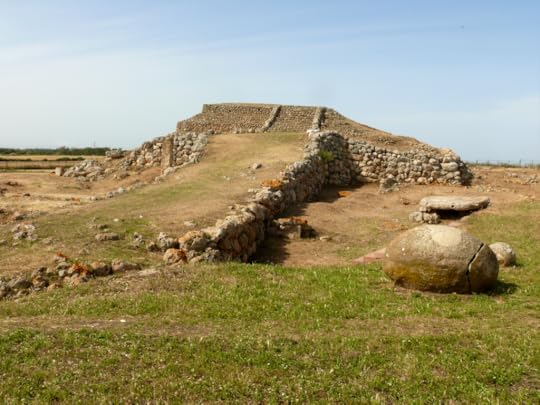 By Gianf84 at Italian Wikipedia, CC BY 2.5, https://commons.wikimedia.org/w/index...
What? Don’t look at me like that. Those ancient conical towers may have been built by sea pirates predating Troy. Which was a whole other rabbit hole branch. I simply love this stuff.
And that led to the roots of “The Code.” Because what is a sexy foreign mobster-assassin without a great code of conduct to live and murder by? Right? Especially when it creates a culture that protects love and the home and family with zealous devotion. It’s the stuff multiple novels spawn from. I had to settle for a quick two while other books wait in line.
I had my hero. But with this diversion I also found out that Sardinia is a bit special. It is considered a part of Italy, but not everyone on the island speaks Italian, or should I say, they may learn a different language first. There’s bits of Spanish, Portuguese, Corsican, and the big one, Sardo. It’s classified as a “Romanza Insulare” – or a branch of Latin of its own, that predates the Italian branch. Which means that the average Italian would not be able to understand it.
A secret language?Mwhahahaha… this villainous writer rubs her hands in glee!
Now they not only had a code, but a secret language. (Caveat: not THAT secret. If you grew up in Sardinia, chances are you’re familiar with it.)
Still. It’s fascinating stuff. And perhaps this little band of merry men (and women) carried their original language from those sea pirates? Hum?
The word Aiaiu comes from that digging. It is attached to the Campidanese dialect prevalent in central and southern regions of Sardinia. Unfortunately, that may be where I began to drift astray because Don Manca (the MMC’s grandfather) would speak Gallurese – a Corscian dialect. (D’oh!) Which would make him be affectionately addressed as “Babbu.”
Sigh. Language!
The book is already written, dang it! And those darn Corsicans may have infiltrated the northern parts of Sardnina with their language, but I’m sticking with the central version.
Credit where credit is dueSometimes rabbit holes are really confusing. And sometimes it’s best to ask for help. Like I did with the Italian phrases. Special thanks to Sarah Allen, Courtney Lynn Rose, and MOST IMPORTANTLY, Dania Voss who were so helpful with their time and resources to track down, or personally assist with translation assistance.
THANK YOU.
Oh, one last thing, since we started with food. Here’s a Gallurese recipe. I described it to my other half, and he’s like, “Oooo that sounds like the top crust of a really good onion soup.” But others have described it like lasagna…except with bread and cheese and rich broth instead of sauce and noodles.
Video from Pasta Grannies:It sounds yummy.
Zuppa Gallurese: Sardinian comfort food
Buon appetito!
Oh, and if you missed the translations in the book, here they are:
“Matrimonio all’improvviso, o inferno o paradiso,”
A sudden marriage, either heaven or hell,
“Dio li fa e poi li accopia.”
God makes them, then joins them.
“Non c’è niente oltre te.”
There is nothing beyond you.
“Questa vita che volevo darti si è sgretolata tra le mie dita.”
This life I wanted to give to you has crumbled between my fingers.
“Mostri le mani.”
Show me your hands
Amore, Ti prometto di proteggerti con la mio vita.
Love, I promise to protect you with my life.
“Buonasera, nonno. Che piacere vederti.”
“È passato troppo tempo! Questa signora non è la tua fidanzata. Sei pazzo?
“Good afternoon*, grandfather. What a pleasure to see you.”
“It’s been too long! This lady isn’t your fiancee. Are you crazy?”
*note on Buonasera – it means “good evening” HOWEVER, doing a little digging on this and it is not uncommon to say this (IN MILAN) as early as 2PM. It varies by region.
That’s all I’ve got. Enjoy the rabbit holes.
Languages of Sardinia – A Brief Introduction
https://en.wikipedia.org/wiki/Barbagian_Code
BANDIT LANDS 9 – The Scarlet Rose