
How it Ends in Ukraine--and Why
Introduction.
George Carlin famously observed of our rulers (“owners,” as he called them), “They don’t give a fuck about you. They don’t give a fuck about you. They don’t care about you. At all. At all. At all.”
The Heart of the Matter is a reader-supported publication. To receive new posts and support my work, consider becoming a free or paid subscriber.
Carlin’s observation is both axiomatic and essential for understanding events. Powerful people have no interest in the welfare of powerless people. Powerful people don’t want to empower anyone else; they want more power for themselves because, as Orwell said, “The object of power is power.”
Once you realize this—once you realize that neither Biden nor Trump, Pelosi or McConnell, Bezos or Musk, gives a damn about you except perhaps to use you as a resource—the effect of propaganda is blunted and you can see geopolitics more clearly. Specifically, you can more accurately understand what will happen because you can better understand what the people in charge want to happen.
Of course I’m not suggesting that when it comes to geopolitics, matters such as national interests, institutional interests, and structural interests aren’t relevant—of course they are. And so is psychology (the difference between motives and drives). But I’ve long been struck by the relatively scant attention paid by even the most insightful historians, economists, and political scientists, I listen to and read to personal interests—which, when it comes to politicians, largely means political interests. Which is really just another way of saying power interests.
But have no fear, novelists to the rescue! After all, a novelist’s stock in trade is character—people built on a foundational understanding of human drives, human motives, and human nature itself. So let’s try to examine the personal motives of the primary characters in the story of the war in Ukraine: (1) President Trump; (2) European politicians and bureaucrats; (3) President Zelensky and his inner circle; and (4) President Putin and his inner circle.
1. Trump.
Though he’s facing stiff resistance from war lovers like Lindsay Graham and lunatics like Michael McFaul, my sense is that President Trump genuinely wants to end the war in Ukraine. I say this because the war doesn’t benefit him politically and ending it would burnish his attempts to brand himself a peacemaker, and because over the last year he’s tried to end it, albeit in typically Trumpian scattershot fashion (saying he’s going to just let the combatants fight it out like children, threatening Ukraine that he’ll cut them off, threatening Russia that he’ll escalate, etc).
But any president who ends a war will inevitably be accused of losing it. This was true of the Korean War, where war lovers peddled the narrative that the stalemate resulted from the Truman’s insistence on fighting a “limited war” (I know the “evidence” I’m presenting here is a movie, but you can find plenty to real evidence on the Internet and when it comes to humor in these mad times, I’m all for “Smoke ’em if ya got ’em”):
This was true too of America’s loss in its war in Vietnam, where the war lovers’ narrative was that Johnson and then Nixon forced the military to fight with “one hand tied behind its back.” In fact, as the Pentagon Papers revealed, the US government had concluded early on that the war was unwinnable—but politicians continued to lie about “light at the end of the tunnel” so they could hand off the inevitable loss label to whoever succeeded them.
The Afghanistan war was no different. As the Afghanistan Papers revealed, three successive American administrations knew this was at best another stalemate, but continued the war anyway because Bush, then Obama, then Trump, didn’t want to be blamed for being the one to lose it.
If you doubt the kind of political fallout an American politician will face for ending an unwinnable war, consider how the Economist framed the end of America’s retreat from Afghanistan, where the debacle wasn’t twenty years of war that led from the Taliban in power to the Taliban in power, but rather President Biden’s withdrawal.
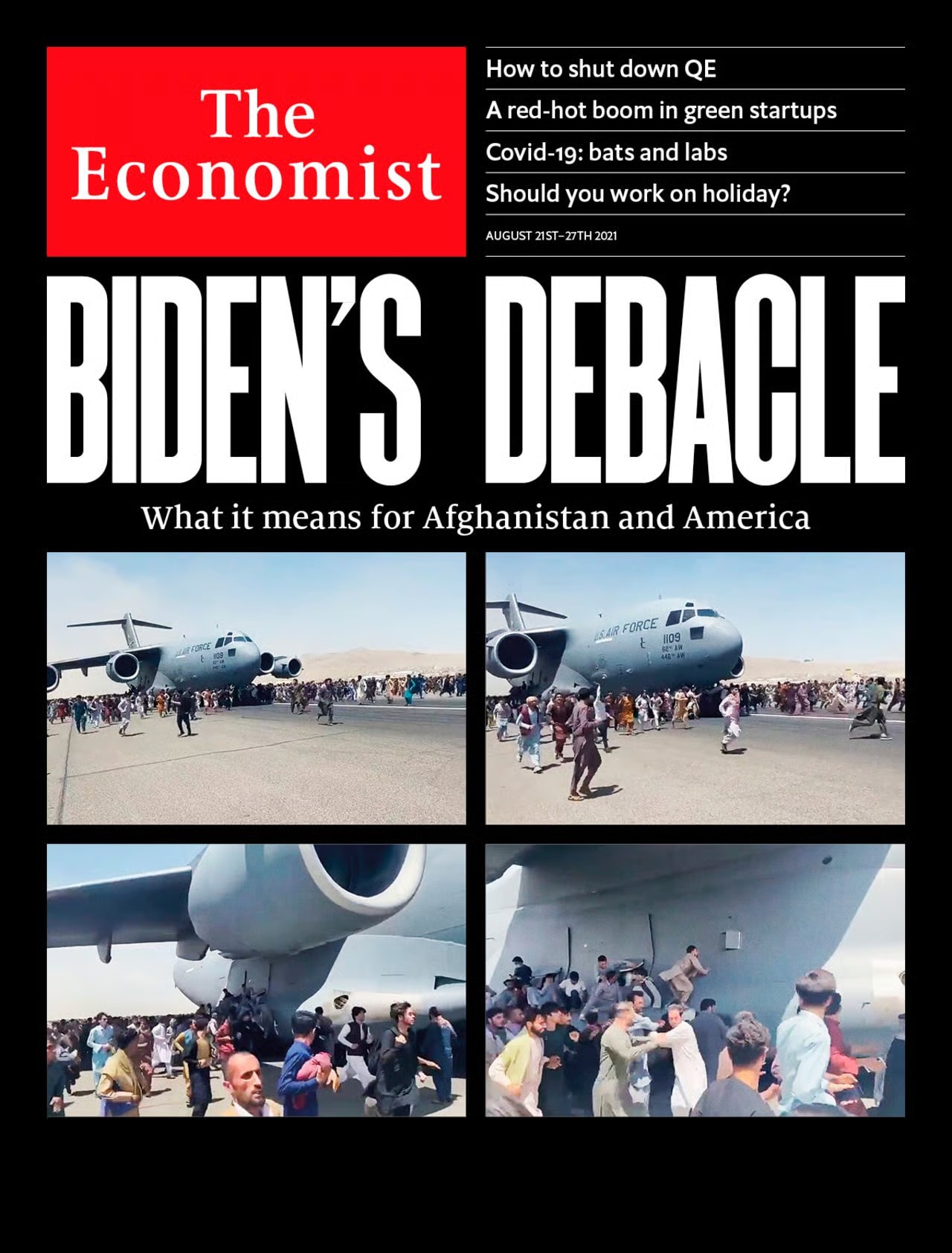
Any American president who tries to stop the slaughter in Ukraine will know headlines like Biden’s will be his. And this is of course by design.
Trump’s dilemma, therefore, is how to end the war without being blamed for losing it (as the war is already lost, this is of course not a moral dilemma, only a political one, but if you want to understand politicians, using morality as a rubric will yield inaccurate results). Trump could end the war almost immediately, but cutting off US financial aid, arms shipments, intelligence sharing, weapons targeting, and other means of supporting the Ukrainian war effort. But he understands that if he ends the war, unwinnable though it is, he’ll be blamed for losing it.
(The “Trump Lost the War” propaganda is of course already happening—follow the latest from the Wall Street Journal or the deeply disturbed Michael McFaul if you doubt me—and the propagandists deploy this sort of bullshit early and often precisely to warn any president who might dare to end a war about the political price he’ll pay if he does.)
Trump’s political dilemma makes me wonder about recent Shocked, shocked! revelations of gargantuan corruption by the Ukrainian government. Cui bono is a better guideline than a rule, but it’s interesting to consider that Trump now has a narrative he could use to insulate himself against the political fallout of ending the war: “We’ve sent this government hundreds of billions of dollars and instead of using it to fight the war (which never would have started if I had been president, blah blah blah), Zelensky and his cronies have been stealing it, and don’t tell me this guy is innocent, that’s like saying he’s a virgin living in a whorehouse. It’s time to recognize reality and focus on America First.”
I don’t expect Trump will do this—I think he’s too afraid of the political consequences. But again, it’s interesting to consider the potential political opening the latest corruption revelations create, who might be behind them, and how they might be exploited.
(I have to mention the Economist again, because their take on the corruption scandal is that revelations of massive Ukrainian government corruption are actually good because it shows Ukraine’s anti-corruption apparatus is working. By that logic, it would be bad if there were no Ukrainian corruption—unless no Ukrainian corruption is good and Ukrainian corruption is also good, and maybe that is indeed their point because come on, it’s the Economist, Forget it, he’s rolling…)
At any rate, like all compelling characters, Trump is faced with a dilemma, his decision on which will reveal his ultimate nature. And while I hope I’m wrong, I expect his decision will be to let the war drag on even though he knows better. In fairness, that’s just what American presidents do.
2. European Politicians and Bureaucrats.
For anyone who’s been peddling the narrative that Russia invaded Ukraine because Putin: (i) is the New New Hitler; (ii) longs to reconstitute the Soviet Union; (iii) believes he is the reincarnation of Peter the Great; and (iv) plans to use Ukraine as a staging ground for the conquest of all of Europe and ultimately of New Jersey, too, a negotiated end to the war will be intolerable.
Why? Because the truth is that NATO provoked this war (everyone not relentlessly propagandized or in on the scam has always known this and indeed warned of it), and the truth is that guarantees of Ukrainian neutrality are the only way of negotiating an end to it. Yes, there will also be territorial concessions—for the loser, the terms of ending a war will always be far harsher than the terms for not fighting it. But as William Burns—Bush 2’s ambassador to Russia and Biden’s CIA director—warned Secretary of State Condoleezza Rice in 2008 in an email accompanying Burns’s memo “Nyet Means Nyet:”
Ukrainian entry into NATO is the brightest of all red lines for the Russian elite (not just Putin). In more than two and a half years of conversations with key Russian players, from knuckle-draggers in the dark recesses of the Kremlin to Putin’s sharpest liberal critics, I have yet to find anyone who views Ukraine in NATO as anything other than a direct challenge to Russian interests.
European leaders have diverted billions of their taxpayers’ money to a foreign government based on insistence that the only way to stop the war is for Ukraine to keep fighting it—and their insistence that if Russia wins, it will go on to conquer NATO member Poland and then the rest of Europe. When instead Russia wins the war and stops in Ukraine, the scam will be exposed and the leaders behind it further disgraced and in severe danger of being toppled. They’ll of course do all they can to blame everyone else for the inevitable outcome but blame deflection at best a fallback plan.
Remember: these leaders are already massively unpopular, and their Churchillian cosplaying and doom-mongering is both cause and consequence of that unpopularity. To be proven so disastrously wrong about the war would almost certainly end their political careers and reputations. They can therefore be expected to continue to do all they can to keep the war going. Unlike Trump, who perceives at least some political gain from ending the war, European elites see only political cost and risk.
3. Zelensky.
Again: everyone not successfully propagandized or in on the scam has always known that NATO provoked this war. President Zelensky himself offered to discuss neutrality with Russia shortly after the invasion began, but abandoned negotiations in Istanbul when western leaders convinced him they would back the war (and probably issued some veiled threats along with the promises).
I don’t respect it, but I understand Zelensky’s calculus. Negotiate an end to the war and you’ll likely be assassinated by Ukrainian Nazis. Keep it going and you’ll be a celebrity, the west will maintain you in power (at least for as long as you’re useful), and you’ll have hundreds of billions of dollars to use for patronage and otherwise.
Zelensky’s decision to abandon neutrality negotiations before Ukraine had lost meaningful territory has resulted in a slow motion catastrophe for his country that is worse today than it was four years ago and will be even worse tomorrow. It’s almost inconceivable that he could now admit his error—he would be permanently rendered infamous, and probably murdered.
The solution for Zelensky and his inner circle, therefore, is to keep the war going until Russia has reached the Dnieper River and possibly taken Odessa, at which point Russia will likely stop taking new territory and offer to negotiate. The terms will be—as they always have been—Ukrainian neutrality, but they will also include the loss of Ukraine’s eastern, Russian-speaking oblasts. As a carrot, Russia will likely guarantee no further conquest and no interference if the EU wants to admit Ukraine, and might also offer to return some of the territories it has seized.
Zelensky will then be able to claim he never quit; none of this catastrophe was his responsibility; he was betrayed by the west and has no choice but to accept these terms to save what’s left of the Ukrainian nation. Disgrace and possible murder one way; a possible face-saving excuse on the other. For a ruler, compared to a choice like this, the lives of ordinary people barely count at all.
4. Putin.
Ukraine is Russia’s most sensitive border, used twice in the 20th century to invade Russia and resulting in losses I don’t think any outsider can really imagine. This means that no Russian government could ever accept Ukraine’s entry into a foreign military alliance and hope to survive—any more than the Kennedy administration could have hoped to survive acquiescence to Cuba’s hosting of Soviet missiles in Cuba.
I know, I know, NATO is a defensive military alliance; NATO has never attacked another country (it has, even beyond the fact that it is now waging war on Russia itself even as EU foreign affairs chief Kaja Kallas says Russia should be broken up into smaller states); Putin knows all this and so NATO is just an excuse.
Let’s assume all that is true. It doesn’t change the political survival calculous of any Russian leader. Allow Ukraine to join a foreign military alliance and you’re done.
And this was true for the Cuban Missile Crisis, too. Secretary of Defense Robert McNamara believed Soviet missiles in Cuba made no significant difference in the strategic calculus of MAD. But even if he’d lived (or been allowed to live), can you imagine Kennedy trying to explain that in the 1968 election? “Yeah, I let Khrushchev and Castro position Soviet missiles 90 miles off the coast of Miami. But it’s really not a big deal!”
To put it another way: no Russian government can or will allow this war to be lost. Obama himself recognized this in 2016, arguing that because the status of Ukraine was a core interest of Russia’s and not of America’s, Russia would always maintain “escalatory dominance” there.
In practice, this means two things. First, that the personification of Putin as the sole cause of the war is at best inaccurate. In fact, no Russian leader could remain in power while permitting Ukraine to join a foreign military bloc, and the political pressure on Putin is almost certainly of the “You’re being too restrained, the imperialists only understand the language of force” variety, the same as for any American politician who’s ever presided over a losing war). In other words, if you believe Putin being deposed or assassinated will lead to peace in Ukraine, you have it exactly backward.
And second, regardless of who rules Russia, if you think the war has been going badly for Ukraine while Russia is winning, you should be terrified of what Russia will begin to do if it ever feels it’s in danger of losing—up to and including the use of nuclear weapons.
To sum up: Putin and his inner circle understand that to allow Ukraine to join NATO, or to be the subject of western “security guarantees,” or to host any significant western military presence at all, would be a suicide pact, politically and perhaps otherwise. The same would be true of any conceivable Russian successor government. This means Russia will continue the war until Ukraine and NATO accept Russia’s insistence on Ukrainian neutrality.
Conclusion.
Acknowledging the foregoing gives me no pleasure. I’m not trying to describe the way things should be but instead proceeding from the way things are. And the way things are is that we ordinary people are cursed with horrible rulers—people who started out lusting for power and then were even made worse by it, people whose concerns have little or nothing to do with the concerns of the people they rule.
But as I’ve said before:
There are only three ways this war will end: (i) the destruction of Ukraine; (ii) the destruction of the world; or (iii) a negotiated settlement that would include UN-supervised elections in Ukraine’s eastern provinces and Ukrainian neutrality. Russia will not allow Ukraine to join NATO, and though that might be upsetting, if you believe Ukrainian NATO membership is a goal worth continuing to slaughter and immiserate millions of Russians and Ukrainians over, you’re necessarily choosing one of the first two outcomes.
I understand the psychological barriers to accepting my view. It’s hard to ask Are we the baddies? Let alone to accept that at least in some respects our leaders are the baddies, or at least that understanding geopolitics as good guys and bad guys, good vs evil is childish at best. And hard too to accept that there are limits to American power—inherent limits and also practical limits as determined by weighing possible benefits vs costs and risks—and that we can’t always work our will in the world if our will is just strong enough.
If I’m correct in my analysis of the motives of the characters in the story of the war in Ukraine, negotiations will be of no more than the kabuki variety and the war will continue until Ukraine’s ability to resist has collapsed. At which point, Russia will not negotiate but rather will dictate terms. Unless, of course, our rulers have already blown up the world over the question of whether Ukraine gets to be NATO’s 33rd member state (I know, I know, it could never happen).
I know from experience I’ll be getting a lot of pushback for this post from people who think they’re supporting Ukraine (they might be supporting the interests of Ukrainian’s current leaders, but the interests of ordinary people not so much). If you’re one such, to save time feel free to cut and paste any of the following:
Kremlin talking points
Chamberlain, Hitler, Munich, Appeasement, (CHiMA)
Rules-based International Order
NATO is defensive alliance
Good guys vs bad guys good vs evil
Ukraine has agency and right to do
Cannot give in nuclear blackmail
No to trust Putin
Useful idiot
Apologies if I’m missing any, but I think those are at least the major ones.
Anyway. If I’m right, we can discuss all this again in a month, or three, or six, when—if our rulers haven’t blown up the world before then—millions more people will have been killed and immiserated and Ukraine’s position will be even worse than it is today. Reason is a weak force in human affairs; propaganda a powerful one. And if the Greeks were right, character isn’t really what determines the outcome of stories anyway. That’s more a matter of fate.
The Heart of the Matter is a reader-supported publication. To receive new posts and support my work, consider becoming a free or paid subscriber.


The Heart of the Matter

- Barry Eisler's profile
- 3038 followers

