Incarnation Fast 3 (Western) Advent I: The Image of God and Our Restoration

 The Spiritual Mysteries of the Divine Calendar: Advent I — The Image of God and Our Restoration ~ November 30 – December 6, 2025 ~
 As we walk the path of Jesus Christ through the Seasons of Salvation in the Divine Calendar, we begin to see the magnificent event of the Word becoming flesh rising on the horizon. Entering the first Sunday of Advent, we turn to the majestic mystery of how Jesus restored the Image of God in human nature at His coming—and how His wholeness becomes our restoration. These weeks will be an intriguing journey, so prepare for a deep dive into the mysteries of Advent.
This is the third week in the Season of the Incarnation Fast. In the first week, we began exploring The Incarnation and Its Mysteries, and last week we reflected on How to Create Space for Christ’s Reign. These past two week laid the foundation for the Incarnation (Nativity) Fast, which began on November 15 and concludes on December 24. The Incarnation is indeed too vast for our minds to fully comprehend, so in this third week we will approach this marvelous event from yet another angle.
The Word Became FleshThe mystery of the Incarnation is beautifully summarized in John 1:14: “And the Word became flesh and dwelt among us, and we beheld His glory, the glory as of the only begotten of the Father, full of grace and truth.”
In John 1:1, we read that “the Word was God”—and yet He became flesh. Jesus revealed God through the example of His life. Wherever He went and whatever He did, He declared God to us, as John 1:18 affirms: “No one has seen God at any time. The only begotten Son, who is in the bosom of the Father, He has declared Him.” Jesus, God in human form, was the brightness of the Father’s glory and the express image of His person (Heb. 1:3).
Why did God become man, a mystery we prepare to celebrate during this season of fasting? He became man so we could know Him as a fellow human being in Jesus Christ, see what we were created to be, and ultimately “be conformed to the image of [Jesus], that He might be the firstborn among many brethren” (Rom. 8:29).
Jesus = The Image of God
In first week of the Nativity Fast, we saw how sin shattered the image of God in man (Gen. 3:3,10). Also, we talked about how the unshattered and original image of God was revealed in our world through Jesus Christ. “He is the image of the invisible God, the firstborn over all creation” (Col 1:15).
This is God’s gift in the Incarnation Season, especially during the Feasts: The life of Jesus enters our soul as a divine seed, which grows and restores the image of God. The Holy Spirit completes this seed’s transformation of our soul into the likeness of Jesus Christ (Gal. 4:19), throughout the Seasons of Salvation, year after year.
Last week, we discovered how the key to enter this spiritual season is the emptying of our honor and prestige through hunger for true fulfillment. What more can we learn about this wholeness we are currently preparing to receive? Let us go deeper into this gift.
Fullness
The image of God reveals our fullness—the fullness of human existence and experience.
The Apostle Paul wrestled with words to express the fullness of God in Ephesians 3:16–19: “That He would grant you, according to the riches of His glory, to be strengthened with might through His Spirit in the inner man, that Christ may dwell in your hearts through faith; that you, being rooted and grounded in love, may be able to comprehend with all the saints what is the width and length and depth and height—to know the love of Christ which passes knowledge; that you may be filled with all the fullness of God.”
We also read in Ephesians 4:13: “Till we all come to the unity of the faith and of the knowledge of the Son of God, to a perfect man, to the measure of the stature of the fullness of Christ.”
In the Incarnation, God united Himself with humanity so that “he who is joined to the Lord is one spirit with Him” (1 Cor. 6:17). Just as Jesus and the Father are one, so shall we be united with God. “That they all may be one, as You, Father, are in Me, and I in You; that they also may be one in Us …” (John 17:21).
The Image of God: When Mankind Reaches Fullness
We read in Genesis 1:26: “Then God said, ‘Let Us make man in Our image, according to Our likeness’” (Gen 1:26a). This twenty-sixth verse of the Bible is so revolutionary that we often fail to grasp its depth.
During these weeks of the Incarnation Fast, we seek to comprehend the gift we will receive in the Incarnation Feasts. Our hungering to receive the spiritual seed of Jesus’ divine-human nature serves as the greatest motivation throughout our preparation and fasting.
Let us now examine Genesis 1:26, phrase by phrase.

Photo by Ravi Pinisetti on Unsplash
“Then God said …”The Hebrew word for God in “Then God said …” is Elohiym, the plural of eloahh, meaning “a deity” or “the deity.” It is significant that Elohiym is plural. The Bible later reveals this plurality as the Holy Trinity.
1 John 5:7 clearly affirms this mystery: “For there are three that bear witness in heaven: the Father, the Word, and the Holy Spirit; and these three are one.”
“… Let Us …”
The Holy Trinity is involved in the act of speaking that created man: “… Let Us …” (note the capitalization of “Us”).
We see God the Father speaking: “For He spoke, and it was done; He commanded, and it stood fast” (Ps. 33:9). God the Son is present with Him, as Proverbs 8:30–31 declares: “Then I was beside Him as a master craftsman; and I was daily His delight, rejoicing always before Him, rejoicing in His inhabited world, and my delight was with the sons of men.” Finally, the Holy Spirit is inseparately involved in creation: “You send forth Your Spirit, they are created; and You renew the face of the earth” (Ps. 104:30).
“… Make Man …”
The word “man” in “… make man …” is the Hebrew adam. This does not refer to a male, as the following verses clarifies, but to both a human being and humanity as a whole: “So God created man in His own image; in the image of God He created him; male and female He created them.” When the Holy Trinity made man in God’s image, it refers both to an individual human being and to mankind as a race.
This is significant because, in creation, all of humanity is represented in a single human being. The text does not say “make mankind” as a multitude of individuals, nor “make a man” meaning a single male or female. “Make man” means the entirety of humanity in every human being.
This reflects the Holy Trinity: Three Persons in one Divine Essence. When Elohiym made man in God’s image, man was created to encompass a multitude of individuals sharing the same humanity. This fullness of a human being, carrying the whole of humanity in the heart, is theologically called a hypostasis.
The Hypostatic Principle
Hypostasis means “person”—but the fullness of a person. We lost the fullness of our personhood in the Fall in the Garden. Yet through the Incarnation, Jesus came to restore the full personhood in the human being—the hypostatic principle within us.
To illustrate this, Apostle Paul describes the Church—the redeemed mankind—as a body: “For by one Spirit we were all baptized into one body—whether Jews or Greeks, whether slaves or free—and have all been made to drink into one Spirit. For in fact the body is not one member but many […] And if one member suffers, all the members suffer with it; or if one member is honored, all the members rejoice with it. Now you are the body of Christ, and members individually” (1 Cor. 12: 13–14, 26–27).
The redeemed mankind—the Church—displays the hypostatic principle. If you cut your finger, every other member of your body reacts. In the same way, God created humanity as individuals sharing one human nature. If one of us suffers, all of us should feel it: “Rejoice with those who rejoice, and weep with those who weep” (Rom. 12:15).
In this age, we can experience this to a limited degree, but after our physical resurrection, this unity will be fully realized. Consider how far humanity has fallen from God’s original design. Sin shattered the reflection of the Holy Trinity in the human race.
Love Your Neighbor as Yourself
Christ said the greatest commandments are: “You shall love the Lord your God with all your heart, with all your soul, and with all your mind. This is the first and great commandment. And the second is like it: You shall love your neighbor as yourself” (Mark 22:37–39). Perhaps we begin to see how “your neighbor as yourself” reflects the hypostatic principle in humanity.
Jesus prayed to the Father: “that they all may be one, as You, Father, are in Me, and I in You; that they also may be one in Us” (John 17:21). He taught us the revolutionary command: “Love your enemies” (Matt. 5:44), because even our enemies share in our common human nature.
Just as each Person of the Holy Trinity is fulfilled in the fellowship with the other two, so every human being will be fulfilled in the fellowship of the entire human race, saturated in the presence of God. This is the vision of humanity after Christ’s return and the resurrection of our glorified bodies. God will overflow within every person, and through Him we enter the fellowship of humanity, allowing us to know God in ways beyond comprehend. This is what the image of God looks like when humanity is redeemed.
The Grace of the Incarnation
This Christmas, we receive a tiny seed of the divine-human nature revealed in Jesus Christ—the grace of the Incarnation. When nutured throughout the Seasons of Salvation, this seed can help us love our neighbor and God more. Christ’s salvation gradually makes us more fully human in the truest sense of the word, year by year.
This does not mean we lose our individual personhood—each member remains unique—but our uniqueness will no longer crash with that of others. Instead, the bond of love among the redeemed will allow the fullness of God to fill us, like one shining city of gold, silver, and precious stones.
“In whom the whole building, being fitted together, grows into a holy temple in the Lord, in whom you also are being built together for a dwelling place of God in the Spirit” (Eph. 2:21–22). “[The New Jerusalem] having the glory of God. Her light was like a most precious stone, like a jasper stone, clear as crystal” (Rev. 21:11).
A Sidenote About the End Times
In the end times, we will witness the spirit of the Antichrist working to replace the image of God with the image of the beast at an unprecedented rate.
Revelation 13:14–15 warns: “And he [the false prophet] deceives those who dwell on the earth by those signs which he was granted to do in the sight of the beast, telling those who dwell on the earth to make an image to the beast who was wounded by the sword and lived. He was granted power to give breath to the image of the beast, that the image of the beast should both speak and cause as many as would not worship the image of the beast to be killed.”
This worship of the beast imprints its image on the human soul. Initially, it may not take the form of a physical idol, but those who succumb will embrace the antichristian spirit in all its manifestations. Eventually, the Antichrist will demand to be worshipped, and the image of the beast will have already prepared human souls to bow before Satan incarnate.
History and recent events reveal how easily humans can lose what it means to be human. Even in our so-called age of enlightenment, the beastly nature manifests itself. Therefore, let us seek to be “conformed to the image of His Son, that He might be the firstborn among many brethren” (Rom. 8:29). Our very existence can become a continuous form of intercession, as the image of God shines ever brighter within us—like a mended mirror reflecting the glory of the Heavenly King.
“… in Our Image, According to Our Likeness.”
There are different views regarding these terms in Genesis 1:26. Still, we may say that:
The image of God is our unique spiritual nature that enables communion with God. While the animal kingdom is full of creatures with souls, humans alone have spirits. Our spiritual nature unites us to God, making us resemble Him. Every human being is made in the image of God. Our makeup reflects traits of God—morality, compassion, love, creativity, symbolism, and abstract concepts like beauty and purpose. These qualities are reflections of God’s image in every human being.The likeness of God is our process of growing in the attributes given in God’s image, even gaining additional ones. Our transformation into Christlikeness (Gal. 4:19) is the process of growing in the likeness of God.Therefore, the image of God is given by grace when God brings us into this world. The likeness of God is attained by grace through our cooperation with the Holy Spirit over a lifetime of faith, beginning with our coming to faith in Jesus Christ: “My little children, for whom I labor in birth again until Christ is formed in you” (Gal. 4:19). As we grow in spiritual virtues and the fruits of the Spirit, we attain the likeness of God. Journeying through the Seasons of Salvation can indeed be part of this transformative process.
The Image of God: You Are gods
With this foundation from Genesis 1:26, we can reflect on a controversial verse that some misinterpret. Psalm 82:6 says: “I said, ‘You are gods, and all of you are children of the Most High.’” Jesus echoes this in John 10:34: “Is it not written in your law, ‘I said, “You are gods”’”? When Jesus calls us gods (lowercase g), He affirms our partaking of the divine nature. We are being redeemed as a divine-human race, destined to become true children of God—gods in this sense.
Some confuse the essence of God with the nature of God. The essence of God is unreachable and incomprehensible; we will never become Gods (capital G), as some sects mistakenly claim—creating worlds of our own is unbiblical.
Instead, we will partake in God’s divine nature. We will become gods, meaning “as many as are led by the Spirit of God, these are sons of God” (Rom. 8:14). We will never share in God’s essence—even in eternity—as Isaiah declares: “‘I am the First and I am the Last; besides Me there is no God” (Isa. 44:6b).
The biblical truth is that we partake in the divine nature—Christ incarnates in us, and we are gradually becoming more like Him. The Apostle Peter makes this clear: “By which have been given to us exceedingly great and precious promises, that through these you may be partakers of the divine nature…” (2 Peter 1:4).
With the first weeks of the Season of the Incarnation behind us, we are now ready to enter a new phase of the Incarnation Fast—the four Sundays of Advent. May the Holy Spirit, by His grace, awaken in us a genuine hunger for the Word to become flesh (John 1:14).

Photo by Anne Nygard on Unsplash
Entering AdventWe have arrived at the first Sunday of Advent. While the exact word does not appear in the Bible, its meaning is rooted in Scripture. The first known use of advent dates to the 12th century, from the Latin adventus, meaning “arrival,” “appearance,” or “to arrive.”
These four Sundays before Christmas cultivate an expectation for the arrival of the Logos, when “the Word became flesh and dwelt among us” (John 1:14). This eager anticipation of the Lord’s coming—the advent of Jesus—has three perspectives: the historical advent, the spiritual advent, and the second advent.
I. The Historical Advent
We read in Isaiah: “Therefore the Lord Himself will give you a sign: Behold, the virgin shall conceive and bear a Son, and shall call His name Immanuel” (Isa. 7:14). In the New Testament, we see its fulfillment: “Now after Jesus was born in Bethlehem of Judea in the days of Herod the king, behold, wise men from the East came to Jerusalem, saying, “Where is He who has been born King of the Jews?” (Matt. 2:1–2).
This is the most familiar perspective of the Lord’s coming. At Christmas, we remember the historical event when the Virgin Mary “brought forth her firstborn Son, and wrapped Him in swaddling cloths, and laid Him in a manger” (Luke 2:7). Yet if our celebration ends here, we miss the deeper spiritual riches the early Church experienced.
Although decorations, deep cleaning, gifts, and Christmas carols are part of the celebration, they should never become the focus. Instead, they should help direct our minds and stir our spirits toward the second perspective of Advent.
II. The Spiritual Advent
Many Bible passages speak of the spiritual effects of the Lord’s first coming. From the Old Testament: “No more shall every man teach his neighbor, and every man his brother, saying, ‘Know the Lord,’ for they all shall know Me” (Jer. 31:34). From the New Testament: “For it is the God who commanded light to shine out of darkness, who has shone in our hearts to give the light of the knowledge of the glory of God in the face of Jesus Christ” (2 Cor. 4:6).
The early Church focused on Christ’s spiritual advent into our inner man. This is also our aim in this series through the Seasons of Salvation. In the Spirit, the Holy Spirit allows us to witness the birth of Jesus. Though often not percieved by our mind or emotions, this reality is possible because every act in Jesus’ life is an eternal act.
The early Church Fathers believed that the Holy Spirit was the eyewitness of every event in Jesus’ life. They based this understanding on John 16:7: “Nevertheless I tell you the truth. It is to your advantage that I go away; for if I do not go away, the Helper will not come to you; but if I depart, I will send Him to you.” The Greek word parakletos, translated as “Helper,” means “intercessor,” “consoler,” “comforter,” and “advocate.” The Holy Spirit is our advocate, speaking on our behalf.
An advocate implies an eyewitness, and since the angel told the Virgin Mary that “the Holy Spirit will come upon you, and the power of the Highest will overshadow you” (Luke 1:35), the Holy Spirit was with Jesus from the moment of His miraculous conception (see also Luke 1:41).
Our Spiritual Eyewitness
With the Holy Spirit as the eyewitness to everything that happened to Jesus, the Spirit allows us to share in His witness. This grace is always available, but during a feast the spiritual heavens open in a unique way, allowing us to draw nearer to the event being celebrated.
We know this from personal experience. When we confess our sins and bow before the crucified Lord, we encounter real forgiveness. How can Jesus—crucified in Jerusalem two thousand years ago—clear our conscience here and now in a genuine experience of mercy?
It is the spiritual principle of Christ’s eternal acts of salvation. The Holy Spirit enables us to come into contact with every act Jesus performed, including those we celebrate in the Incarnation Feasts. The Spirit allows our spirit to interact with a historical event in Jesus’ life, even though it occurred millennia ago in the Middle East.
In the spiritual realm, time ceases to exist as we know it. In the Holy Spirit, past, present, and future are continually here and now. “He indeed was foreordained before the foundation of the world, but was manifest in these last times for you” (1 Pet. 1:20). “All who dwell on the earth will worship him, whose names have not been written in the Book of Life of the Lamb slain from the foundation of the world” (Rev. 13:8).
The clearing of our conscience from the guilt of sin is undeniable proof that Jesus is not only a historical figure but God in the flesh.
The more deeply we experience this second form of the advent of Jesus—His spiritual incarnation in our inner man—the more alert we become to the third perspective of Advent: The Second Advent.
III. The Second Advent
In 1 John we read: “But we know that when He is revealed, we shall be like Him, for we shall see Him as He is. And everyone who has this hope in Him purifies himself, just as He is pure” (1 John 3:2b–3). And the Apostle Paul writes: “And do this, knowing the time, that now it is high time to awake out of sleep; for now our salvation is nearer than when we first believed. The night is far spent, the day is at hand” (Rom. 13:11–12a).
Jesus Himself warns us: “Watch therefore, for you do not know what hour your Lord is coming. But know this, that if the master of the house had known what hour the thief would come, he would have watched and not allowed his house to be broken into. Therefore you also be ready, for the Son of Man is coming at an hour you do not expect” (Matt. 24:42–44).
The weeks of Advent stir our longing for the Second Coming of Jesus. The more we come to know Him—and the more the Holy Spirit forms Christ in our inner man (Gal. 4:19)—the deeper our longing grows for His second advent. As Revelation proclaims: “And the Spirit and the bride say, ‘Come!’” (Rev. 22:17).
This four-week countdown to Christmas connects us with the eighth and final Season of Salvation: the Season of the Second Coming. Jesus is “the Alpha and the Omega, the Beginning and the End” (Rev. 21:6). So, the First and Second Advent builds expectation to see Jesus face to face: “But we know that when He is revealed, we shall be like Him, for we shall see Him as He is” (1 John 3:2).
Luke Chapter One & The Image of God
The Divine Calendar provides a special journey for the Advent Sunday Gospels through Luke chapter one. The purpose of these final four Sunday readings of the Incarnation Fast is to awaken in us a growing longing and childlike expectation for the coming of Jesus.
Jesus is coming—and He is coming soon! Let us clean our homes, prepare our souls, and celebrate with those we love, so that Christ may find a warm welcome when He arrives. “For where two or three are gathered together in My name, I am there in the midst of them” (Matt. 18:20).
If a president or monarch were to visit our home, we would go the extra mile to prepare. How much more should we prepare when the King of kings has announced His coming on Christmas Day?
Let us therefore live these Advent days with simple, childlike faith and joyful expectation. “Behold, I stand at the door and knock. If anyone hears My voice and opens the door, I will come in to him and dine with him, and he with Me” (Rev. 3:20).

Photo by Marek Piwnicki on Unsplash
Sunday Gospel for the Image of God and Our Restoration: Luke 1:1–25 (NKJV)Inasmuch as many have taken in hand to set in order a narrative of those things which have been fulfilled among us, 2 just as those who from the beginning were eyewitnesses and ministers of the word delivered them to us, 3 it seemed good to me also, having had perfect understanding of all things from the very first, to write to you an orderly account, most excellent Theophilus, 4 that you may know the certainty of those things in which you were instructed.
John’s Birth Announced to Zacharias5 There was in the days of Herod, the king of Judea, a certain priest named Zacharias, of the division of Abijah. His wife was of the daughters of Aaron, and her name was Elizabeth. 6 And they were both righteous before God, walking in all the commandments and ordinances of the Lord blameless. 7 But they had no child, because Elizabeth was barren, and they were both well advanced in years.
8 So it was, that while he was serving as priest before God in the order of his division, 9 according to the custom of the priesthood, his lot fell to burn incense when he went into the temple of the Lord. 10 And the whole multitude of the people was praying outside at the hour of incense. 11 Then an angel of the Lord appeared to him, standing on the right side of the altar of incense. 12 And when Zacharias saw him, he was troubled, and fear fell upon him.
Zacharias’ Prayer Has Been Heard13 But the angel said to him, “Do not be afraid, Zacharias, for your prayer is heard; and your wife Elizabeth will bear you a son, and you shall call his name John. 14 And you will have joy and gladness, and many will rejoice at his birth. 15 For he will be great in the sight of the Lord, and shall drink neither wine nor strong drink. He will also be filled with the Holy Spirit, even from his mother’s womb. 16 And he will turn many of the children of Israel to the Lord their God. 17 He will also go before Him in the spirit and power of Elijah, ‘to turn the hearts of the fathers to the children,’ and the disobedient to the wisdom of the just, to make ready a people prepared for the Lord.”
18 And Zacharias said to the angel, “How shall I know this? For I am an old man, and my wife is well advanced in years.” 19 And the angel answered and said to him, “I am Gabriel, who stands in the presence of God, and was sent to speak to you and bring you these glad tidings. 20 But behold, you will be mute and not able to speak until the day these things take place, because you did not believe my words which will be fulfilled in their own time.”
Elizabeth Conceives21 And the people waited for Zacharias, and marveled that he lingered so long in the temple. 22 But when he came out, he could not speak to them; and they perceived that he had seen a vision in the temple, for he beckoned to them and remained speechless.
23 So it was, as soon as the days of his service were completed, that he departed to his own house. 24 Now after those days his wife Elizabeth conceived; and she hid herself five months, saying, 25 “Thus the Lord has dealt with me, in the days when He looked on me, to take away my reproach among people.”
What Was Zacharias’s Prayer?
In Luke 1:6 we read about Zacharias and Elizabeth: “And they were both righteous before God, walking in all the commandments and ordinances of the Lord blameless.” The priest Zacharias and his wife were a God-fearing couple. They loved the God of Israel and strove to keep His commandments. But now they had reached old age and were still childless.
As the narrative continues, Zacharias enters the Temple in Jerusalem to burn incense. Most likely, he prayed his personal prayers as well. But what might he have prayed for?
Luke tells us: “Then an angel of the Lord appeared to him, standing on the right side of the altar of incense. And when Zacharias saw him, he was troubled, and fear fell upon him. But the angel said to him, ‘Do not be afraid, Zacharias, for your prayer is heard; and your wife Elizabeth will bear you a son, and you shall call his name John’” (Luke 1:11–13).
At first glance, it may seem that Zacharias prayed for a son, and that God finally granted his request. But did he really?
We know Zacharias and Elizabeth “were both righteous before God, walking in all the commandments and ordinances of the Lord blameless.” What prayers would such a couple carry on their hearts in old age? Were they still seeking an heir? Was their own legacy their greatest concern? Or could their deepest prayer have been for the salvation of Israel?
Their Deepest Prayer
Could it be that the prayers that welled up from this godly couple were for the people of Israel, that God would send His promised Messiah? After all, Zacharias was a priest, ordained to serve God on behalf of the people.
Rather than being concerned with Elizabeth’s barrenness, could the burden on Zacharias’s heart have been that God would “turn many of the children of Israel to the Lord their God” (verse 16)? Or “to turn the hearts of the fathers to the children, and the disobedient to the wisdom of the just” (verse 17)? Or that God would “make ready a people prepared for the Lord” (verse 17)? Don’t these sound more like the prayers of a man described as righteous and blameless before God?
The Unexpected Answer
We read in Luke 1:13: “But the angel said to him, ‘Do not be afraid, Zacharias, for your prayer is heard; and your wife Elizabeth will bear you a son, and you shall call his name John.’” If the salvation of Israel was Zacharias’ continuous prayer, how would he react to an angel announcing that God would give him a son? Surely he would be puzzled—this was not exactly what he had been praying for.
The angel revealed that this child would be his “joy and gladness, and many will rejoice at his birth. For he will be great in the sight of the Lord, and shall drink neither wine nor strong drink. He will also be filled with the Holy Spirit, even from his mother’s womb” (Luke 1:14–15).
His heir would be a mighty instrument in the Lord’s hand, going before the Messiah “in the spirit and power of Elijah, ‘to turn the hearts of the fathers to the children,’ and the disobedient to the wisdom of the just, to make ready a people prepared for the Lord” (Luke 1:17).
Zacharias’ son would bring him joy and gladness because John the Baptist would fulfill many of his father’s deepest prayers. But the way God answered those prayers for Israel’s salvation clearly surprised the priest. He had not expected a child at his age. “And Zacharias said to the angel, ‘How shall I know this? For I am an old man, and my wife is well advanced in years’” (Luke 1:18). He had prayed earnestly, yet when the answer came, it came in a way he never expected.
You Did Not Believe
Luke tells us: “And the angel answered and said to him, ‘I am Gabriel, who stands in the presence of God, and was sent to speak to you and bring you these glad tidings. But behold, you will be mute and not able to speak until the day these things take place, because you did not believe my words which will be fulfilled in their own time’” (Luke 1:19–20).
If Zacharias was “righteous before God, walking in all the commandments and ordinances of the Lord blameless,” and if he had long been praying for a son in his old age, then naturally we would expect him to respond with faith—especially knowing the stories of Abraham and Sarah so well.
But if God answered the prayer for the salvation of Israel by promising him a son, that would indeed be an unexpected answer—one that required time to absorb. Zacharias struggled with the way the Lord answered his prayer.
Silent Expectation
God silenced Zacharias, but not solely as a consequence of his disbelief. His muteness made him into a sign of the silence of the prophets of the Old Testament, who awaited the coming of the Promised Messiah.
The final words of the last Old Testament prophet, Malachi, may well have reflected the prayer on Zacharias’s heart—one that John the Baptist would ultimately embody: “Behold, I will send you Elijah the prophet before the coming of the great and dreadful day of the Lord. And he will turn the hearts of the fathers to the children, and the hearts of the children to their fathers, lest I come and strike the earth with a curse” (Mal. 4:5–6).
After Malachi, the prophets remained silent until John the Baptist, the last prophet before Jesus. Zacharias’ muteness proclaims the silent waiting preceding the Messiah’s advent. “For all the prophets and the law prophesied until John. And if you are willing to receive it, he is Elijah who is to come” (Matt. 11:13–14).
Luke 1:23–25 tell us: “So it was, as soon as the days of his service were completed, that he departed to his own house. Now after those days his wife Elizabeth conceived; and she hid herself five months, saying, ‘Thus the Lord has dealt with me, in the days when He looked on me, to take away my reproach among people.’” Even Elizabeth withdrew from public, quietly awaiting the miraculous child.
The Message: Stillness in Receiving the Image of God
What is the message and grace for us in this first week of Advent? It is the silent waiting of Zacharias and Elizabeth—deeply knowing, with peaceful confidence, that the Lord is about to fulfill His promise. On the fourth Sunday of Advent, we will see Zacharias declaring the name the angel announced: “His name is John” (Luke 1:63). In his silence, the assurance of the angel’s message—that God would answer his prayer through his son—took even deeper hold.
“Be still, and know that I am God; I will be exalted among the nations, I will be exalted in the earth!” (Ps. 46:10). “For thus says the Lord God, the Holy One of Israel: ‘In returning and rest you shall be saved; In quietness and confidence shall be your strength’” (Isa. 30:15).
God commanded Joshua, the priests, and his men of war to walk around Jericho’s walls without shouting or making any noise “with your voice, nor shall a word proceed out of your mouth, until the day I say to you, ‘Shout!’” (Josh. 6:10). This silence prevented words of disbelief from breaking the faith of others.
The Lord silenced Zacharias as a powerful sign that God would indeed answer this couple’s prayers for Israel through their son, the Forerunner of the Messiah.
Let us approach the Incarnation Feasts with peaceful confidence and silent assurance that the Holy Spirit will impart the divine seed of Christ into our inner man. The grace of this inner stillness helps us resist the loud chaos of the world’s materialistic celebration of Rudolph and Father Christmas. Our Heavenly Father’s greatest gift is His Son. Let us welcome our Savior with silent expectation.
Concluding Advent I — The Image of God and Our RestorationThank you for taking the time to read this long blog post. It is a true privilege to have you join this journey. May the Lord richly bless you on this first Sunday and throughout the weeks of Advent.
If you are participating in the Incarnation (Nativity) Fast from November 15 to December 24, you may find it helpful to review what we talked about previously regarding What Is Fasting?
Please leave a comment below—we’d love to hear your thoughts. If you found this post helpful, feel free to share it using the buttons at the top of the page.
Join the Journey Through the Seasons of SalvationJoin us on this weekly journey through the Seasons of Salvation as we walk in the footsteps of Jesus Christ through the key seasons of His life.
Sign up to receive this year’s Divine Calendar, which introduces the Seasons of Salvation and guides you through the journey ahead. As a welcome gift, you’ll also receive my young adult novel, The Legend of the Divine Calendar, delivered straight to your inbox.
Visit the Seasons of Salvation blog for insights into the coming week, posted every Saturday. We’d be honored to have you join us.
Save Your Prayer Card on Your Smartphone
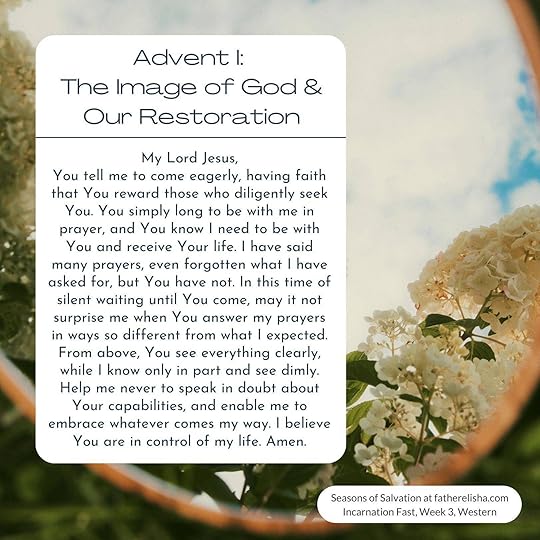
Photo by Katherine St Pierre on Unsplash
The post Incarnation Fast 3 (Western) Advent I: The Image of God and Our Restoration first appeared on Father Elisha: Let me take you on an intriguing journey..