Haidt Triggers Thought about Morality
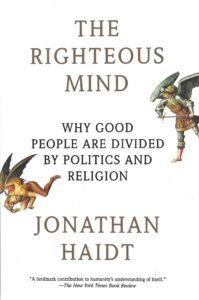
Jonathan Haidt. 2012. The Righteous Mind: Why Good People are Divided by Politics and Religion. New York: Random House.
Review by Stephen W. Hiemstra
The idea that truth is anchored in the transcendence of God has fallen on hard times in a world where it’s your truth and my truth. Relativistic ethics, which used to be a way-out-there idea, has gone mainstream, leaving people confused and confrontational. What’s really going on?
IntroductionIn his book, The Righteous Mind: Why Good People are Divided by Politics and Religion, Jonathan Haidt writes: “This book is about why it’s so hard for us to get along.” (xviii) He goes on to explain: “I’ll show that religion is (probably) an evolutionary adaptation for binding groups together and helping them to create communities with a share morality.” (xxii) The word religion suggests that his focus is on human institutions, not on theology, which focuses on God.
Haidt organizes his argument and his book around three principles:
Intuitions come first, strategic reasoning second. (xx)There’s more to morality than harm and fairness. (xxi)Human beings are ninety percent chimp and ten percent bee. (xxii)Haidt employs an analogy of an elephant (intuitions) and rider (strategic reasoning) that primarily serves the elephant. He likens the righteous mind to a tongue with six taste receptors. The chimp is selfish while the bee is groupish. Haidt builds his arguments around these core principles/metaphors and his writing focuses on empirical studies that support these concepts.
Background and OrganizationJonathan Haidt received his bachelor’s degree from Yale University. His master’s and doctoral work are from the University of Pennsylvania. He did postdoctoral work in cultural psychology at the University of Chicago. He has written a number of books. He is currently on the faculty at New York University in the Stern School of Business. I previously reviewed his book, Anxious Generation.
Haidt writes in twelve chapters, preceded by an introduction and followed by a conclusion, references, notes, and an index. He writes:
PART I: Intuitions come first, strategic reasoning second
Where does morality come from?The intuitive dog and its rational tailElephant’s ruleVote for me (Here’s why)PART II: There’s more to morality than harm and fairness
Beyond WEIRD moralityTaste buds of the righteous mindThe moral foundations of politicsThe conservative advantagePART III: Morality binds and blinds
Why are we so groupish?The hive switchReligion is a team sportCan’t we all disagree more constructively? (ix)Haidt’s writing standards out because he pays close attention to empirical studies that support his arguments. A major contribution of this work is that he organizes recent thinking on moral psychology into a coherent narrative.
Elephant and RiderHaidt summaries the relationship between the passions (elephant) and reason (rider) as follows:
“I have argued that the Humean model (reason is a servant) fits the facts better than the Platonic model (reason could and should rule) or the Jeffersonian model (head and heart are co-emperors).” (79)
He goes on to elaborate saying: “The rider evolved to serve the elephant, but it’s a dignified partnership, more like a lawyer serving a client than a slave serving a master.” (79)
It seems odd that Haidt ignores the more ancient distinction between Greek anthropology (head and heart are independent) and Hebrew anthropology (head and heart are interdependent). If one adds the doctrine of original sin, then Haidt’s analogy of elephant and rider is anticipated by about two thousand years. It is only through the intervention of the Holy Spirit that reason prevails over emotion where Haidt’s rider gets the upper hand.
Consider the Apostle Paul’s statement:
“For I know that nothing good dwells in me, that is, in my flesh. For I have the desire to do what is right, but not the ability to carry it out. For I do not do the good I want, but the evil I do not want is what I keep on doing.” (Rom 7:18-19 ESV)
If you equate the flesh with passion and the law with reason, the argument is the same. The elephant prevails over the rider in the absence of divine intervention.
Taste Buds with Six ReceptorsHaidt’s caution about morality being more than harm and fairness leads him to talk about six taste receptors. In other words, the passion for fairness is a simplification of traditional morality. Here we find another theological parallel in a postmodern heresy to limit the image of God to the single dimension of love.
Haidt, as a cultural Jew, is no doubt familiar with God’s self-revelation to Moses after the second giving of the law:
“The LORD passed before him and proclaimed, The LORD, the LORD, a God merciful and gracious, slow to anger, and abounding in steadfast love and faithfulness.” (Exod 34:6 ESV)
If love is but one attribute of God, then limiting our discussion of God to that one attribute necessarily leads to a partial revelation and, by analogy, to a moral compass that is seriously out of adjustment.
The fall of communism provides a political analogy. Marx defined value as limited to the contribution of labor—he defined capital as simply dead labor. The economic weakness of communism therefore arose as communist countries underinvested in capital, dissipating saving through provision of additional benefits to labor. With the passage of time, this underinvestment led to the stagnation of labor productivity and the ossification of industry. The Iron Curtain eventually fell because the economy could not support the vast military needed to support communist rule. Defining value as only one attribute—the contribution of labor—eventually led to an inability to compete with the multiple dimensions of value (labor, management, and capital) working in capitalism.
Chimps and BeesFollowing Darwin’s hypothesis of natural selection, Haidt writes: “When groups compete, the cohesive, cooperative group usually wins.” (224) He posits that the key adaptation that gave homo sapiens an advantage over other humanoids was shared intentionality, which led to the development of language (237-240). Haidt writes:
“While foraging, one person pulls down a branch while the other plucks the fruit, and they both share the meal. Chimps never do this…When early humans began to share intentions, their ability to hunt, gather, raise children, and raid their neighbors increased exponentially.” (238-239)
Haidt describes humans as ninety percent chimp (selfish) and ten percent bee (groupish). “Bees construct hives out of wax and wood fibers, which they then fight, kill, and die to defend.” (240) Haidt goes on to discuss at great length the events that the hiving behavior, things like group singing, dancing, and marching.
AssessmentJonathan Haidt’s The Righteous Mind: Why Good People are Divided by Politics and Religion is an amazing book that will force you to think, even if you draw different conclusions from the empirical observations presented. Pastors and others interested in apologetics will want to be aware of his arguments.
Footnoteshttps://en.wikipedia.org/wiki/Jonatha....
Haidt Triggers Thought about MoralityAlso see:Haidt Analyzes Pervasive Mental IllnessGoleman: Emotional Intelligence Brings LightBooks, Films, and MinistryOther ways to engage online:Author site: http://www.StephenWHiemstra.net Publisher site: http://www.T2Pneuma.com Newsletter at: https://bit.ly/prep_25, Signup
The post Haidt Triggers Thought about Morality appeared first on T2Pneuma.net.