
Send in the Genius: Stephen Sondheim
This article also appears in the September-October issue of the Library of Congress Magazine, which is primarily devoted to Stephen Sondheim’s collection coming to the Library. The cover story contains more detail.
It was late in rehearsals for “A Little Night Music,” and Stephen Sondheim had yet to write the show’s penultimate song. The male lead was to sing it during a scene with an ex-lover, explaining why he couldn’t leave his still-virginal wife and rekindle his relationship with her. But director Hal Prince determined the song should instead be for her.
Sondheim attended a rehearsal of the scene, directed to reveal the change in focus. He was convinced. Afterward, Sondheim and Prince retired to a bar to discuss it; Sondheim took notes, then went home to write the first chorus. The next day, he played it for his collaborators and with their blessing completed the song that night — possibly the fastest Sondheim ever wrote a song.
By this time, he knew the show intimately and, more relevantly, the strengths and weaknesses of actress Glynis Johns, who would sing the new song. She had a light, silvery voice but couldn’t sustain long notes.
This led to a song of short phrases that suggested a series of questions: “Isn’t it rich? Are we a pair?” And because the character Johns played is an actress, the song included lines like “Making my entrance again with my usual flair/Sure of my lines.”
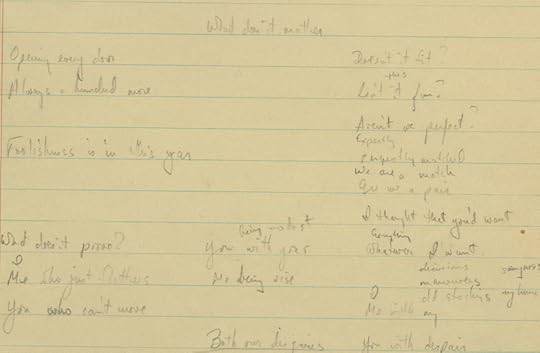 Sondheim sketched out an early draft of “Send in the Clowns” lyrics in longhand, trying different lines and words. The pattern of short questions is developing on the right hand side.
“Send in the Clowns,” written in about 24 hours, ironically became Sondheim’s most famous and oft-recorded song, with well over 400 covers. Judy Collins’ recording of it won a Grammy, as did Sondheim for song of the year. Since then, it has been performed and recorded in almost every style imaginable (including a disco version by Grace Jones).
Because of the speed with which it was written, Sondheim made far fewer sketches for the song than for almost any other song. But what is there is deep and rich, including three dense pages comprising an interior monologue — the characters’ subtext — and two pages of monologue with the character expressing her reasons and arguments to him.
Subscribe to the blog— it’s free!


Library of Congress's Blog

- Library of Congress's profile
- 74 followers

