
ISAAC’S STORM by Erik Larson
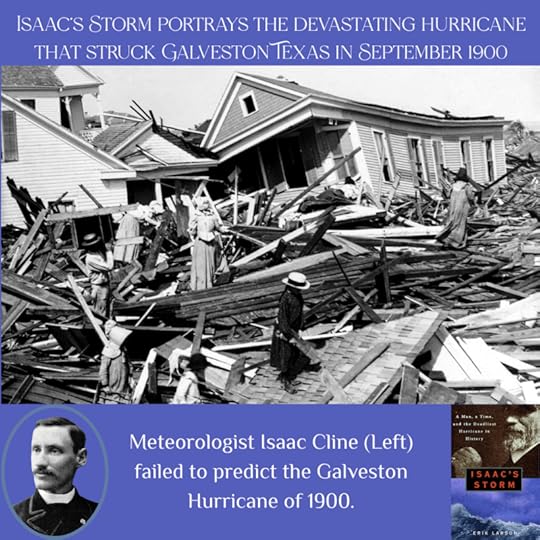
In his 1891 monograph, meteorologist Isaac Cline (1861-1955) claimed that the thought of a hurricane every doing serious damage to the port city of Galveston Texas was “a crazy idea.” How tragically wrong he proved to be when, nine years later, on 8 September 1900, Galveston was destroyed by a hurricane.
Even though ISAAC’S STORM is a work of fiction, author Erik Larson is too good a writer not to put this tragedy into context. Not only does he gives us a brief history of meteorology (a history that stretches back to Ancient Greece and beyond), but he also tries to provide us with a glimpse into the mindset of Victorians, and men, in particular. In 1900, the United States was still a young country, filled to the brim with confidence. Of course, this confidence veered into overconfidence all too often, as can be seen from Isaac Cline’s statement above. Victorian men did not ever want to feel that they were wrong. If they were actually wrong about something, their course of action was to dig their heels in. They were also closed-minded about other cultures. In the case of Isaac’s superiors at the Weather Bureau, this meant that any information from Cuban meteorologists was to be blocked. This also, proved to be a tragic mistake, because the Cubans, who were much more used to hurricanes than the Americans, were actually better meteorologists. They actually predicted the hurricane that struck Galveston. By contrast, the citizens of Galveston were told, that morning in September 1900, that the weather was going to be “pleasant” with “increasing winds”. There was nothing, nothing to indicate that a dangerous hurricane was approaching.
And so, the Galveston hurricane has remained the worst natural disaster in US history. Out of a total population of 37,000, Galveston may have lost as many as 8,000 people that day, about one-fifth of its population.
Erik Larson makes this tragedy personal, by portraying it through the relationship between Isaac Cline and his younger brother Joseph. Joseph also was a meteorologist, working at the Weather Bureau. But, at nine years younger, he was Isaac’s subordinate. This not only meant that he earned less money, but that his opinions were not respected in the same way that Isaac’s were. This proved to be yet another tragic mistake as it was Joseph, not Isaac who correctly predicted that a devastating hurricane was coming.
However, Isaac was punished by the scale of his loss. Unlike his brother Joseph, who was an unmarried man, Joseph had a wife and three daughters with another on the way. Isaac nearly drowned, and was only able to save one of his daughters, the youngest Esther Bellew. Joseph managed to save the two older daughters Allie May and Rosemary. But Isaac’s wife Cora disappeared. It took over a week, but her body was finally discovered in the ruins of his house.
Strangely enough, Isaac was promoted and his pay increased not long after this fiasco. By contrast, Joseph was demoted and his pay decreased. To be fair, Joseph had refused an assignment on the grounds of ill health, while Isaac left Galveston with the Weather Bureau, when it moved to New Orleans.
But it still remains a puzzle as to why Isaac was promoted, when his actions (or rather lack of them) were responsible for so many deaths. Reading between the lines, we can imagine that one of the reasons why Isaac may have been so successful was his personality. He comes across as a genial colleague, someone who was a good team player. By contrast, Joseph was much more confrontational. It also didn’t help that he was a high-maintenance person who constantly complained about his health. The brothers differing treatment, as well as their differeing predictions about the storm, caused a permanent rift. After Isaac left for New Orleans in 1901, the brothers never spoke again.
If you have never heard about the Galveston hurricane, and enjoy historical fiction, I highly recommend this book, which is extremely well-researched and well-written.
 The post ISAAC’S STORM by Erik Larson appeared first on Cynthia Sally Haggard.


Cynthia Sally's Blog

- Cynthia Sally Haggard's profile
- 129 followers

