
Writing Tip Wednesday: Putting a dog in the book? Pros & cons
There’s some sage — or not so much — writing advice that if you want to make a character likable, give him a dog.
On the other hand, once you give a character a dog, if it’s not just a one-shot deal.You have to remember there’s a dog and tend to it.
Considering putting a dog in your book? Consider the following tips.
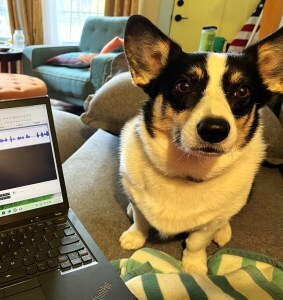
My new dog Willow reminds me that it’s impossible to work without a break when you have a dog to remind you that it’s time to do something. What, though, is not always clear.
Putting a dog in a book is a lot like putting one in your life, I’ve been reminded recently. I’ve acquired a dog after being dogless for more than a decade. I wasn’t really looking for one, but she’s here anyway. In the meantime, I’m working hard [way behind] on my fifth Bernadette “Bernie” O’Dea mystery and have to keep remembering to get her friggin’ dog into the book in a way that’s not just a distracting detail.
Dogs are different than cats, both in life and in writing. Cats can be around, doing their thing, without taking up a lot of space or attention for the most part. I never worry about what to do with the cats in my books [Bernie has three].
Dogs are THERE. All the time. They make their presence known. Few decisions can be made without considering how the dog fits in. What to do with her if you go away. How to fit in interruptions if you’re sitting there writing all day, because she just isn’t going to entertain herself, like the cats do. Being sure to put your plate of crackers or even the little thing with milk for the coffee up high if you get up, even for a second, because she’ll be right on it otherwise. Figuring out what she wants, since if you don’t, she’ll keep staring at you until you do. And then start barking. Insistently. While staring at you like you’re the biggest dummy in the world.
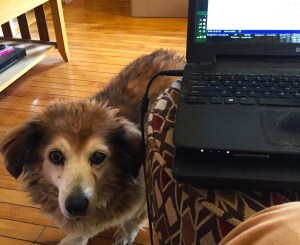
My dog Emma was a master of the baleful stare while I was trying to write, a job she took seriously even into her 16th year, when this photo was taken.
I hadn’t forgotten that you can’t have that first coffee in the morning without bringing the dog out, no matter what the weather. I hadn’t forgotten that you can’t go to bed at night before bringing the dog out for one last peepee and poopoo, no matter the weather or how tired your are or if you’re in your PJs [which I almost always am]. I HAD forgotten that baleful stare, perfected by my dog Emma, when I was trying to work and she wanted me for something. She was a corgi-sheltie-beagle mix who took her role as supervisor of all I did seriously. Not only watching when I did any kind of task, but also herding me by poking my calves with her nose any time I went into the kitchen. I’m pretty sure she wanted to make sure I found the food all right. Watchfulness would change to baleful stare if she wanted to go outside, or thought I should be preparing some food that she could help with.
In the first book in my series, Cold Hard News, I gave a bad guy a very likeable dog, based on my own dog Dewey. It wasn’t just the old saw that an easy way to make an unlikable character more likeable was to give him a dog. It was also the lesson learned from my long newspaper career — nothing sells papers like a photo of a dog on the front page. Not that my book cover would have a dog, or anyone would even know he was there without reading the book. Still, burned in my brain is DOG=ENGAGED READERS.
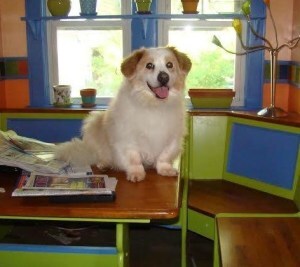 No dog was more likable than happy, laughing Dewey, my corgi-Australian shepherd mix who never met a person he didn’t like.
At the end of the book, [SPOILER ALERT!] I couldn’t just let the dog go, so I had Bernie acquire him. I vowed though, that the dog would have to be part of the mystery in each book. Not a big part, but would have to carry his weight and not just be some tedious [for readers and for me] detail that Bernie was letting in, letting out, walking, trying to keep her rigatoni from, etc.
Similar to a lot of other things to do with writing mysteries, figuring out how the dog fits in is both fun and a bother. Now on the fifth book in the series, I have a post-it on my book outline whiteboard [a writing tip for another day] that just says “DOG.”
I once read a fantastic Ruth Rendell book in which someone volunteered to take care of someone else’s dog, then seemingly forgot all about it. I wondered if the usually reliable Rendell had, too. It was really distracting. I won’t spoil the book, but it’s yet another lesson about putting a dog in your book.
It was a lesson to me, too. At an author event once, a reader was very concerned that in my second book, No News Is Bad News, when Bernie had to get back home after spending the night somewhere else, she didn’t mention the dog as one of the reasons she had to leave. Nitpicky? Yeah, I guess. But I admit, if I were a reader it would’ve bugged me too. When Dubby “disappeared” for a while in my third book, Bad News Travels Fast, it seemed to bother readers more than the horrific things happening to the book’s humans. At least if emails and comments from readers were any indication.
Dubby began as the “make a character likeable” thing. His name was originally Dubya — dubba ya — a nickname for George W. Bush. A tangent, so if you want to know more, read the book. Bernie, got tired of explaining how to pronounce it and what it meant as years passed, so in between the third and fourth book she changed it to Dubby. I was having the same issue, so I thought that was a good call.
Including a dog as a way to enhance character doesn’t always have to be simply to add likeability. A secondary dog character, Heidi, popped into my third book because I thought her owner, the fire chief, needed her. He’s already likeable as hell, but it was more a way to show some depth to his character. She’s his therapy dog, but he keeps that to himself more or less,
Don’t forget about the dog’s character, either. I’ve had three dogs as an adult, and they’ve all had wildly different personalities. Your dog-owning readers won’t buy the dog if it’s just a bland barking, sniffing and peeing thing. Dubby is happy-go-lucky, often in contrast to his owners. He’s pretty much my long-gone dog Dewey. Heidi is a German shepherd who looks like she’s fierce and in charge, but is a training school flunk-out with a big and anxious heart. When Bernie’s dog is missing, she asks Sandy if Heidi could track him down. “If he was standing right in front of her with a salami in his mouth,” Sandy answers.
I know this is a long “tip,” but, to sum up:
Yes, if you think it’ll help with character development, give a character a dog. I know people I meet when I’m out and about seem to like me better when I have one with me. But it doesn’t just have to be for “likeability.” Just be sure you understand and fully develop the reason the dog’s there.If you put a dog in your book, be sure to give it a job to do beyond the character development. Don’t just leave it there wanting its walkies. Dogs, both in books and real life, can cause problems when they’re left to their own devices. The more thought that goes into the dog’s role in your book, the more useful it is, the better.Give the dog a personality, or it won’t ring true.Don’t forget about the dog! Readers won’t.Finally, and probably the most important: It’s a mystery novel. Kill all the people you want. But never ever ever ever ever kill off a dog [or cat] in your book.A dog can be a very good thing, both in life and in a book. A dog that’s ignored or not given a role, though, won’t be happy in real life. In a fictional world, it’s the book istelf, and its readers, who won’t be happy. Write one in, but for the sake of all that’s important, don’t ignore the dog.

A happy dog.
And a reminder: Someone who leaves a comment on one of our posts this month will win a bundle of cozy mysteries. Comfortable reading the long, cold winter.


Lea Wait's Blog

- Lea Wait's profile
- 509 followers

