
They, Them, Ze, Zir and You Guys
Blog Nov 2025. Jule Selbo
INFO on FREE BOOKS at the end of the BLOG, you guys!

Hey, you guys. This is a relatively ‘old’ scholarly reflection (the topic became kind of big in the early 2000s), but I still find it interesting to ponder when I trip over it…
Do you guys remember a NY TIMES article by Audrey Bilger, the president of Reed College? She put this debate on the map in 2002 and ended her opinion with an influential WE MUST STOP THIS!!!

She called out against using ‘you guys’ as a term of address for women, writing that calling women ‘guys’ makes femaleness invisible. I paraphrase her opinion a bit: ‘Oprah says it. The cast of Friends say it, my yoga instructor says it, as do my students. But is it a good thing? Should we use ‘you guys’ to refer to a mixed gender group or as a term to refer to a group of women?
Why, Audrey Bilger asks, if one guy is clearly ‘male’ and two or more guys are male, why/how does the plural become, for the most part, gender neutral?
What do you prefer? What is preferable when referring to a group or duo of mixed gender?
What are you guys doing over the weekend?What are you all doing over the weekend?What are you folks doing over the weekend?What are you people doing over the weekend?What are you two (three, four or twelve or…) doing over the weekend?Why do we care? Do we?
A linguist named Steven Clancy noted (around 2001) that ‘male’ terminology such as ‘you guys’ has a tendency to catch on, whereas ‘female’ terminology doesn’t. It’s acceptable for us to refer to a group of women as ‘you guys’ but we don’t refer to a group of men as ‘you gals’ (unless it’s a joke or derogatory).
American television has made the use of ‘guys’ to include two or more in all genders acceptable and of normal usage is many foreign countries. Most people around the world now accept it as gender neutral.
And, you guys, as we all know, gender itself is a bit of a hot topic. Referring to gender, we can get dinged, we want to get it right. How we use it, report it, live it —is a hot topic.
A linguist prof in Britain (Emma Moore) wrote that it was from the 18th century onwards that people started using male pronouns when describing someone of a non-specific gender in writing and this marked the time when opinions on what pronouns should be used started to change. The prof explained: “You might have a sentence like ‘if a student comes to see the teacher, he must bring his homework’, where he is supposed to refer generically to males and females…However, there are lots of psychological studies that show when people hear that generically, they don’t hear it as gender neutral – they do just think about men.”
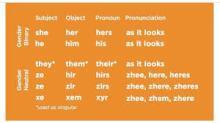
Remember the use of ze/zir? They were neopronouns to be used for he/him and she/her. Ze as the subject and zir as an object or a possessive. Zeself and Zirself were to be used as reflexive. I have yet to see this in the crime mystery books I read. Has anyone?
So you guys, as we know, the word ‘they’ seems to be doing a lot of heavy work now.
We writers (some of us) spend time (perhaps too much time) thinking about what words we want to use to make our craft/art accessible, clear, and enjoyable. Who has tried to write using only ‘they’, ‘their’ and ‘them’. What problems were encountered?
AI search states: The American Dialect Society named the singular “they” the word of the year in 2015 and again in 2019.
So, I guess someone cares. (I didn’t even know there was such a thing as A WORD OF THE YEAR.)
Dictionaries note the prominent role of ‘they’ in modern language. AI Overview states: The use of ‘they’ as a singular, gender-neutral pronoun has not (as some expected) gone out of style; it has become widely accepted in modern English for both generic and personal use. It’s formally accepted as a standard pronoun for referring to individuals whose gender is unknown, irrelevant, or non-binary.
Well, you guys, it is sort of nice (IMO) to be able to use ‘they’ or ‘their’ for singular reference. “The winner can come collect their prize.” I tend to find it the awkward to use the ‘his or her’ or “his or her or their” prize. It gets harder (IMO) in crime mystery genre if we write: ‘They will arrive at the prison, to serve their time for murder…’ when we need to make it clear it is ONE person. So as an example, some of us will revert to using NAMES of characters and avoid (or drop) possessive pronouns: Bill will arrive at prison, to serve time for the murder…
I am wondering: what publications are using this wordage: Ze arrived at prison, walked by zeself past zir and smiled.
I would expect there are publications with ze and zir are out there but they have never crossed my path.

I have screenwriting students who twist their minds into shredded biscuits trying to make their work clear – after all screenplays are considered ‘blueprints’ for production— thus costumers, make-up departments, casting departments et al are doing quick reads to set out the basic needs for a production. The ‘they’ pronoun doesn’t give them quick reference. I point it out once to my students (understanding it is a bias I have) and then let them choose their own pronouns. The Hollywood industry gives this advice: Prioritize clarity: If using “they” for a character, make sure the context is clear to avoid confusing the reader. For example, instead of writing “They enter,” write “Hazel enters” … “They drink the potion and collapse” write “Jim drinks….” even if it’s been established that Jim is the only person in the room… (then no one has to go back and re-read to get the information.
In the crime mystery genre, getting a review that a book is a page-turner or a fast-read is usually considered a good thing. Does using ‘they’ or ‘them’ to refer to singular entities or ‘the guys’ or ‘you guys’ harm that ability to ‘fast-read’? Because our brains aren’t used to it? Or because we tend to use genders of our antagonists/protagonists/supporting characters in such a way to make some kind of point or to initiate more conflict?

But, you guys (back to the ‘you guys’ article I happened on that got me thinking about this again) – the reading that started this train of thought: The novelist Alice Walker (The Color Purple, Meridien and more) was also interested in ‘you guys’ usage. She said use of the term to refer to women reflected a “fear of being feminine.” Give this a watch if you have time… it’s short:
https://www.youtube.com/watch?v=yqvHXYcN0xc
Audrey Bilger, the universal linguist and literature professor (as reported before, also President of Reed College in Oregon) that I enjoy reading – after she wrestled with the idea of shrugging off the importance of the use of ‘you guys’ as referral to any gender in a group, came to agree with Alice Walker. But Alice also wrote, at the end of one of her (their, zir) essays: “From my observation of the speech patterns of girls and young women — including my daughters and students — I think ‘you guys’ is a horse too far out of the barn to be roped back in.”
Yes? No? Who cares?
Would love to hear – and all who comment are eligible for free crime mysteries!
Best to you all – Jule


Lea Wait's Blog

- Lea Wait's profile
- 509 followers

