When can you call yourself an expert?
My son Josh is planning to go to medical school after completing his undergraduate degrees. To this end, knowing that clinical experience bodes well on a medical school application, he spent the summer doing an EMT (Emergency Medical Technician) certification so he can clock clinical hours working as an EMT on weekends and summers.
He got through all the online learning components of the certification, then planned to take the in-person hands-on exam in December.
Josh told me right before we went on a trip to California that he can’t wait until the time he can raise his hand when the flight attendant asks “Is there a doctor or medical professional on board?”
As fate would have it, on our flight from Phoenix to Oakland, the passenger sitting right next to my daughter Angie passed out and fell into the aisle. (Don’t worry — she recovered).
The flight attendant picked up the microphone and said “Is there a doctor on board?”
I looked back at Josh and smiled at him. I could tell he was fidgeting in his seat as he waited to see if anyone ran back to help the passenger.
Thankfully, there were both a doctor and nurse on board who took good care of the patient.
When we all filed out of the plane I looked at Josh and asked “How hard was it to not raise your hand to help?” Josh laughed and said “I was going to say:
I have completed the online portion of my EMT certification which means I can’t administer any direct medical aid, but I can observe the other medical professionals! I am certified as a lifeguard, though!
We were doubled over laughing.
There will be a day in the near future when Josh will be able to confidently raise his hand when someone needs medical help on an airplane.
For now, he does not have the proper training to be considered a medical expert.
When can you call yourself an expert?There are some fields, like medicine or law, that have very specific criteria for identifying when and how practitioners can be considered experts.
For many other service based professions, the criteria is more murky. And I think we do ourselves and our clients a disservice by not defining “expert” in a more specific set of ways.
We often jump to defining an expert as someone who has the following kinds of attributes:
Graduated from a prestigious university like Harvard, Stanford or Oxford with an advanced degreeHas decades of experience working in their area of expertise to great critical acclaimHas accomplished extremely difficult things with remarkable results, like scaling a business to a billion dollarsThese are all accurate descriptions of experts.
But it leaves out both other ways to develop expertise, as well as valid claims on the word “expert” that do not involve so much time or professional rigor.
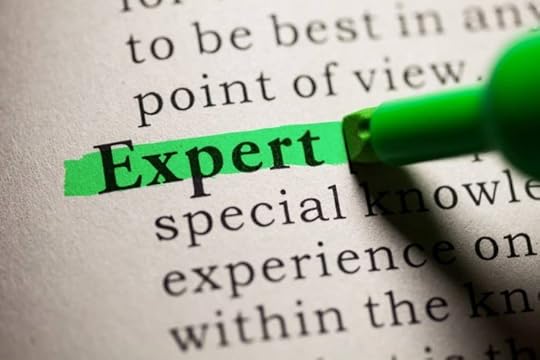
Let’s define “expert”Miriam-Webster defines expert as:
one with the special skill or knowledge representing mastery of a particular subject
Which leads to define the word “mastery:”
a highly developed skill in or knowledge of something
Note in both definitions there is not an indication of where someone learns the skill or knowledge, how they learn it or how long it takes to learn it.
As consumers of services, we have the right to define the specific kind of expertise we are looking for.
If we need brain surgery, we probably want a brain surgeon who went to a rigorous medical school, and who has an excellent history of successful surgeries.
If we want to make more money in our business, is it essential that our coach or consultant went to Harvard or has made $100M?
Maybe or maybe not.
What I think we want is confidence that whomever we are hiring to help us is capable of delivering the results we desire.
3 Kinds of Smarts That Lead to ExpertiseI have a shorthand for categorizing different ways to develop expertise: Book Smarts, Street Smarts and Natural Smarts.
Book SmartsBook Smarts are developed in a very deliberate, rigorous and measurable academic environment. There are some fields that benefit and grow from such rigor, and suffer when they are not in place.
My friend Bob Sutton, Professor of Management at Stanford, recently wrote a great post on LinkedIn about lessons he learned from being a co-founder of the d.school and a fellow at IDEO for almost 20 years, developing the design thinking methodology.
Bob said:
“I believe one of the mistakes we made was to award novices “certificates” in design thinking after three to five day programs without teaching them sufficient humility. All too often, these eager rookies would race off, and in full Dunning-Kruger cry, and launch design thinking projects and classes that were badly conceived and implemented. Their colleagues then concluded “design thinking doesn’t work.” Unfortunately, some participants would then teach one hour design thinking workshops and award certificates. One company trained thousands that way. I asked them, over and over, “can you name a product or service that has been improved with design thinking?” They never could.
Bob cautioned against the same thing happening with AI:
Yet the same “certificate problem” seems to be repeating itself when it comes to AI. Universities and private companies are handing out AI certificates at a blistering rate. And I keep stumbling over folks who use such certificates to brag about, exaggerate, and peddle their new-found “certified expertise.” I bet you do too.
Academic rigor is really important in certain fields, and it can be absolutely worth your time and money to invest in an advanced degree or undertake an academic approach to research if you want to develop expertise in that area.
Life SmartsLife Smarts are developed outside of academic halls, by getting your hands dirty doing work in your field.
I make no claim to fame on Book Smarts. I graduated with a BA in International Service and Development from a tiny experimental liberal arts college called World College West. It doesn’t even exist anymore (it merged with New College, then New College closed). I have never gotten an advanced degree, mainly because I much prefer to learn through practical, hands-on experience.
My learning ground is the work I do every day with clients, conversations and collaborations I have with experts in my field, project debriefs and lessons learned conversations with my team, and voracious consumption of books and podcasts in my field.
Every 5-7 years, I synthesize what I learn in a book.
After 30 years of doing this, I have developed expertise in a number of specific areas.
Natural SmartsNatural Smarts have no correlation with academic training or practical experience.
There are some folks, many of them very young, who just know how to do something really, really well the first or second time they do it.
They are either extremely gifted in the exact skills needed to accomplish the task or old souls hiding in a young body (kidding on that last one).
This can be a 20 year old entrepreneur who dropped out of college and grows a massively profitable software business in 6 months.
They have “it,” which can allow them to claim the definition of expert: “special skill or knowledge representing mastery of a particular subject.”
So when can you call yourself an expert?That’s not my call, that is your job to claim the title that fits how you know yourself. I recommend doing this:
Examine where your expertise comes from: Book, Life or Natural Smarts or a mix of all three.Determine your criteria for feeling confident you can deliver the results your clients desire on a consistent basis. If you meet the criteria, call yourself an expert.Don’t get twisted up around the term “expert.” You don’t have to use it if it causes you stress.The more important consideration for entrepreneurs is: “Do I care about the people I work with and can I help them solve their problems or achieve their aspirations? Am I willing to never stop learning how to do it better?”
Focus on that and you will do great work.