
Jonah Makes a Splash
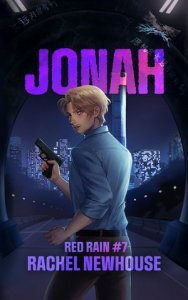 Rachel Newhouse has started the third arc of her Red Rain series with a bang. Jonah is the longest installment yet, and brings back the elements that have made earlier entries in the series top Amazon’s sales charts in their categories: frantic action, suspense, twist after twist after twist, and bombshell revelations dropped in the middle—all carried along by Mrs. Newhouse’s trademark narrative voice, so once I picked up the story I couldn’t put it down.
If you’re just joining the series for the first time … strap in; you may find this story’s takeoff a bit rough. From my perspective as a longtime reader of the series, Mrs. Newhouse seems to me to usually be good about either working any necessary background from previous installments into the narrative, or simply telling the story in a way that your imagination seamlessly fills in the gaps … but she also likes to start many of her stories with, or in the middle of, fast-paced action scenes where any space for explanations has to go to the immediate context before the series context, and that seems to go double for this one.
At the end of Operation Thunderbird, Philadelphia Smyrna (aka Andromeda Nolan)—“naively sheltered pacifist teenage girl” turned “revolutionary figurehead for Jesus”—changed a carefully-orchestrated plan at the last moment, only to find her “Dr. Nic”—her former nemesis turned dysfunctional father figure—being placed under arrest. That’s where we open this story, and things immediately go off the rails for both sides.
Unlike Crook Q and “Prisoner 120518” (which mostly give alternate perspectives of the same events; I recommend the latter “side story” above the former “main entry,” as explained in the linked reviews), however, this doesn’t turn into nonstop action, but rather a suspenseful “slow-motion chase.”
Mrs. Newhouse also uses the increased length to develop some key themes that have mostly been only hinted at before. In particular, characters’ Christian faith has mostly come into previous stories in their mostly-nonviolent resistance to “the United,” supplemented with prayer in moments of crisis and occasionally sensed silent-but-verbal spiritual guidance—but here we get actual extended discussion of spiritual concerns between the characters. (One that doesn’t suggest that any of the characters has any knowledge of pre-twenty-first-century Church history, but still.) And it is primarily on the basis of this new thematic depth that makes me think that this is the first story in this series that, by itself (not one of several in a “reading list,” or as part of an eventual omnibus), could be suitable for a thoughtful in-depth discussion in a book club.
As mentioned above, this story is yet again carried delightfully along by Mrs. Newhouse’s talented narrative voice: once I started into this story, I couldn’t put it down until I’d finished it, and I never felt like it was dragging or slower than it should be. On the other hand, as with “Laodicea”, if it weren’t for the labels above each chapter and the fact that the two point-of-view characters are almost always together (and are on each others’ minds when they are separated), it would have been very difficult to keep track of whose perspective we were seeing things from at any given point in the story. Of course, because Philli and Nic are traveling and working together, and Mrs. Newhouse does clearly mark each chapter with the name of its point-of-view character, this is merely a level of greatness she has not yet reached, not truly a hindrance to enjoyment of her story.
(There were also a couple of places where as a writer, pedant, and “technical” person myself, I tripped over a phrase that made me say, “Did you have to word it that way?” But those were few and far between, and hit “buttons” that I know to be idiosyncratic to me, so I feel they are more indications that I should have taken the time to read the “beta” chapters my Patreon contribution level entitled me to and suggest wording changes then, than anything that any other reader would likely even notice.)
On the other hand, one mark of authorial maturity that this story does illustrate comes at the very end, where to avoid spoilers I will only say there is an instance of what I’m inclined to call “Chekhov’s gun”. Inter-book structure has been a weakness of the series from the beginning, as with almost every installment the series’ scope has grown beyond her previous intention; first it was going to be a standalone novella, then maybe a trilogy (plus a side story or two), then a nine-main-book series, and now “God alone knows …”
Now, “necessity is the mother of invention”—at least in the hands of an author of Mrs. Newhouse’s caliber, at the top of her form—and so she has gotten a lot of mileage out of challenging our and the characters’ perceptions (retconning, except that everything in previous stories remains “canon,” just explained by totally unexpected machinations and other twists that the point-of-view characters didn’t see), and adding great significance to elements that were originally intended as incidental details. But here she has taken a major plot element from the previous book, in which it was conspicuously and surprisingly not used at the crucial moment, and used it now in a way that feels so satisfying I am reasonably confident she planned it this way to begin with. (If not, she’s yet again done instinctively what some great writers take long practice to master.)
I can’t say that Jonah is Mrs. Newhouse’s best work to date, but it’s meeting the high bar set by the last several books in this series, and keeps the series racing forward. I’m looking forward to seeing what happens next (fair warning: this book has perhaps Mrs. Newhouse’s biggest cliffhanger ending yet …).
I received a “free” electronic copy of this book as a supporter on the author’s Patreon.


