
The Lowdown on a Class Action Lawsuit vs. AI
Kaitlyn Dunnett/Kathy Lynn Emerson here. On October 2, I received an email from the literary agency that handles my Kaitlyn Dunnett and Kate Emerson titles. The subject was the proposed $1.5 billion dollar settlement of a class action lawsuit case against Anthropic for using copyrighted novels to train AI without permission from the authors or publishers. I’d joined this class action months earlier, but without much hope of seeing any money out of the deal, especially after it was announced that only books that had their copyright filed with the copyright office would be included in the settlement. Anyone can add © to the copyright page of a book, and that has its uses, but in legal proceedings like this one, protection against “copyright infringement” only extends to those who have also completed all the paperwork. For novelists who are traditionally published, the publisher handles this . . . or not. Not is more common than one would think. I wrote sixty-four traditionally published books, some of which had reprint editions with other traditional publishers. As a result, I found eighty-two entries under three names on a list of books pirated for AI training. I had serious doubts that many of them were protected beyond the insertion of a © symbol.
Anyway, getting back to the letter. It was full of helpful suggestions for finding out if my books were included and how to proceed if they were, keeping in mind that this is a deal not yet approved by the court. That won’t happen until April, after all the claims are in, and there could still be an appeal. The deadline to file a claim is March 23, 2026, and each eligible “Work” on the “Works List” will be entitled to a share of settlement monies. If the “work” is still under contract, the publisher is co-rights holder and the payment for that book is split 50/50. If rights have reverted, the author gets 100% of the settlement amount. What that comes to in dollars will depend on how many people file claims and for how many titles, but the estimated payout looks to be the rough equivalent of what a mid-list author like me might expect to see from a sub-rights sale such as an audio-book, large print, or book club edition.
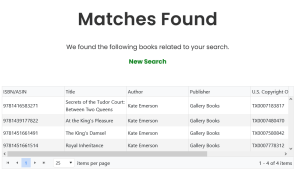
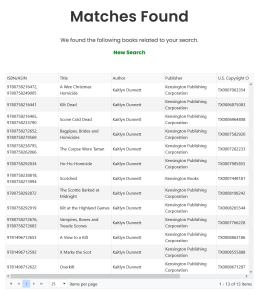
So, not expecting much, I followed the link to the Works List and typed in “Kate Emerson” to search. Four out of the six titles I published with Gallery Books were there. Why the other two aren’t, I have no idea. Then I checked “Kaitlyn Dunnett.” Although the publication dates overlap, none of the Deadly Edits mysteries are covered, but all thirteen of the Liss MacCrimmon Mysteries were copyrighted. Even with Kensington getting 50%, that will be a nice income boost.
Then came the big question: did any of my many former publishers file copyrights on books that have reverted to me? I typed in “Kathy Lynn Emerson” and pretty much stopped breathing when the results came up. I believe my last words before my head exploded were “Holy crap!”
That list contained sixteen of my books.
Before I get into how complicated it is to put in a claim, there are a couple of anomalies worth mentioning. Of the five books I wrote for Harper Monogram, only one is on the list. Of the three I wrote for Harlequin/Silhouette, only one, of the six I wrote for Bantam Loveswept, only one. Many writer friends who published primarily with category romance publishers, have been cut out of the settlement entirely because no copyright paperwork was filed. On the other hand, St. Martin’s, who published the first seven Face Down Mysteries, copyrighted them all. Of my small press publishers, Pemberley Press copyrighted the four Diana Spaulding 1888 Mysteries and Crippen & Landru copyrighted the collection of short stories I wrote for them.
So now what? The website that lists eligible books also has a handy FAQ page and links to the form that needs to be submitted and to instructions for filling it (them) in. For those books with a 50/50 split it’s very easy to file claims, and more than one book can be listed on a single form (thank goodness!) but for the others? Keep in mind I am not complaining. In a couple of cases, the settlement amount is likely to be more than that book has earned to date. But there is a lot of jumping through hoops involved. For each of my sixteen Kathy Lynn Emerson titles I have to prove that the rights reverted to me by sending the relevant paperwork (contract or reversion letter or other proof) and in a couple of cases the publisher listed is not the one I had the original contract with and who (I assume) filed the copyright. I have no explanation for this, but it means supplying more paperwork to prove I have all the rights back. The form I have to fill out is daunting in itself, not least because it requires careful typing of a each ISBN and each U. S. Copyright Office number. Let’s just say it’s a good thing they’re allowing almost six months to file. Otherwise my head really might explode.
I had a couple of questions as I was going over what information to gather, so I sent an email to the info link listed at the settlement website as the place to send questions. I got a fast reply. Unfortunately it was an automated response with answers to FAQs and giving no indication that anyone would actually reply to my very specific questions. I’ll either have to figure the answers out on my own or use the phone number listed on the website to contact a lawyer being paid by the settlement to answer questions. After the email response, I foresee being put on hold for hours before being cut off without talking to a human being, but we shall see.
I’m hoping this information is useful, or at least interesting, to folks who read this blog. Fellow writers, check the list if there’s any chance your books might be on it. But even more importantly, check the copyright status of your titles. If your publisher didn’t register the copyright, you can do it. I don’t suppose another situation like this one will come along anytime soon—thousands of books illegally used to train artificial intelligence is pretty over the top—but you never know when having a legal leg to stand on could turn out to be important.

Kathy Lynn Emerson/Kaitlyn Dunnett has had sixty-four books traditionally published and has self published others. She won the Agatha Award and was an Anthony and Macavity finalist for best mystery nonfiction of 2008 for How to Write Killer Historical Mysteries and was an Agatha Award finalist in 2015 in the best mystery short story category. In 2023 she won the Lea Wait Award for “excellence and achievement” from the Maine Writers and Publishers Alliance. She was the Malice Domestic Guest of Honor in 2014. She is currently working on creating new editions of her backlist titles. Her website is www.KathyLynnEmerson.com.


Lea Wait's Blog

- Lea Wait's profile
- 507 followers

