Nina Munteanu: Revisiting “Through the Portal Anthology”
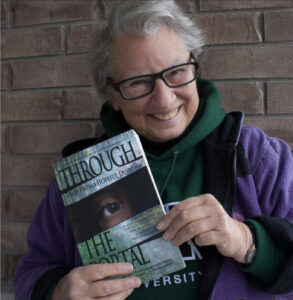
An Interview with Nina Munteanu: Revisiting “Through the Portal Anthology”
Ten months ago, on my Dec 2, 2024 post, I interviewed Nina Munteanu on the anthology she and co-editor Lynn Hutchinson Lee worked on with a release date with Exile Editions of December 31, 2024. Through the Portal: Tales from a Hopeful Dystopia is an eco-fiction anthology of over 30 stories that explore strange new terrains and startling social constructs, quiet morphing landscapes, dark and terrifying warnings, and lush newly-told folk and fairy tales.
Simon: So, Nina, tell me what’s new with it. Has it made the New York Times Bestseller List?
Nina: No! Not New York. But it has made it on a bestseller list in Edmonton. It also picked up a few awards and has been featured in several bookstores and events. The whole concept of hopeful dystopia, particularly in eco-fiction, is catching on and generating some dialogue. Reviews and praise for the anthology have been wonderful.
Comments by judges of the BC Writer’s Award, which Portal won, include: “Every story here is a delicious short gem.” “An ambitious project with an unusual slant of positivity in the face of a dystopian future has turned into a solid piece of work, incorporating a good range of stories, some very literary and abstract, others simple tales of destruction and regrowth or the hope of regrowth.”
The Seaboard Review says: “Many of the stories explore the power of connection, and the potential ways we might heal the land and ourselves…By showing us what we stand to lose, these stories offer a reason to increase our actions to preserve the planet… Will ingenuity, love, and respect for the earth help us work through whatever changes might lie ahead? Through the Portal offers hope that these qualities, if not enough in and of themselves, will help us find our way.”
Dragonfly.eco called Portal, “a stunning collection of short stories and poetry that address our most existential concerns.”
One Goodreads reader, who appreciated being introduced to the term “solastalgia” by the anthology, said that “this book will make you think, cry, and also laugh.”
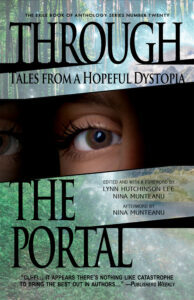
Screenshot
Climate Fiction Writers League also interviewed Lynn and I on the process of curating a collection like this with such a strongly defined narrative that for some might appear contradictory: hopeful dystopia.
Simon: On that note, how does one reconcile that apparent contradiction? Isn’t a dystopia all doom and gloom? Where’s the hope?
Nina: I suppose you’re right, Simon; many dystopian narratives take place in some awful doomy kind of place or situation or some apocalyptic world filled with wretched creatures. Catastrophic disasters. Insidious corruption and ruin. Totalitarian government ‘utopias’. A broken biosphere. Pretty gloomy stuff. The hope comes with moving through it, how that scenario is treated by characters and what characters (or readers) learn from it. Hopeful dystopias tap into the human spirit of ingenuity, compassion and healing. Here’s what the book jacket says: Hopeful dystopias are so much more than an apparent oxymoron: they are in some fundamental way the spearhead of the future—and ironically often a celebration of human spirit by shining a light through the darkness of disaster.
Simon: This isn’t the first anthology you’ve edited, is it?
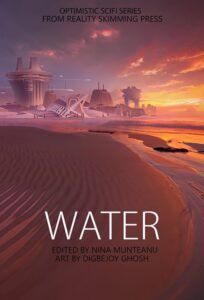
Nina: You’re right, Simon. I also edited a small collection of short stories for Reality Skimming Press called Water. I’m rather proud of that little book, given its theme and the incredible writers who contributed.
Simon: Now that you’ve had a few anthologies under your belt, what advice would you give to potential anthology editors?
Nina: I would suggest reading Lisa Timpf’s recent article on JaneFriedman.com. The article provides advice and insights on anthology editing gleaned from interviews with me and several other anthology editors; it has a lot of great advice including what the job entails, required skills, and the payoffs. My take home advice for potential anthology editors is: find a theme that you feel strongly about, remain flexible and ready to compromise with submissions but keep true to the theme and meaning of the anthology. Don’t waver, or you and the anthology will suffer for it. Like a good novel with meaning, every anthology tells a story too.
Simon: Are you working on a writing or editing project now?
 Nina: Yes, it’s the same one I was working on last year—I’m not nearly as prolific as you, Simon! The book I’m writing is a dark eco-fiction novel about how Nature echoes our own misconducts and deceptions, a kind of karma-Zen exploration that edges into eco-horror. I’m happy to say that it is almost finished and I expect to pitch it to my publisher by end of the year.
I’m also still coaching writers to publication. I have several clients I’m working with now and thoroughly enjoying the various projects they’re sharing with me. Anyone interested can look me up at NinaMunteanu.me, where they can find information on my coaching as well as weekly articles on writing.
Simon: Where can readers find you and your work otherwise?
Nina: On social media, I’m on Bluesky and LinkedIn. Readers can also find my articles on writing, publishing and ecology on various sites, including my own sites TheMeaningOfWater.com and NinaMunteanu.me. Most of my books can be found on Amazon. You can find several of my short stories on Metastellar. The anthology Through the Portal: Tales from a Hopeful Dystopia is available at a number of booksellers, including Amazon, and through the publisher site Exile Editions.
Simon: Thanks, Nina!
Nina. My pleasure, Simon.
The post Nina Munteanu: Revisiting “Through the Portal Anthology” appeared first on Simon Rose.