AROUND THE WORLD WITH VIRGINIA CAMPBELL
AROUND THE WORLD TO SCENT-SATIONAL PROVENCE, FRANCE!
BY VIRGINIA CAMPBELL
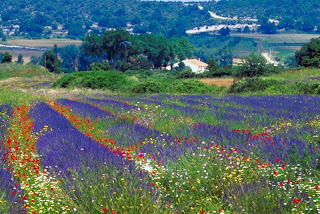 PROVENCE! Just saying the word conjures endless fields of sunflowers, the scent of lavender wafting though a breeze, beautiful clear skies, charming medieval villages, regional food, the azure of the Mediterranean and wonderful culture.
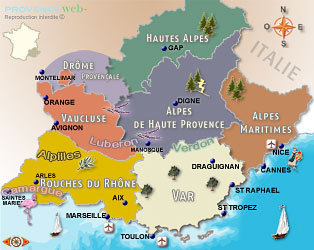
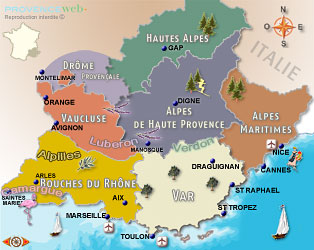
It is easy to understand why so many famous artists, including Renoir, Cezanne, Van Gogh, Picasso, found inspiration from this area of France. Provence is the most Southeastern section of France. It is comprised of five major departments or areas. These are Vaucluse, Bouches-du-Rhone, Alpes-des-Haute-Provence, Var and Alpes-Maritimes. Depending on which guide book you read, the Cote d'Azur or French Riviera (Var and Alpes-Maritimes) may or may not be included as part of Provence. The coast of Provence has some of the earliest known sites of human habitation in Europe.
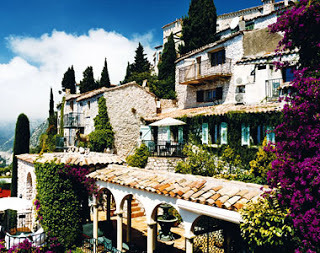
 The area is also full of historical sites. Many towns/villages include Roman ruins, old churches, cobblestone streets, and beautiful fountains. Visit a chateau, there are several across the region. The chateau in Tarascon, though basically empty, has been well preserved. Each village is more charming than the next. The larger towns, such as Avignon, Arles, Aix-en-Provence and Orange, all have sites of historical significance.
Culture abounds as well. For the art lover, follow Van Gogh’s path in Arles, where you can see several sites he painted. Visit the mausoleum in St. Remy where he stayed. In Aix-en-Provence, tour Cezanne’s home and catch a glimpse of Mont Ste-Victoire. Stop at the Picasso museum in Antibes, Renoir’s home in Cagnes-sur-Mer, and the Chagall Museum in Nice. Just outside St. Paul de Vence is the Foundation Maeght, a wonderful, small modern art museum. Or select one or more of the museums unique to the area, such as the Musee de la Lavande on the D2 toward Gordes, the Musee de la Faience (ceramics) in Moustiers or the Musee de l’Olivier, celebrating the olive tree in Haut-d-Cagnes (old Cagnes). Visit Grasse for the perfume museums.
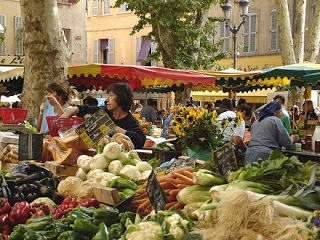 The markets, not to be missed, are a treat for the senses--a feast of sights, sounds, and scents. These interesting and varied venues, held every day of the week somewhere in Provence, provide a great opportunity to purchase a beautiful tablecloth, some sweet smelling soaps, a bottle of freshly pressed olive oil or select a painting to commemorate your trip. If your idea of shopping is Rodeo Drive or Fifth Avenue, head to the boutiques in St. Tropez and Cannes. St. Remy, Lourmarin, Gordes, Eze, Mougins and Tourettes-sur-Loup are among the smaller towns with charming boutiques and galleries. Head to Moustiers or Vallarius for faience (ceramics) and Biot for the areas hand-blown “bubble” glass.The antique center of Provence is Isle sur la Sorgue, which is frequently featured in US home decorating magazines. Antique markets are held in several other towns including Cannes, Nice and Villeneuve-les-Avignon.
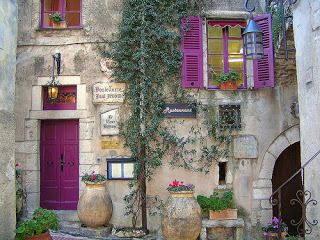 Situated in Provence, in the South of France on the Mediterranean coastline, is the city of Nice. This area is the center of the France Fragrance Industry. Just down the road from Nice is the city of Grasse, the World Capital of Perfume. In Provence you cannot escape perfume, flowers are everywhere and Nice has the best flower market of all, over 100 market stalls dedicated to flowers. The February Carnival in Nice is famous for its ‘Battle of the Flowers’ where spectators are pelted with flowers and petals by the lavishly decorated floats as they parade through the city. Visitors and tourists to the city can go on a walking tour around various gardens open to the public, visit greenhouses and perfumeries, there are several excellent Museums dedicated to the History of Perfume and the Fragrance Industry that are worth visiting and you can even take a short course in perfume making at the ‘Parfumerie Molinard’. The France Fragrance Industry began in Nice in the 16th Century. Originally a leather and tanning center in the 13th Century, the area became famous for its leather gloves. Then it became the fashion in the 16th Century to wear perfumed leather gloves (thanks to Catherine de Medici) and that was the beginning of the Perfume Industry in Grasse and Nice. The fragrance industry production now surpasses that of leather.
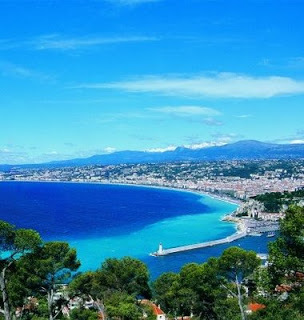 Provence is a gourmand’s paradise. Visit the wineries of Chateauneuf-du Pape for tastings. Eat at one of the region’s celebrated restaurants. Visit an olive grove for samples of freshly pressed olive oil. Pick up various types of locally made goat cheese and tapenades at the markets. Check online for cooking classes to learn first-hand how to make a Provencal specialty. Just savoring the beauty, clear skies, and changing terrain of the area provides a special vacation. There is truly something for everyone in Provence!
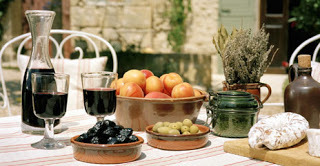
Originally a Greek colony, Provence was part of the Roman Empire and eventually became incorporated into France in the 15th century. Although the Greek influences are evident, Provence’s gastronomy is more akin to neighboring Italy than the rest of France. Tomatoes, garlic, herbs, eggplant, artichokes, and almonds are just some of the cast of regulars. There are a number of dishes that Provence is famous for. Bouillabaisse is their classic seafood stew made with an assortment of fish and shellfish, tomatoes, garlic, saffron, herbs, wine and olive oil. Bourride is similar to bouillabaisse except that it does not have tomato and is thickened with aioli, a garlic mayonnaise, and another traditional Provencal concoction. Pistou is the Provencal equivalent of pesto and used as a sauce, condiment and as a flavoring agent in soupe au pistou, Provence’s version of Minestrone. Another famous appareil is tapenade, a ground mixture of olives, anchovies, capers, olive oil and lemon juice. In the fall and winter, a variety of daubs, or stews are produced from various meats and wild game. “Herbes de Provence” is an assortment of herbs containing some combination of thyme, sage, rosemary, basil, lavender, savory, fennel seed, marjoram, tarragon, oregano, and bay leaf.
AIOLI 1 whole bulb of garlic1 cup extra virgin olive oil, more if needed
Salt to taste
Lemon juice, to taste, (optional)
Traditional aioli is made only with olive oil and garlic via a mortar and pestle but you can use a food processor. Peel the garlic cloves and puree them in the processor. Then add the oil in a very thin stream until a smooth paste is achieved. Season with salt and lemon juice if you like. Modern versions puree the garlic with two egg yolks to make a thicker and more American-grocery-store mayonnaise. Either way Aioli can be used as an accompaniment to meat, fish or vegetables, served on toasted bread, or used as a flavoring agent.
TAPENADE
8 oz. black olives, pitted2 oz. capers
1 can (2 oz.), anchovies, drained
5 cloves garlic
Juice of half a lemon
Olive oil as needed
Puree all the ingredients in a food processor except the olive oil first. Then add the olive oil in a thin stream until a spreadable paste is achieved. Other additions to the tapenade include sun-dried tomatoes and various herbs. Like aioli, it is served with meat, fish, vegetables, or on toasted bread. Tapenade can also be used as a filling. Take a paillard, (a thin slice of meat), such as a cutlet or a chicken breast that you’ve pounded thin, roll it with a tapenade stuffing and then sauté.
RATATOUILLE
Provencal vegetable stew that is popular all along the Mediterranean coast. It is a summer dish, best when the vegetables are in season and at their peak.
1 red and 1 green bell pepper, roasted, skins and seeds removed
4 tomatoes, blanched, skins and seeds removed
1 medium eggplant, cut into large dice
3 small zucchini, cut into half inch slices
1 large onion, roughly chopped
5 cloves garlic, chopped
Salt and pepper to taste
Olive oil as needed
Assorted herbs, chopped, to taste
Slice the peppers into half-inch strips and roughly chop the tomatoes. In a large Dutch oven sauté the onions, peppers, zucchini, and eggplant separately, in olive oil until each vegetable browns. If you do them all at once the pan will be overcrowded and they will not sauté, they will steam and not brown. After all the vegetables are browned, combine them in the Dutch oven, add the tomatoes and garlic, a squirt or two of olive oil, salt and pepper. Cover and cook over low to medium heat for 30 minutes or until very tender. Add the herbs at the end and check for additional salt and pepper. You can use any combination of herbes de Provence but basil, thyme, oregano, and marjoram are common selections.
HERBS DE PROVENCE
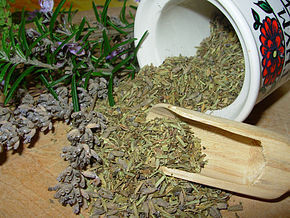
A blend of dried herbs that thrive in the Mediterranean climate of Provence in southern France. Herbes de Provence usually includes thyme, summer savory, basil, marjoram, rosemary, and lavender. Some blends may also contain dried bay leaves, sage, and sometimes even cracked fennel seed (though technically speaking, the last isn't an herb). The use of Herbes de Provence isn't limited to the Mediterranean region, however; it's a kitchen staple throughout France, probably because its flavor is so versatile. It goes smashingly with everything from roasted lamb and potatoes to zucchini, eggplant, and tomatoes. It's especially delicious with chicken. Herbes de Provence is best added to dishes before or during cooking, to give the flavors time to infuse. Make your own blend of the traditional seasoning widely used in Mediterranean cooking. Use it to season lamb or poultry, in a honey glaze for pork or roasted turkey, and with roasted onions, garlic, and other root vegetables. Use well-dried, organic herbs.
Herbes de Provence
1/4 cup thyme leaves1/4 cup summer savory leaves
3 tablespoons basil leaves
2 tablespoons crushed bay leaves
2 tablespoons crushed rosemary leaves
1 tablespoon crushed lavender flowers
Mix the whole leaves together and store in an airtight jar in a cool, dark place. Just before using, crush to a fine powder and add to foods.
Roast Chicken with Herbes de Provence
1 organic, whole chicken1 lemon, halved
3 large cloves garlic
1 bunch of herbs, including fresh rosemary, thyme and oregano
1 onion, sliced
1 teaspoon dried Herbes de Provence
1 1/2 lbs. small new potatoes
1 – 2 Tablespoons unsalted butter, melted
1 teaspoon Kosher salt
fresh coarsely-ground pepper
Preheat oven to 425 degrees. In a cast iron Dutch oven place rinsed and dried baby potatoes. Set aside. If necessary, remove giblets from the inside of the chicken. Rinse chicken and pat dry with a paper towel. Sprinkle the inside of the cavity with salt and freshly ground pepper. Stuff cavity with garlic cloves, bunch of fresh herbs and lemon wedges. Place atop bed of potatoes. Place sliced onion around the chicken, also atop the potatoes. Spread melted butter all over the chicken’s skin. Then sprinkle with Herbes de Provence, Kosher salt and fresh ground pepper. Cook on the oven’s middle rack for 1 1/2 hours.[image error]
BY VIRGINIA CAMPBELL
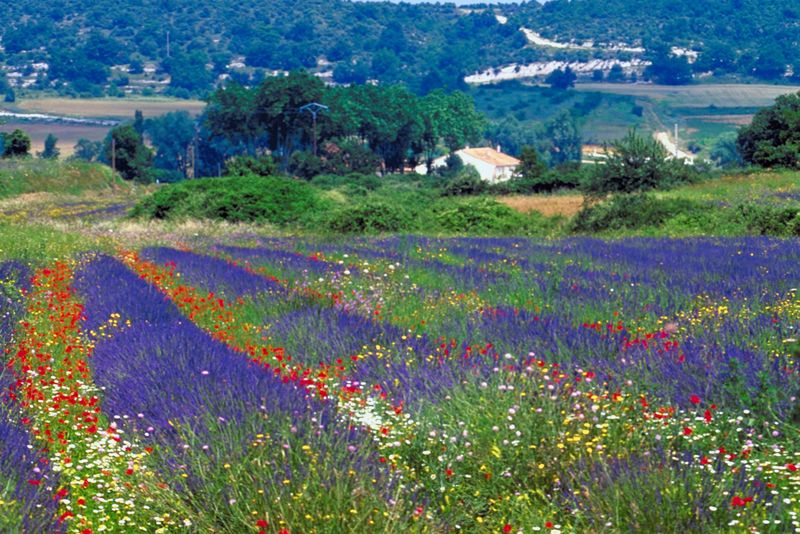 PROVENCE! Just saying the word conjures endless fields of sunflowers, the scent of lavender wafting though a breeze, beautiful clear skies, charming medieval villages, regional food, the azure of the Mediterranean and wonderful culture.
It is easy to understand why so many famous artists, including Renoir, Cezanne, Van Gogh, Picasso, found inspiration from this area of France. Provence is the most Southeastern section of France. It is comprised of five major departments or areas. These are Vaucluse, Bouches-du-Rhone, Alpes-des-Haute-Provence, Var and Alpes-Maritimes. Depending on which guide book you read, the Cote d'Azur or French Riviera (Var and Alpes-Maritimes) may or may not be included as part of Provence. The coast of Provence has some of the earliest known sites of human habitation in Europe.
 The area is also full of historical sites. Many towns/villages include Roman ruins, old churches, cobblestone streets, and beautiful fountains. Visit a chateau, there are several across the region. The chateau in Tarascon, though basically empty, has been well preserved. Each village is more charming than the next. The larger towns, such as Avignon, Arles, Aix-en-Provence and Orange, all have sites of historical significance.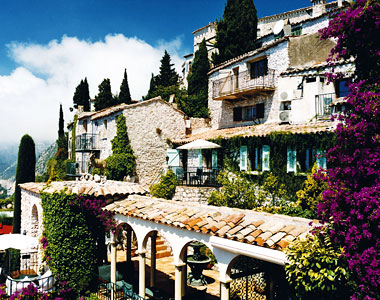
Culture abounds as well. For the art lover, follow Van Gogh’s path in Arles, where you can see several sites he painted. Visit the mausoleum in St. Remy where he stayed. In Aix-en-Provence, tour Cezanne’s home and catch a glimpse of Mont Ste-Victoire. Stop at the Picasso museum in Antibes, Renoir’s home in Cagnes-sur-Mer, and the Chagall Museum in Nice. Just outside St. Paul de Vence is the Foundation Maeght, a wonderful, small modern art museum. Or select one or more of the museums unique to the area, such as the Musee de la Lavande on the D2 toward Gordes, the Musee de la Faience (ceramics) in Moustiers or the Musee de l’Olivier, celebrating the olive tree in Haut-d-Cagnes (old Cagnes). Visit Grasse for the perfume museums.
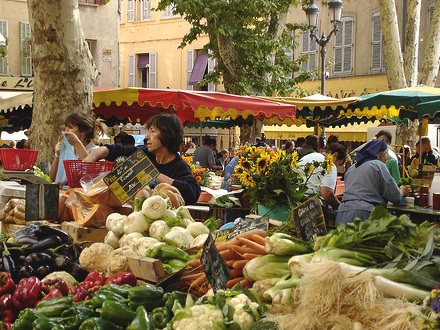 The markets, not to be missed, are a treat for the senses--a feast of sights, sounds, and scents. These interesting and varied venues, held every day of the week somewhere in Provence, provide a great opportunity to purchase a beautiful tablecloth, some sweet smelling soaps, a bottle of freshly pressed olive oil or select a painting to commemorate your trip. If your idea of shopping is Rodeo Drive or Fifth Avenue, head to the boutiques in St. Tropez and Cannes. St. Remy, Lourmarin, Gordes, Eze, Mougins and Tourettes-sur-Loup are among the smaller towns with charming boutiques and galleries. Head to Moustiers or Vallarius for faience (ceramics) and Biot for the areas hand-blown “bubble” glass.The antique center of Provence is Isle sur la Sorgue, which is frequently featured in US home decorating magazines. Antique markets are held in several other towns including Cannes, Nice and Villeneuve-les-Avignon.
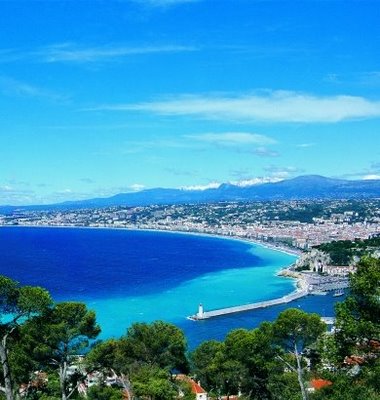
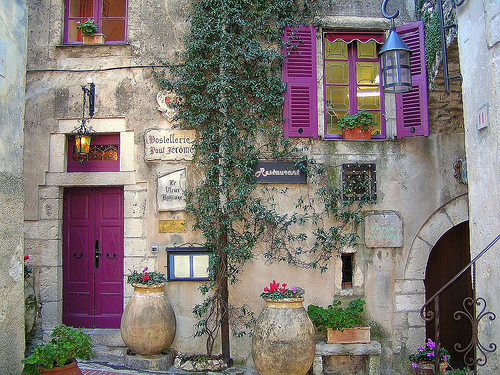 Situated in Provence, in the South of France on the Mediterranean coastline, is the city of Nice. This area is the center of the France Fragrance Industry. Just down the road from Nice is the city of Grasse, the World Capital of Perfume. In Provence you cannot escape perfume, flowers are everywhere and Nice has the best flower market of all, over 100 market stalls dedicated to flowers. The February Carnival in Nice is famous for its ‘Battle of the Flowers’ where spectators are pelted with flowers and petals by the lavishly decorated floats as they parade through the city. Visitors and tourists to the city can go on a walking tour around various gardens open to the public, visit greenhouses and perfumeries, there are several excellent Museums dedicated to the History of Perfume and the Fragrance Industry that are worth visiting and you can even take a short course in perfume making at the ‘Parfumerie Molinard’. The France Fragrance Industry began in Nice in the 16th Century. Originally a leather and tanning center in the 13th Century, the area became famous for its leather gloves. Then it became the fashion in the 16th Century to wear perfumed leather gloves (thanks to Catherine de Medici) and that was the beginning of the Perfume Industry in Grasse and Nice. The fragrance industry production now surpasses that of leather.
 Provence is a gourmand’s paradise. Visit the wineries of Chateauneuf-du Pape for tastings. Eat at one of the region’s celebrated restaurants. Visit an olive grove for samples of freshly pressed olive oil. Pick up various types of locally made goat cheese and tapenades at the markets. Check online for cooking classes to learn first-hand how to make a Provencal specialty. Just savoring the beauty, clear skies, and changing terrain of the area provides a special vacation. There is truly something for everyone in Provence!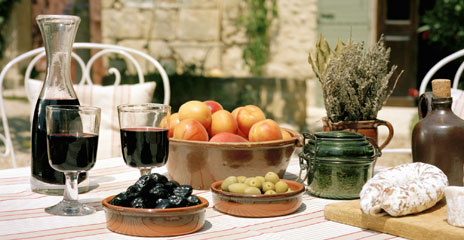
Originally a Greek colony, Provence was part of the Roman Empire and eventually became incorporated into France in the 15th century. Although the Greek influences are evident, Provence’s gastronomy is more akin to neighboring Italy than the rest of France. Tomatoes, garlic, herbs, eggplant, artichokes, and almonds are just some of the cast of regulars. There are a number of dishes that Provence is famous for. Bouillabaisse is their classic seafood stew made with an assortment of fish and shellfish, tomatoes, garlic, saffron, herbs, wine and olive oil. Bourride is similar to bouillabaisse except that it does not have tomato and is thickened with aioli, a garlic mayonnaise, and another traditional Provencal concoction. Pistou is the Provencal equivalent of pesto and used as a sauce, condiment and as a flavoring agent in soupe au pistou, Provence’s version of Minestrone. Another famous appareil is tapenade, a ground mixture of olives, anchovies, capers, olive oil and lemon juice. In the fall and winter, a variety of daubs, or stews are produced from various meats and wild game. “Herbes de Provence” is an assortment of herbs containing some combination of thyme, sage, rosemary, basil, lavender, savory, fennel seed, marjoram, tarragon, oregano, and bay leaf.
AIOLI 1 whole bulb of garlic1 cup extra virgin olive oil, more if needed
Salt to taste
Lemon juice, to taste, (optional)
Traditional aioli is made only with olive oil and garlic via a mortar and pestle but you can use a food processor. Peel the garlic cloves and puree them in the processor. Then add the oil in a very thin stream until a smooth paste is achieved. Season with salt and lemon juice if you like. Modern versions puree the garlic with two egg yolks to make a thicker and more American-grocery-store mayonnaise. Either way Aioli can be used as an accompaniment to meat, fish or vegetables, served on toasted bread, or used as a flavoring agent.
TAPENADE
8 oz. black olives, pitted2 oz. capers
1 can (2 oz.), anchovies, drained
5 cloves garlic
Juice of half a lemon
Olive oil as needed
Puree all the ingredients in a food processor except the olive oil first. Then add the olive oil in a thin stream until a spreadable paste is achieved. Other additions to the tapenade include sun-dried tomatoes and various herbs. Like aioli, it is served with meat, fish, vegetables, or on toasted bread. Tapenade can also be used as a filling. Take a paillard, (a thin slice of meat), such as a cutlet or a chicken breast that you’ve pounded thin, roll it with a tapenade stuffing and then sauté.
RATATOUILLE
Provencal vegetable stew that is popular all along the Mediterranean coast. It is a summer dish, best when the vegetables are in season and at their peak.
1 red and 1 green bell pepper, roasted, skins and seeds removed
4 tomatoes, blanched, skins and seeds removed
1 medium eggplant, cut into large dice
3 small zucchini, cut into half inch slices
1 large onion, roughly chopped
5 cloves garlic, chopped
Salt and pepper to taste
Olive oil as needed
Assorted herbs, chopped, to taste
Slice the peppers into half-inch strips and roughly chop the tomatoes. In a large Dutch oven sauté the onions, peppers, zucchini, and eggplant separately, in olive oil until each vegetable browns. If you do them all at once the pan will be overcrowded and they will not sauté, they will steam and not brown. After all the vegetables are browned, combine them in the Dutch oven, add the tomatoes and garlic, a squirt or two of olive oil, salt and pepper. Cover and cook over low to medium heat for 30 minutes or until very tender. Add the herbs at the end and check for additional salt and pepper. You can use any combination of herbes de Provence but basil, thyme, oregano, and marjoram are common selections.
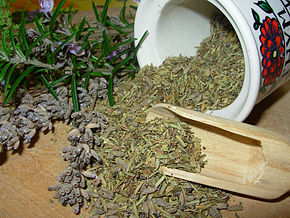
HERBS DE PROVENCE
A blend of dried herbs that thrive in the Mediterranean climate of Provence in southern France. Herbes de Provence usually includes thyme, summer savory, basil, marjoram, rosemary, and lavender. Some blends may also contain dried bay leaves, sage, and sometimes even cracked fennel seed (though technically speaking, the last isn't an herb). The use of Herbes de Provence isn't limited to the Mediterranean region, however; it's a kitchen staple throughout France, probably because its flavor is so versatile. It goes smashingly with everything from roasted lamb and potatoes to zucchini, eggplant, and tomatoes. It's especially delicious with chicken. Herbes de Provence is best added to dishes before or during cooking, to give the flavors time to infuse. Make your own blend of the traditional seasoning widely used in Mediterranean cooking. Use it to season lamb or poultry, in a honey glaze for pork or roasted turkey, and with roasted onions, garlic, and other root vegetables. Use well-dried, organic herbs.
Herbes de Provence
1/4 cup thyme leaves1/4 cup summer savory leaves
3 tablespoons basil leaves
2 tablespoons crushed bay leaves
2 tablespoons crushed rosemary leaves
1 tablespoon crushed lavender flowers
Mix the whole leaves together and store in an airtight jar in a cool, dark place. Just before using, crush to a fine powder and add to foods.
Roast Chicken with Herbes de Provence
1 organic, whole chicken1 lemon, halved
3 large cloves garlic
1 bunch of herbs, including fresh rosemary, thyme and oregano
1 onion, sliced
1 teaspoon dried Herbes de Provence
1 1/2 lbs. small new potatoes
1 – 2 Tablespoons unsalted butter, melted
1 teaspoon Kosher salt
fresh coarsely-ground pepper
Preheat oven to 425 degrees. In a cast iron Dutch oven place rinsed and dried baby potatoes. Set aside. If necessary, remove giblets from the inside of the chicken. Rinse chicken and pat dry with a paper towel. Sprinkle the inside of the cavity with salt and freshly ground pepper. Stuff cavity with garlic cloves, bunch of fresh herbs and lemon wedges. Place atop bed of potatoes. Place sliced onion around the chicken, also atop the potatoes. Spread melted butter all over the chicken’s skin. Then sprinkle with Herbes de Provence, Kosher salt and fresh ground pepper. Cook on the oven’s middle rack for 1 1/2 hours.[image error]


No comments have been added yet.