A History of Understanding in Nine and a Half Steps
Last night I read a poem at Kimberley Moore’s mid-week Music & Words event in Norwich which I was invited along to. I love the magic that Kimberley weaves at these events – it’s a beautiful, intimate pottery studio with fairy lights and beautiful artwork and plants and it feels like we’re in someone’s living room.
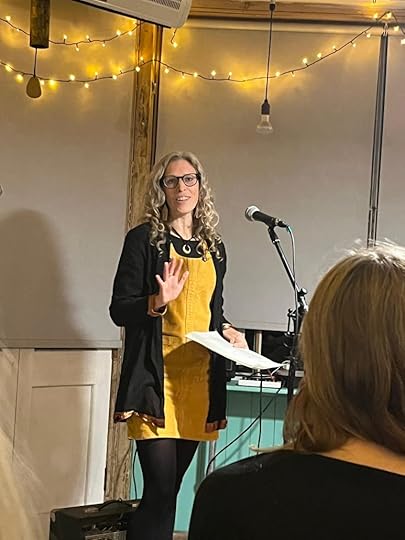
This is my ‘proem’ that I performed (it’s not quite poetry and it’s not quite prose). It’s quite long, so I’d recommend making yourself a cuppa before you sit to read it. Before I read, I shared with the audience Nina Simone’s words: An artist’s duty is to reflect the times. Here is my response to reflecting the times.

A History of Understanding in Nine and a Half Steps
STEP ONE
It’s 2030
and I ask you to allow me to dream.
A young woman of twenty-six years old
walks along a coastal road as the sun glints off the Mediterranean.
Desert finches are buffeted in the warm wind above her
as they dart in and out of the branches of young olive trees
that line the road.
Eventually, she reaches her destination
and she walks the path she has been down so many times
until she reaches the headstone that bears her sister’s name.
She bends down, brushes a leaf away, smiles.
She thinks of her laugh,
the grace of her drawings,
the way she danced with abandon when certain songs came on the radio.
The young woman sits there for some time,
grateful for the breeze that cools the heat of the day.
Now she will visit her best friend,
twenty-seven headstones up the path
and forty-three to the left
and then her aunt,
and then her neighbour,
and then her professor, the one who brought Shakespeare alive for her.
There is a route she takes.
It is familiar.
It is comforting.
They never saw the re-planting of olive trees,
the re-building,
the permanent ceasefire.
So she carries it for them;
does everything she does now for them,
and for all the others.
She sees a flash of colour bolt past her and follows it.
It is a sunbird, settling on a jasmine bush nearby and using its curved beak to
extract the nectar.
She watches, transfixed, not wanting to move a millimetre in case she scares it.
She thinks, everything is wrapped up in this little bird: freedom, life, colour, courage.
She thinks, there is always hope.
There is always hope.
Step Two
I’m cleaning the bathtub.
It’s been a while and I’m scrubbing hard when suddenly,
I start weeping.
I’m not expecting it and it takes me by surprise
and I sit back, waiting for the tears to stop.
But they don’t, and the scrubber is now abandoned
and I surrender to the grief.
To the not understanding.
Perhaps somewhere in my memory there is a pocket
that has triggered this.
Perhaps I am remembering my three children
when they were small, their smooth soft bodies in the tub,
their squeals and shrieks and splashes and shampoo-saturated hair
standing stiff upon their heads.
And perhaps I cannot comprehend how it must feel
to return home from working a long shift in a hospital
to find nine of your ten children dead.
Yahya, Rakan, Raslan, Jubran, Eve, Rivan, Sayden, Luqman, Sidra.
All gone.
Step Three
If we had been alive at the same time,
we would have been friends, Anne Frank and I.
I’m ten years old and I decide with that ferocious certainty of children,
because I understand Anne.
I understand her irritations and sadness,
her loneliness and love, and that fierce urge to write.
And alright, I don’t know what it’s like to be hidden in an annexe
and to live in constant fear of being discovered.
But I’ve grown with stories of my father’s family
perishing in the camps,
the stars of David sitting solemnly beside their names in the family tree,
the survivors scattering to Israel and America
in search of a new life.
So I claim Anne as my confidante
and bind myself tightly to her.
Yes, we would have been close friends, I think.
Maybe even best friends.
Step Four
I’m in Parliament Square. The rain is
ricocheting off my waterproof coat and
I’m focusing on writing a sign with a
black marker pen.
There it is, I finish it and catch
a glimpse of a small band of men
standing amongst our group, faces like iron,
holding aloft signs that say There is No Genocide.
It slaps me in the face
and I turn my own sign around:
I Oppose Genocide.
I Support Palestine Action.
But a mere twenty seconds later a police officer appears
and reads me my rights.
He tells me I’m being arrested under Section 13 of the terrorism act.
That I cannot support a proscribed organisation.
I am taken aback it’s happening so quickly
and I say, ‘You don’t have to do this.
You can act on your conscience.
You know this is wrong.’
He clears his throat and replies ‘I’m just following orders.’
And I can’t help myself, I tell him
That’s what they said in 1930’s Germany.
He’s angry now and clasps my wrists tightly together
before snapping the handcuffs around them.
That’s too tight, I say.
But he just leads me towards the police van,
rain teeming down
as we step over puddles and around too-close cameras that click in my face.
Step Five
I’m eighteen and away from home alone
for the first time.
I have been assigned to a kibbutz an hour
from Tel Aviv, a place of sharon fruit and avocadoes and oranges
and low-lying buildings hugging the contours of this rain parched land.
I take up a habit of a smoking Noblesse cigarettes
and drinking more than is good for me
on those warm nights.
I fall into bed far too late and get up
far too early to irrigate the avocado trees
and learn words of Hebrew that sound exotic on my tongue:
Bevakashan. Boker tov. Sliha.
I fall in love with an Israeli soldier
who comes home at the weekends from military service.
He is dark haired and swarthy and
when he tells me about the patrols he goes on
and those crazy Palestinian kids throwing rocks at his jeep,
one of them nearly shattering the windscreen,
I think, poor him, what a nightmare.
He can’t wait to leave the army,
to travel,
to work,
for his life to start.
I think, imagine having to constantly defend yourself
and your country like this.
What’s wrong with these Palestinians anyway?
Several months later, and I’m putting up
a huge Israeli flag on the wall of my first university room.
I still wear the necklace that spells out my name in Hebrew:
Rivka and I start writing down phrases in a notebook,
for when I go back again.
Since my time on the kibbutz, my Jewish roots have taken
on proportions of immensity; I am newly bonded with the
far-flung aunties and cousins
and I start looking into ways
I can spend a year out in Israel.
I am smitten: with an ideal, a land, a language,
a soldier.
Step Six
As soon as I read her article in Al Jazeera, I feel
something shimmer like silver down the length of my spine:
Knowing.
It is knowing that she is the person I’ve been looking for.
It is half-way through 2024 and the latest war against Gaza
has been raging for over half a year.
I’ve been posting about it on Facebook, calling for a Ceasefire,
and one by one the far-flung cousins who I’ve
not had contact with for years pop up,
condemning me, shaming me,
telling me I don’t understand anything.
One tells me my father, if he were still alive,
would be ashamed of me.
Another says I will burn in hell.
I block them, one by one.
And I keep scouring the web for a Palestinian writer who
can run a writing workshop for Norwich Writers Rebel,
the group I run.
I imagine he or she will be from the Diaspora,
for I have no idea how to find someone in Gaza itself.
But then, there it is in Al Jazeera, the article about
the loss of the territory’s libraries,
there she is.
And it moves me, this article, not just for the rich, warm
wisdom of her voice, but also because
libraries have shaped me my entire life –
entering a cathedral of books calms me, soothes me,
just like I am soothed when I enter a forest.
Her name is Shahd Alnaami.
She looks young, not much older than my eldest
and I search for her on Instagram.
What do you say to a person you’ve never met
whose pain and loss and resilience sings
through their writing?
So I send a brief message, telling her I was moved
by her article and I stand in solidarity with her.
Two hours later, she messages back.
This is the start of a friendship I have come
to treasure like a glimmering dawn after a long night.
Two workshops later, and we leave one another
frequent voicenotes.
I can hear the drones and the bombs
in the background and sometimes she is scared
but mostly she is stoic.
There is always hope, she says,
breathing it like a mantra, again and again.
Hope, however fragile, she says, is an act of resistance.
This war against her people has made her wise beyond her 21 years.
I have never known courage like this.
Not when she loses her home twice
to airstrikes and starts living on the roof of her uncle’s house.
Not when she must endure the
desperate weeping of the neighbourhood kids,
begging for food, crying that their stomachs hurt from hunger.
Not when she loses her oldest and closest friend who she grew up with.
Not when her thirteen-year old sister
is pulled out dead from beneath the rubble
from her bombed building and Shahd says
that she still wants to do the workshop –
that her sister would have wanted that.
And sometimes – of course – that stoicism slips.
How can it not?
One night I see a post she has put
on her Instagram story. It reads:
Tell me one good reason to stay alive.
And something in me cracks and buckles.
I sit at the kitchen table and read it again and again.
It’s nearly midnight in Gaza
and I ask her if she wants to speak.
Who am I to say anything at all
with my fridge filled with food and
my mornings filled with birdsong; my family intact?
She tells me that her father, Ahmad, who was born in
the same month as me and who I feel such affection for,
went to the aid distribution point that morning to find food.
But instead of bread, he found bullets;
some were killed.
In the chaos he lost his only pair of shoes,
his money was stolen
and he returned home shoeless, breadless, cashless, traumatized.
I let her cry
as she asks me
Why do they hate us so much?
We only want to live in peace.
And I have no good answer for her.
I have no answer for her at all.
Step Seven
It’s my last year of university.
I’m still obsessed with Israel.
With resurrecting my Jewish roots.
I visit friends over there –
go on treks in the Negev desert and
walk through the sun-soaked souks
of the old Arab quarters and observe shabbat.
I decide to take a course outside my studies
called Politics, Economy and Society of the Middle East
and little do I know,
that this will change everything.
In this classroom, Arab scholars will lay bare the facts
as the region’s history unfurls before me in all its jagged rawness:
the Six-day war, the Sabra and Shatila massacres,
the intifadas and annexation of the West Bank.
I am stunned. Speechless.
The image comes back to me time and again
of the young Palestinian boys hurling rocks at
the armoured vehicle of the kibbutz soldier
as understanding edges in and takes root.
Didn’t he know? Didn’t he understand?
I read all I can get my hands on.
I join Friends of Palestine.
The Israeli flag comes down from my wall,
the necklace is removed,
the Hebrew phrase book closed.
When I see my dad, we have heated debates about
whose land it is – he laughs,
tells me I have chutzpah,
but that I’m wrong.
Imagine a painting, a family heirloom, he says,
that somebody has taken away from your family for two thousand years –
wouldn’t you want it back? Of course you would.
I find his logic ridiculous, and tell him as much
but he laughs again
and we agree to disagree.
You’re a passionate one, he says and smiles at me affectionately.
I think: there is so much I don’t understand.
I think: there is so much more to learn about this confusing, complicated world.
Step Eight
I’m sitting in front of City Hall in Norwich.
I’m holding the sign again,
yes, that same one that reads
I oppose Genocide. I support Palestine Action.
Just saying that here, now,
I could get arrested.
And if there are any police officers here amongst you,
you’re obliged to handcuff me.
But the thing is, that I do oppose genocide
and I’ll say it again and again
until my throat closes and my skin cracks.
And the thing is, that I do support Palestine Action.
Because they’ve never hurt anyone
and they only want to dismantle the
war machine that I also want dismantled.
I want the harm to stop.
The sun is pouring into my eyes
and I’ve wrapped my kuffiyeh around my head.
I thought they wouldn’t bother with arrests
out of the big cities,
but I realise quickly I was wrong,
for barely have we sat on the steps
than we’re surrounded by policemen,
all glaring fluorescent efficiency, like supercharged wasps.
I feel panic rise up in me –
I don’t want to get arrested again
and I know I could put my sign down right now
and move to the side where there’s a large crowd of supporters.
I turn my head to look at them and there’s a woman
holding a sign that reads
‘Palestinian children deserve to live.’
I can see the faces of my husband and daughter,
the strength and love that emanates from them,
and something in me breaks.
I drop my head and weep –
for the suffering, for the destroyed dreams,
for the rollcall of daily names cloaked in numbers.
My friend Jackie is sitting beside me and she is also crying.
I shift closer to her and her warmth comforts me as we clasp hands.
Even if I wanted to move, I can’t now.
I will continue to sit for the Palestinian children.
The Palestinian children who deserve to live.
I watch as my friends and comrades are peeled off the steps
until it is my turn.
I’m told I’m being arrested for terrorism offences;
I open my mouth and the words flow out like water over stones.
I tell them how the equivalent of a classroom full of children
are being murdered every day in Gaza
and I ask if they have children themselves.
But they keep saying I’m being arrested and that anything
I say can and will be taken down and used as evidence against me.
And every limb of my terrorist body is hauled up from the city hall steps
and carried by six police officers to a waiting van.
I see another friend make a heart sign at me through the window
and I smile weakly at her, close my eyes, and lay my forehead
against the cool glass.
This is too much.
I am exhausted by this.
Step Nine
It’s October 2025
and I ask you to allow me to dream.
The latest war against Gaza has been raging for 2 years.
I’m sitting again, with the same sign, in Parliament Square.
There are hundreds of people around me, waving Palestinian flags,
singing, drumming, talking, resting in the weak October sunshine.
I can see at least a few people in wheelchairs;
one of them is the blind man, going in for his fourth arrest,
and I can see vicars in their dog collars,
an elderly man with his war medals and a teenager who looks like he’s not
even left school, his blond hair streaked black, green and red.
A heaviness weighs upon me like lead –
here I am again.
There are well over a thousand people and it’s going to take a long time
to arrest us all.
I take out a book and try to read, but I can’t focus
so I close my eyes, welcome the October sun on my face, breathe slow and even.
And then, perhaps I feel it before I see it,
something shifting: an energy that was not there before.
When I open my eyes, what I am looking at I instinctively know will go
down in history:
this moment, this square, this constellation of people.
Picture this:
a policewoman. She’s in her thirties, hair smoothed back into a neat, dark bun
beneath her hat.
She is standing in front of a woman around the same age
dressed in medical scrubs, Doctor emblazoned on her front as she
sits cross-legged with the sign.
But the policewoman is not arresting her, she appears frozen – with what?
With indecision? With weariness? With suppressed trauma from having to arrest
these people she knows are not criminals?
I study her face, not tearing my eyes from her.
The policewoman is crouched down so the two of them are at eye level
and they are staring at one another intently.
And then….
Without a word passing between them,
the doctor shifts on the ground to make room for her
and passes the policewoman the sign.
She sits, staring ahead while the doctor writes out another one.
The press are there immediately, hungry for stories,
for the shot that will make waves.
And as I look at the two of them, sitting there shoulder to shoulder,
I realise something else is happening:
behind these two I see a policeman.
He is wavering; I can see he is fighting with his conscience –
every emotion flitting over his face and crossing his eyes
like clouds skudding across the sky.
I watch as he breathes in,
an inhale long and deep and brave
and then he does it; he sits, the sign silently handed to him.
It is happening, one by one,
like a wind rippling across a prairie,
members of the Metropolitan police force are holding up the sign,
some sitting, some standing,
all the way back over the sea of heads
to the statue in the corner of Parliament Square of Millicent Fawcett,
suffragist leader and social campaigner.
Her face is soft but determined, and
between her hands she is clasping a banner that reads
Courage calls to courage everywhere.
As I watch this extraordinary scene unfolding, unfurling,
I feel hope catching at me in a way it has not done
for a very long time.
I know that my grandchildren will learn and speak of this day
in their school of the future;
how it led to a revolt in the ranks
of the seats of power;
how a prime minister was pushed out
and support for an occupying country withdrawn,
not only in words, but in deeds.
How a new politics of care and kindness was established,
how one brave policewoman resisted
and the ripple effects of her act.
But for now, I simply sit with my sign
and I drink in this sight, my cheeks glistening with tears of gratitude –
that I was here to witness this;
that Millicent Fawcett’s words are right;
that courage does call to courage and
that there is always hope.
There is always hope.
Step Nine and a half
I am ten years old.
I have just finished reading The Diary of a Young Girl by Anne Frank
and I lie back on my bed.
It’s hard to understand, but I know that my life has shifted in some way,
that I can never be quite the same having read this book.
I don’t understand why she had to die,
why so many had to die.
Something is planted in me at that moment:
an acorn that roots deep in my skinny ten-year old frame:
Injustice.
It is wrong.
It is wrong.
I want to live in a better world than this,
and I will help build that world.
I hug the book tightly to my chest,
close my eyes and smile.
Yes, we would have been best friends, Anne and I.

The post A History of Understanding in Nine and a Half Steps appeared first on Rebecca Stonehill.