
Writing a series: What to leave in, what to leave out
When I’m at events where I have an opportunity to sell my books, the most-asked question by far from potential readers is “Do I have to read them in order?”
Short answer: “No!”
But if you know me, you know there’s never a short answer.
I’ve been a reader of mystery series for decades longer than I’ve been a writer of one. I take it for granted that there will be references to things that happened in previous books that I don’t have the full story on, but also understand, without even thinking about it, that I don’t need to know what happened to get the full benefit of the story in the book I’m reading.
Great book, but what happened to Pete’s leg?
As a writer, that’s how I approach it, too. There are now four books in the Bernadette “Bernie” O’Dea mystery series, with a fifth one on the way. That’s a lot of murder, mystery and mayhem. The characters have gone through stuff. They’re going to mention it, or think about it. But they can’t too much, or they’ll cross the line. Readers of the current book who haven’t read past ones shouldn’t be hit with things that have little or nothing to do with the plot of the current book. Best case, it’s an unnecessary distraction. Worst case, they think it has to do with the plot of the book they’re reading, but they don’t have enough information and get frustrated.
It’s a fine balance. I tell potential readers that each mystery story is contained in its book. They don’t need to read previous books to understand the plot. They also don’t need to wait for a future book for plot loose ends to be tied up.
If they enjoy how character relationships evolve, they should start at the beginning.
I usually add that I like to start at the beginning of a series, and if I read a book that’s in the middle of a series, and enjoy it, I have to go back and read the first one after I’m done. As I read my way through a series, when I get to the book I’ve already read, I read it again and see how my perception of what’s going on has changed.
I also tell them that in my mystery world, when horrific things happen to people, a few months later they’re still going to be having some kind of effect. That’s true for non-horrific things. Each of my books takes place within a few months of the previous one. I can’t help but have references in my books to things that happened in previous ones, but I try to keep them general and brief, giving readers just enough info for the context they need for the current book.
Usually by now the potential reader’s eyes have glazed over and they buy a book just to shut me up. They usually buy the first in the series. Probably just to be safe, since I lost them somewhere in the weeds of my answer to their question.
I don’t remember ever looking up, or doing much research, on how to handle information from previous books in a series when writing. I already understood the balance from a lifetime of reading mystery series. Dorothy L. Sayers, Sue Grafton, Elizabeth George, P.D. James, Nevada Barr and countless others were my tutorials. Some handle it more deftly than others. Some provide lots of info, some none. As I read hundreds (thousands?) of mystery series books, my brain socked away my reader preferences.
One of my writer guidelines is “What would Maureen the reader want?” When writing I’ve developed, I hope, a system that touches on things that happened in previous books that are still somehow relevant without spoiling those books for new readers or messing up their enjoyment of the one in their hands.
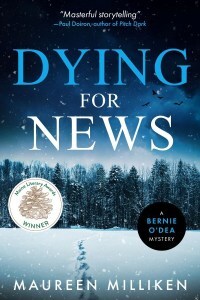
I experienced a huge example of all of this earlier this month, when I was a guest at my aunt’s book group. They’d all read DYING FOR NEWS, the fourth book in my series. Only my aunt had read the previous three. Unfamiliarity with the first three books didn’t seem to keep them from enjoying it. (Whew! Thank you!) Still, the biggest question of the day was, “What happened to Pete’s leg?”
In DFN, Pete, the police chief and Bernie’s love interest, is recovering from a serious leg injury that has some impact on character development and minor plot impact. Readers need to know he has issues with his leg. The book refers a couple of times to his hiking accident, but readers who don’t know what happened probably get that it’s a euphemism for something much bigger. While there’s emotional fallout from how he injured it, the details aren’t necessary in DYING FOR NEWS. Anything they need to know about it for their understanding of the book is in the book. It’s not much more than what I’ve written here.
Pete’s “hiking accident” is a major part of the previous book, BAD NEWS TRAVELS FAST. To go into detail about it in later books would spoil the narrative arc, as well as the drama and suspense for anyone who hasn’t read it.
But too much detail in subsequent books can also spoil the story in those books. Readers may feel like those details have something to do with the current plot, which they don’t.
It took a lot of writerly thinking to achieve the balance of taking care of new readers without spoiling two books for them. It could also spoil the current book for people who’ve read the previous one — who wants a rehash of stuff they already know? Let’s get on with the new story!
I didn’t tell the members of my aunt’s book group what happened to Pete’s leg. If they want to know, they have to read it for themselves.
A couple things about that: The biggest reason is I don’t want to spoil the fun of BAD NEWS TRAVELS FAST for them. I wrote it a certain way, and knowing what happens lessens the impact. Also, listening to myself trying to explain the plot of a book, or even an out-of-context plot point, makes me want to run home and curl up on the couch with a blanket over my head.
I also didn’t tell them that just to force them to buy the third book. It’s a column for another day to fully get into it, but I am a firm believer that the only thing a writer should do in order to make readers want to read the other books in a series is to write a compelling enough story that they want more. I’ll answer questions about books that don’t spoil the story. Happily and at length. I would also never ever have a plot cliff-hanger that someone would have to buy the next book in order to resolve. I don’t feel that’s playing fair with readers.
Every writer handles it differently, but it’s important to understand that balance if you’re planning on writing a series. Aspiring writers should think hard about the tissue that will run through the books. Seasoned writers should keep it front of mind as they continue a series.
Think about your reader self and how you’ve reacted to how that’s done in series. If you’re setting out to write a mystery series, but have never read one, sit down with a couple to see what they do and how you feel about it.
It’s okay for readers to wonder what happened to Pete’s leg. How much it matters and how much you reveal in later books is up to you as a writer.


Lea Wait's Blog

- Lea Wait's profile
- 508 followers

