Web Presence 101.6 – Facebook
It’s been a while since one of these posts, since spring was such a busy time for me, but with new social networks cropping up I thought I should get the ball rolling again.
 Facebook is still (in 2012) the biggest and best-known social media site. There are two main kinds of Facebook content stream: individual user accounts, which is what most people are familiar with, and Pages, which are a bit like micro-websites within Facebook. You’ll need the former to use Facebook at all, and when you get close to being published, the latter is a good idea too.
I’ll admit right now that I’m not a big fan of Facebook, and don’t use it much, but it’s impossible to ignore, particularly as they have started creating “community pages” (read, “content sucked in from Wikipedia”) about every topic under the sun; presumably including any author with a Wikipedia page about them. Like it or not, unless you create your own Facebook page about yourself, someone else will probably do so—and you won’t control that content.
User accountsI won’t say much about user accounts except: be careful! Don’t friend all and sundry, and don’t be tempted to fill in all the information fields just because they’re there. There was a very disturbing story doing the rounds a few months ago, about a smartphone app that combined social media content to produce what was in effect the perfect stalking tool. Keep an eye on the privacy setting, or better still don’t put anything into your profile that you wouldn’t want made public. There have been plenty of articles published on the subject, and I invite you to check them out. Suffice to say that I post as little personal information on FB as I can get away with!
Pages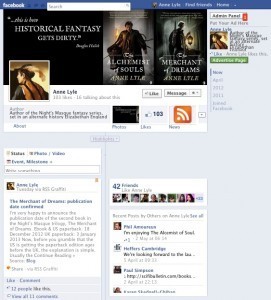 It might seem egocentric to have a “fan page” about yourself when you’re not even published yet, but really it’s just a handy way around the “mutual friending” structure of Facebook. If you don’t have a fan page, you will have to friend every single reader who wants to follow you – which means they get access to all the personal stuff you post! Much better—and safer—to set up a page they can Like. There’s also the advantage that Facebook pages are visible to the wider internet, including search engines, whereas your ordinary Facebook account is not.
Also, as mentioned above, once you are big enough to merit a Wikipedia page, Facebook will create a Page about you that you don’t control, so it’s worth getting in on the ground floor and attracting a following. That will push your Page above the automated one in any search results and ensure than anyone on Facebook who’s looking for you will find real, fresh information, not a bunch of third-hand, rarely updated stuff.
As you can see from the screenshot of my own page, the new “timeline” view allows, nay encourages, you to add an image to the top of your page. The size is fixed and a bit weird, so you may have to do some fiddling around with your chosen image to get something suitable.
I populate the page with my blog feed via RSS, and check back once or twice a day to see if anyone’s left a message. I also post the occasional bit of unique content, usually if I have some news that isn’t significant enough for a blog post but is too long for a tweet. Because I mostly post on here rather than my personal account, my friends who follow me aren’t swamped with content.
That’s really all I have to say about Facebook. If you love it you may find it a great promotional tool, but for me it’s just a way to reach a few more fans, particularly who don’t use Twitter.
My facebook pageIn the next post I’ll look at Goodreads, which is a social media site specifically for book-lovers – just what every writer wants!