
Back for one last section of the Great River–and a post from the archives
In November, 2015, My Own True Love and I began what turned into a multi-year adventure, driving the Great River Road along the Mississippi from where the river begins in Minnesota to where it ends in Louisiana. * We envisioned doing the entire trip in three weeks—a totally unrealistic assessment given the fact that between us we are interested in just about everything. On our first trip we lasted the better part of three weeks: We spent two days in Memphis, three days in and around New Orleans, and then drove back again north without a schedule. We got as far Vicksburg, where the weather turned ugly and we gave up. On our next trip, we drove north to Lake Itasca in Minnesota and started to work our way back south. At the end of that trip, we had many miles left to travel and many things still to see. Last summer, we “finished” the project with a series of day trips out of Memphis.**
In fact, we had one piece of the road left: As we reached southern Minnesota, in 2018, we decided to skip over the Twin Cities and go back another time. There was so much to see in Minneapolis and Saint Paul that we knew we wouldn’t make any progress down the river if we stopped.
We finally made it back this year. By the time you read this, we’ll be back home.
Driving north, we decided to travel by U.S. highways rather than the interstate. As we went, we found ourselves reminiscing about places we had stopped on previous trips: the Froelich tractor museum, the lock master’s house in Guttenberg, the lumber museum in Clinton. The Great River Road became a trip down memory lane.
My guess is the entire adventure took us close to fifteen weeks, broken up in chunks of ten days and two weeks.
*Actually, we had intended to do the trip in 2014, but had to revise our plans due to an ailing elderly cat and an elderly house in the middle of extensive renovations. Instead of the big trip, we took a bite out of the middle on a four-day weekend from Nauvoo to Quincy in Illinois. It was a very good start.
**I didn’t write a single blog post about the experience. I was deep in the run-up to releasing The Dragon from Chicago Instead of chronicling our adventure, I was writing posts about women journalists. (Sorry. Not sorry.) However, I did write a newsletter looking at the trips as a whole. You can read it here.
_________________________
One of our most memorable stops in the stretch through Iowa and Minnesota was the Vesterheim Norwegian-American Museum in Decorah, Iowa. I was pleased to re-visit the post I wrote then. I hope you enjoy it, too.
*****
On the first day of our Great River Road adventure (1), My Own True Love and I veered about 45 miles off the Great River Road so I could sneak in a bit of a research for the book proposal I’m working on at the Vesterheim Norwegian American Museum and Heritage Center in Decorah, Iowa.(2) Sandy was a willing co-conspirator because 1)it would be a shame to have to come back if I sell the book and 2)it looked like a pretty fabulous museum.
And let me tell you, it IS a pretty fabulous museum.
The museum explores the story of Norwegian immigration to the United States, putting it in the context of nineteenth century Norwegian culture and the broader experience of nineteenth century immigration to America. It also celebrates Norwegian folk art, then and now. In fact, if you’re in Decorah for a longer period, you can sign up for classes in rosemaling, traditional embroidery techniques (3), folk music, flatbread baking (4), etc, etc, etc.
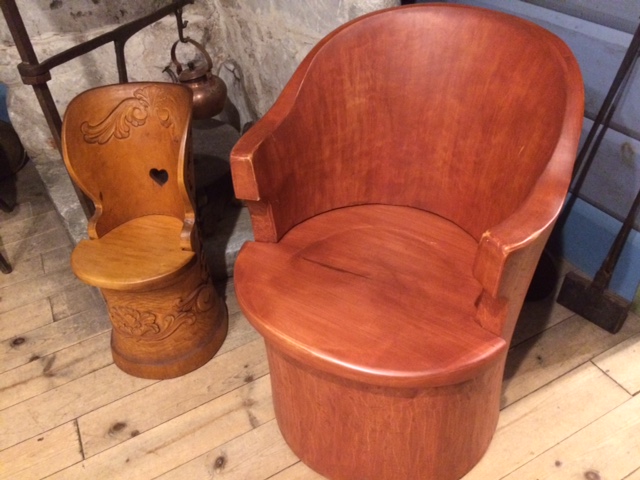
Kubbestol–Traditional Norwegian log chairs. More comfortable than they look!
The folk art exhibits are breathtakingly beautiful. Well-trained docents give tours of a campus of well-maintained historic buildings, ranging in size and complexity from a small log storage cabin (5) to a nineteenth century Lutheran church. And the exhibit on Norwegian immigration not only told me a portion of the story of immigrants to the United States that I had not heard before, but it made elements of the broader story of nineteenth century immigration to this country more vivid for me.
Here are some of the things that caught my imagination:
The first group of Norwegians emigrants sailed from Norway on July 4(!), 1825. They were known as the “Sloopers” because their ship was a sloop that was tiny for ocean-going even by the standards of their time. Like so many early emigrants they were religious dissenters. Some of them were Quakers; (6) others followed the pietist teachings of Hans Nielsen Hauge. The official state church of Norway persecuted both groups.Norway was second only to Ireland in the percentage of its population it lost to emigration in the century between 1825 and 1930. Norwegians left their homes for many of the same reasons as the Irish: growing population, limited arable land (7) and the potato famine that swept Europe in 1845.In the mid-nineteenth century, emigrants provided their own food for the voyage and cooked it on the ship on open fires in long bins filled with sand.A “stove wood” house, built of pieces of wood cut to the length that would fit in a woodturning stove and held together with plaster. The walls were about one foot thick and well-insulated. Unlike log cabins, a man could build a stove wood house by himself.I came away stunned by new awareness of just how hard it was for emigrants to leave their homes to travel to a new country. I was also stunned by the love of decoration pervasive in traditional Norwegian culture.
If you’re anywhere near Decorah, take the time for a visit.
(1)Part 3, or maybe Part 4, depending on whether you count our consolation prize four-day weekend in 2014. And you really should, because it was weird and wonderful.
(2) Yes, that’s a hint. But it won’t help you much.
(3) Personally, I’m tempted by the hardanger classes. (Autocorrect changed this to harbinger classes. Perhaps a good choice for Halloween weekend. Beware, beware….)
(4) Or Norwegian Christmas cookies
(5)The answer to the question of where people stored things in a one-room cabin.
(6) Norwegian Quakers, you ask? I did, too. According to our docent, Denmark/Norway fought on the French side in the Napoleonic Wars. (Brief pause while I check this.) Some Norwegian prisoners of war were taken to England, where Quakers and Methodists visited them in prison and managed to convert a number of them from the state-sponsored Lutheran church.
(7) In the case of Norway, the limits were imposed by the country’s geography. In the case of Ireland, they were artificially created by British policies.


