Creating Safe, Authentic Mentoring Spaces
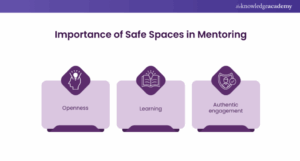
Here are some creative and well-thought-out logical ideas for fostering safe and authentic mentoring spaces:
1. “Truth Serum” Icebreakers (Optional Anonymity)Begin sessions with a light-hearted but revealing icebreaker. Instead of typical “tell me about your weekend,” use prompts like “Share one professional challenge you faced this week that taught you something, even if it felt like a failure” or “What’s one skill you’re secretly struggling to master?” Offer the option for anonymous submissions at the start of a group session to encourage vulnerability, then discuss themes as a group.
2. “Vulnerability Vault” ProtocolEstablish a clear and explicit “Vulnerability Vault” agreement at the outset of the mentoring relationship or program. This goes beyond standard confidentiality. It explicitly states that personal struggles, failures, or sensitive ideas shared within the mentoring space are treated with the utmost respect and will not be used for judgment, gossip, or negative consequences outside the agreed-upon boundaries. Reiterate this protocol regularly.
3. “Mentor as Mirror” ExerciseEncourage mentors to regularly reflect back their mentees’ feelings and ideas without judgment. Instead of immediately offering solutions, mentors can practice phrases like, “It sounds like you’re feeling frustrated with X. Is that right?” or “What I’m hearing is that you’re exploring Y. Can you tell me more about that?” This validates the mentee’s experience and ensures they feel truly heard.
4. “Shared Struggles” StorytellingFacilitate a session where mentors (and potentially mentees) share their own past professional struggles or failures. This “lead by example” approach, as highlighted in the source, normalizes imperfection and demonstrates that even experienced professionals face challenges. It creates a powerful sense of camaraderie and psychological safety.
5. “Boundary Setting Blueprint” WorkshopConduct a mini-workshop or provide a template for both mentors and mentees to collaboratively define their individual and relational boundaries. This includes communication frequency, preferred contact methods, topics that are off-limits, and how to respectfully address unmet expectations or conflicts. This proactive approach prevents misunderstandings and builds trust.
6. “Feedback Feast” FrameworkImplement a structured framework for giving and receiving feedback that prioritizes psychological safety. This could involve the “SBI” (Situation, Behavior, Impact) model for constructive feedback, or a “Start, Stop, Continue” approach. Emphasize that feedback is a gift for growth, not a critique of worth. Train both parties in this framework.
7. “Co-Creation Agenda” ApproachEmpower mentees to co-create the agenda for each mentoring session. While mentors can offer guidance, the mentee drives the topics and questions. This shifts the dynamic from a didactic one to a collaborative partnership, ensuring the mentee’s needs are at the forefront and they feel ownership over their development.
8. “Safe Exit Strategy” ProtocolClearly communicate and normalize the process for ending a mentoring relationship, whether it’s at the end of a defined program or if a mismatch occurs. Provide a graceful and respectful “safe exit strategy” that allows either party to express concerns or conclude the relationship without fear of repercussions or awkwardness, as suggested by the source.
9. “Authenticity Prompts” DeckCreate a deck of “authenticity prompts” or conversation starters designed to encourage deeper, more vulnerable discussions. Examples: “What’s a belief you hold about your career that you’re starting to question?” or “Describe a time you felt truly aligned with your values at work, and a time you didn’t.”
10. “Digital Detox” SessionsFor virtual mentoring, encourage “digital detox” sessions where both parties commit to minimizing distractions. This could involve turning off notifications, closing other tabs, and using video to enhance non-verbal communication. Acknowledge the challenge of virtual connection and proactively mitigate it.
11. “Mentoring Micro-Goals” AccountabilityBreak down larger mentoring goals into smaller, actionable “micro-goals” for each session. This creates a sense of continuous progress and allows for more frequent “wins,” which boosts confidence and reinforces the safety of the space. Celebrate these small victories explicitly.
12. “Peer Mentoring Pods” for Shared ExperienceAlongside one-on-one mentoring, establish “peer mentoring pods” where mentees at similar stages can share experiences and offer mutual support. This creates an additional layer of psychological safety, as individuals can connect with others facing similar challenges, normalizing their experiences and reducing feelings of isolation.
13. “Resource Round-Up” ContributionEncourage both mentors and mentees to contribute to a shared “resource round-up” related to their discussions. This could be a shared document of articles, podcasts, or tools. It fosters a learning-oriented environment and reinforces the idea that knowledge sharing is a two-way street, empowering the mentee to contribute.
14. “Cognitive Adaptability Challenge”Inspired by the concept of cognitive adaptability, design specific activities that encourage both mentors and mentees to explore different perspectives and challenge their own assumptions. This could be a “devil’s advocate” exercise or a discussion on a controversial industry topic, conducted within the safe space to practice open-mindedness.
15. “Gratitude Garden” RecognitionConclude mentoring relationships or significant milestones with a “gratitude garden” activity. Both mentor and mentee share specific instances where they felt supported, learned something valuable, or appreciated the other’s authenticity. This formalizes appreciation and leaves a positive, lasting impression of the safe space created.
The post Creating Safe, Authentic Mentoring Spaces appeared first on Peak Development Strategies.