Walking the Strait of Juan de Fuca
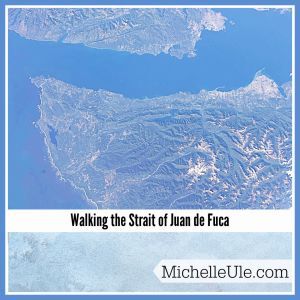
Walking the Strait of Juan de Fuca recently gave us a beautiful time in nature.
(And this photo essay).
The Strait is the watery divide between Washington State and British Columbia, Canada, to the north.
We’d traveled to Sequim, Washington, to spend time, again, along that body of water.
We wanted to hike Dungeness Spit, but the weather discouraged us.
So, we admired it from a distance.
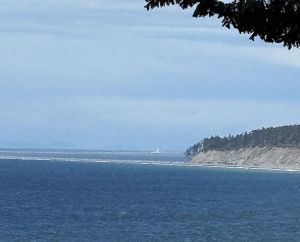
That’s the Dungeness Lighthouse, a distant white tower in this photo.
It’s five and a half miles one way–and you have to return the same way.
I didn’t have eleven miles in my knees.
So we plunged down a steep bushy trail to the rocky shore below our B&B.
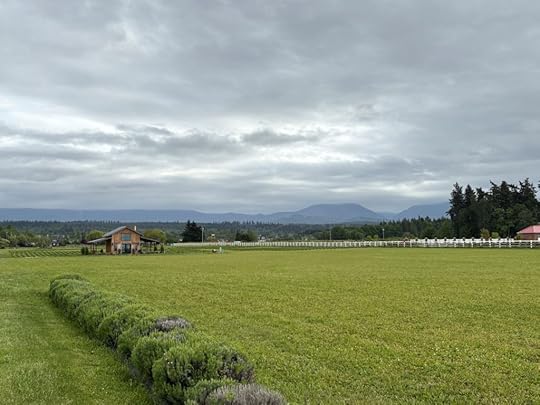
Through the Olympic Mountain scrubSequim sits in the “rain shadow” of the Olympic Mountains in the northwest corner of the continental US.
The weather is better than most of Washington State.
White capped mountains stand to the west, and lavender fields spread across the plain.
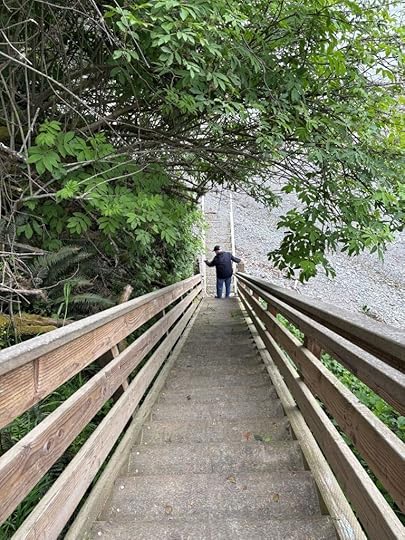
To reach the strait, hikers plunge down a steep set of staircases through ferns, wild geraniums, and pines.
At the bottom of our trail, my husband opened a “drawbridge” to the beach to navigate more easily.
And then we stood across the watery border with Canada.
The teeming sea, calling gulls, and the rocky low tide lay between us.
The wind blew strongly on that cloudy day.
Glorious.
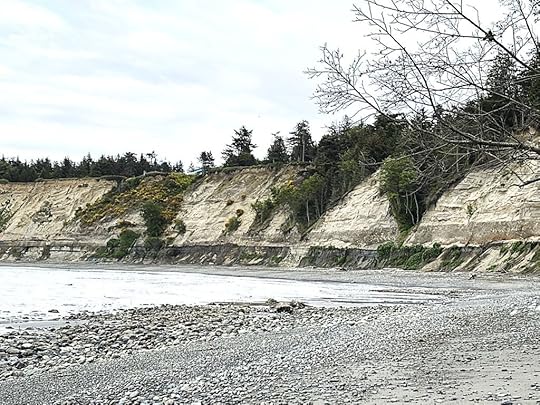
The rocky Strait of Juan de FucaWe headed east (we were on the US side) before the rocky beach narrowed to water.
See the height of those shoreline bluffs?
The ladders only reach halfway up.
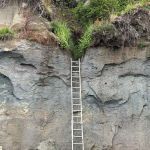
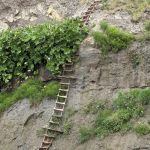
It took a lot of agility to use them. We were thankful for the steep stairs!
Why the Strait of Juan de Fuca?Fur trader and sea captain Charles Barkley sailed the Imperial Eagle through the strait in 1787.
He named it for Juan de Fuca, a Greek navigator from the 16th century. De Fuca sailed on a Spanish expedition seeking the Strait of Anián. (Anián was believed to be the boundary between North America and Asia.)
History doesn’t record if de Fuca found what he sought.
The waterway named after him opens up the entire Puget Sound for commerce and military use.
On the day we visited, the rocky shore was ours to explore. Only two ships traversed the strait during our visit.
We felt a long way from anywhere!
We’ve crossed the Strait several times on the ferry between Port Angeles and Victoria.
My husband made his first cell phone call while on a submarine transiting the Strait.
It’s been a friendly boundary for many years.
Sometimes you can even spot pods of orcas swimming past.
What makes up the Strait?Besides ocean water?
All sorts of rocks, sand, petrified wood, and logs wash up along the Strait of Juan de Fuca.
(Agates, jasper, carnelian, and occasionally jade).
I fell in love with the different colored stones along the waterway–and took too many photos! Here’s a sample
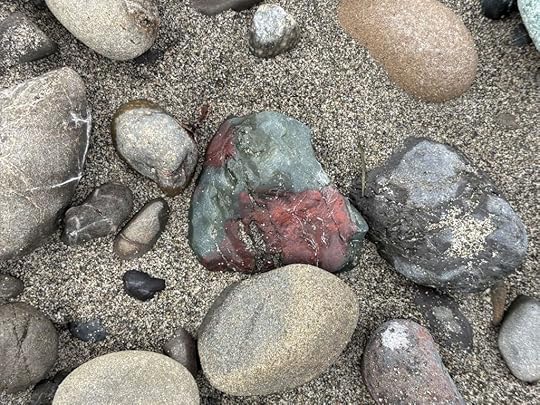
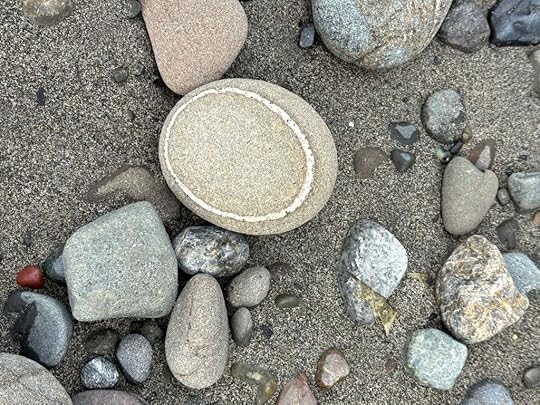
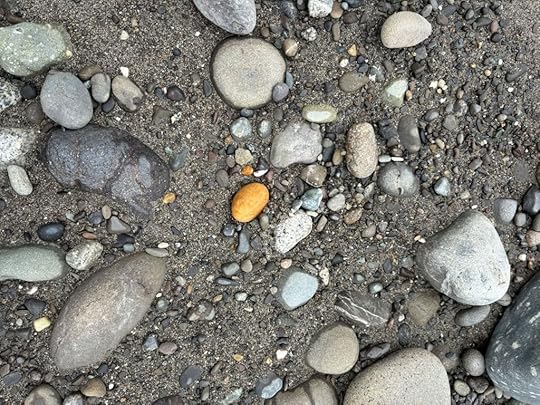
Our God made such a splendid, unique, and colorful world.
The wind blew, the gulls flew, we breathed deeply, and just appreciated.
I carried both rocks and shells up the steep bluff staircase from the Strait of Juan de Fuca.
And entered a different world altogether.
The post Walking the Strait of Juan de Fuca appeared first on Michelle Ule, Author.