How can we learn to navigate life with a strong inner compass?
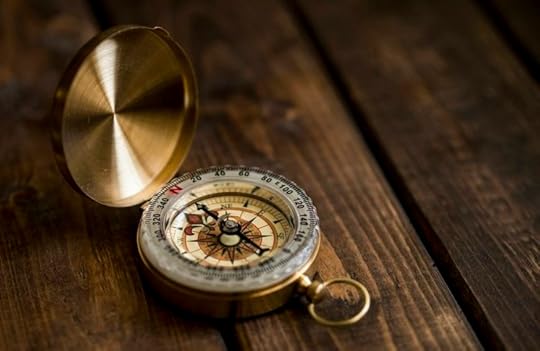
Src: Aaron Burden Unsplash
My heart beat fast, post-workout, as I smiled at my co-writing friends on Zoom, rocking on my blue exercise ball that I used instead of a chair. My mind swirled with to-dos. I couldn’t decide what writing project to work on. I really wanted a latte, but felt getting one was a distraction, so willed myself to stay put.
The co-writing group was a cameras-on-or-off-for-90-minutes group. I turned my camera off. Paced a bit. Told myself to meditate for 5 minutes. Toward the end, with my eyes closed, something nudged my crossed legs. As I opened my eyes, my blue exercise ball swayed inches from my face, like an invitation to play. The breeze must have pushed it, but what was I thinking right before the nudge?
Meandering. I chuckled. Seemed my intuition visited me in the form of a slightly deflated orb urging me to meander up to the coffee shop around the corner to get that latte, where I ended up giving a stranger my phone number.
What is an inner compass? And how do we learn to navigate the ocean of life with a strong one?
what’s an inner compass?trailer with Hrund Gunnsteinsdóttir
In this month’s thought echoes podcast with Hrund Gunnsteinsdóttir, we explored the waters of intuition she wrote about in her new book: InnSæi: Heal, Revive and Reset with the Icelandic Art of Intuition.
Hrund described three aspects of InnSæii (the Icelandic word for intuition):
Unconscious Mind (sea within) — the unconscious world within us, holds space for imagination and absorbs all our sensory inputs. If you put the sea within into silos or boxes, it ceases to flow.
Self-Awareness (to see within) — our ability to see inside ourselves, to know ourselves and our emotions well enough to be able to put ourselves into other people's shoes and discern intuition from biases, fears, and wishful thinking.
Inner Compass (to see from the inside out) — meaning to navigate the ocean of life with all its uncertainty and do so with a strong inner compass — knowing what to say yes or no to and feeling good about it.
Instinct is something that is wired into our DNA, but intuition develops over time. That was a new twist for me. I knew we all have intuition (whether we hear or listen to it or not). But for me, I felt it’s always been there, not something that grows over time and was affected by all we take in, consciously and unconsciously.
As the world keeps changing, we have an opportunity to “be tuned into ourselves and the world around us, be better able to navigate like fish in water, helping us become more resilient,” says Hrund. She advises to have a sense of humor. We’re human and definitely not perfect. Honing our intuition takes patience and practice.
Hrund surprised me when she said we cannot rely on our intuition if we feel emotionally imbalanced. I always thought if we honed our intuition we could rely on it in stressful situations like meditation with the promise that if you practice being calm and present you’ll be able to call upon that skill on a moment’s notice.
And she surprised me again, when she talked about how emotions were about putting things in motion, to let them go out of our bodies. My approach for processing emotions has been more about replaying something that happened and brainstorming what I could do differently to avoid an unwanted emotion. What I haven’t been doing (like all my life) is sitting with the emotion — to acknowledge, absorb, take action or not, and letting it go. I’m imagining engaging this way of processing my emotions would be healthier for me and those around me.
“Intuition as an inner compass really helps us discern what we think, what’s important that we do, and also understand what are the things we might want to let go of and feel good about it.”— Hrund Gunnsteinsdóttir
Think of intuition as part of our intelligence. When we weave together analysis and intuition, rational thinking and creativity, Hrund refers to this as flow. She spoke of finding the balance between the two rhythms of being and doing. Being deliberate and being receptive. Having a plan and being open to the unexpected. Resting and being very active. It’s as if we need to allow the flowing in our lives to ebb once in a while, a slice of space to absorb our doings.
There are several ways we can’t hear or don’t listen to our intuition. One of them is because so many of us are in fight or flight mode so much of the time. Or burning out by doing too much. Or we get stuck (think of stagnant water that needs to flow, or a frozen glacier that melts and leaves behind beautiful mineral deposits in the process, as John Grant, a musician, explains in InnSæi).
Hrund offers an antidote, “When we are fully present in the moment, we are best able to tune into our intuition and build on all the knowledge, expertise, and experience we’ve accumulated throughout our lives. If we're not fully present, our system is not as regulated as it could be, and it's easier to panic. It’s easier to jump to conclusions.” We want to train ourselves to listen to our intuition. Every time we don’t listen, we’re training ourselves to ignore it and that seems like a missed opportunity.
If we use our values as an intuition filter, according to Victoria Lemle Beckner, PhD, we have a way to “identify the qualities within ourselves that we want to express in our behavior, such as being curious, brave, loving, fair, dedicated, artistic, and playful. They can guide what we do (calling a friend who needs support) and how we do it (with kindness and empathy). Values resonate in the heart and are freely chosen. At any moment, we have the capacity to bring openness to a difficult conversation or creativity to making dinner. Values are not about how the other person responds or whether the dinner turns out tasty. When we act from our values, we often feel alive, in flow, and aligned internally. Even when difficult feelings are present, acting from our values feels right.”
When I asked Hrund how people could start to hone their intuition, she recommended starting an attention journal. Pay attention to what you’re paying attention to. Make a simple note as if documenting a photo shoot: nice smile, colorful flags. No judgment, just notice what you are noticing. Try it for a week and see what patterns emerge.
Another good suggestion came from Christy Geiger. When learning to listen to your intuition, test for “boomerangs.” That concept, caught my attention — there were times I thought I’d made a decision in a grounded way only to have a lingering doubt surface a day later. Christy says, “The ‘boomerang’ effect is a useful checkpoint, prompting you to re-evaluate and make any necessary adjustments. It does not mean the gut was wrong, it means there are more layers and dynamics to be concerned with.”
***
While waiting for my latte and chatting with the barista about slipping away from my co-writing group, a guy behind me wanted to learn more. I smiled as soon as he had questions for me.
So, this is why I had an impulse to get a latte.
Although when I told my husband, his intuition told him something else.
“You gave a strange man your phone number?”
I laughed.
Gotta keep your sense of humor. We aren’t perfect, and our intuition isn’t always either.
When was a time you remember listening to your intuition?
WOULD LOVE TO HEAR YOUR COMMENTS.
If you enjoyed this post, I invite you to subscribe to my thought echoes newsletter below.