At the edge of damage…
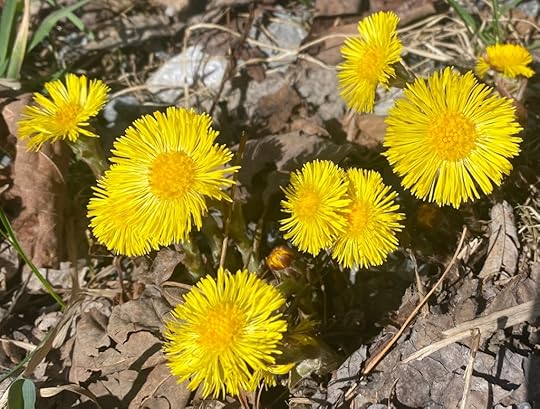
A few days of radiant sunlight and steady breeze, a burnish on my cheeks: solid medicine. It’s spring.
In rapid succession now, the coltsfoot, the lungwort, Siberian squill, my mini daffodils bloom. Each day I remain out of the hospital feels like a victory, a day worth savoring. Afternoons, evenings, I lie in bed reading Dostoyevsky.
There’s this line from a Louise Glück poem I mull over as I walk around my budding forsythia, the Daphne I planted last summer that survived the winter. The line is: “Nothing can be forced to live.” In these lengthening days, I wonder if perhaps my attitude has been skewed for years, gritty-mouthed and wry, one foot behind me ready to flee, the other toes nestling into the garden. Mid-April, and green shoots and velvety petals thrust from the earth. The honeybees swarm. The groundhogs feast and dig. The children ride bikes.
We’re early enough in the season that I can yet pick out this patch of Chionodoxa, the lilac buds. My sandy Vermont hillside thrusts towards life. A poem my friend Jo sent my way, and I’ll send yours is below. Swan’s words about the crack in our world — how much these resonant with me. Now, in my days and nights after chemo, as I begin putting my life and soul back together, I remind myself (as my siblings remind me) to lean into my cracks, to embrace the holes and the whole of my life.
BOWL BY HEATHER SWANfor my mother
From the mud in her hands,
the bowl was born.
Opening like a flower
in an arch of petals,
then becoming a vessel
both empty and full.
Later, in the kiln
it was ravaged by fire,
its surface etched and vitrified,
searing the glaze into glass
as its body turned
to stone.
It is at the edge of damage
that beauty is honed.
And in Japan,
the potter tells me,
when a tea bowl
cracks in the fire,
that crack is filled
with gold.