SMART Goals Development
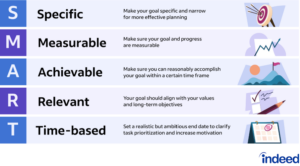
Below are some creative and logical ideas to help you or your team effectively develop SMART (Specific, Measurable, Achievable, Relevant, and Time-Bound) goals:
1. Use the “Backward Design” MethodSpecific: Start with the end result in mind and reverse-engineer the steps needed to get there.Example: If your goal is to increase revenue by 20% in Q3, identify which departments need to act and how their roles contribute.2. Incorporate Milestone TrackingMeasurable: Break down large goals into smaller milestones with measurable checkpoints.Example: Instead of aiming to onboard 500 customers by year-end, aim for 125 per quarter.3. Create Collaborative GoalsAchievable & Relevant: Involve team members in brainstorming sessions to ensure buy-in and practicality.Example: “Increase marketing campaign leads by 10% through collaborative cross-departmental efforts.”4. Gamify Your GoalsTime-Bound & Measurable: Introduce gamification techniques like progress bars or point systems to track progress toward goals.Example: Reward teams when they reach 50%, 75%, and 100% of their target.5. Align with Organizational VisionRelevant: Ensure every goal ties back to broader organizational objectives.Example: If the company’s focus is sustainability, a goal could be “Reduce paper waste by 30% within six months.”6. Use Data as a Starting PointMeasurable & Specific: Base your goals on historical data or trends for realistic benchmarking.Example: “Increase website traffic by 15% compared to last quarter’s average of X visitors.”7. Adopt a Quarterly SMART Goal FrameworkTime-Bound & Achievable: Plan shorter-term quarterly goals instead of long-term ones to adapt more flexibly.Example: Set Q1-specific targets like “Launch two pilot programs for product testing by March.”8. Emphasize Continuous LearningAchievable & Time-Bound: Encourage personal growth goals alongside professional ones.Example: “Complete one certification course in digital marketing within six months.”9. Integrate Cross-Team DependenciesSpecific & Relevant: Create interconnected goals that require collaboration between teams.Example: “Sales and Marketing teams will collaborate to generate 200 qualified leads per month.”10. Use Realistic Stretch GoalsAchievable & Realistic: Balance ambition with feasibility using stretch goals that push boundaries without overwhelming teams.Example: “Increase monthly sales from $50K to $60K over six months through targeted strategies.”11. Apply Metrics Beyond NumbersSometimes qualitative measures are just as valuable as quantitative ones.Example:Instead of just focusing on “50 new clients,” focus on improving client satisfaction ratings from X% to Y%.The post SMART Goals Development appeared first on Peak Development Strategies.


No comments have been added yet.