
CMP# 211 Book Review: Jane Austen's Bookshelf
 This blog explores social attitudes in Jane Austen's time, discusses her novels, reviews forgotten 18th century novels, and throws
some occasional shade
at the modern academy. The introductory post is here. My "six simple questions for academics" post is here.
This blog explores social attitudes in Jane Austen's time, discusses her novels, reviews forgotten 18th century novels, and throws
some occasional shade
at the modern academy. The introductory post is here. My "six simple questions for academics" post is here. This post is a review of the newly-published Jane Austen's Bookshelf which discusses some of the better-known female writers that Austen read. My blog focusses on more obscure authors, some of whom enjoyed great success in their day and were read until well into the 19th century, such as Elizabeth Helme and Elizabeth Meeke. For more, see the "authoresses" link at the upper right hand side of the page. CMP#211 Eight pioneering women writers who were on Jane Austen's bookshelf
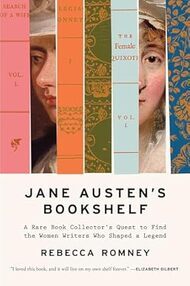 So where are you in your journey from Austen fan to Austen superfan? Have you worked out the Austen family tree? Do you smile politely when someone quotes Austen's "little bit of ivory" at you, because you've already heard or read it a hundred times? Have you read any or all of the novels mentioned in Northanger Abbey? Did you know that "Lover's Vows," the play performed by the young people in Mansfield Park, was a real play?
In my opinion, Jane Austen's Bookshelf by Rebecca Romney is geared toward people who are not far along in their Austen journey, but are ready and eager to learn more. On the other hand, well-informed Janeites might find that it covers familiar territory, while others might be bemused by the proposition that Maria Edgeworth and Frances Burney are forgotten writers whose connection to Austen was waiting to be rediscovered.
I don't mean that as a criticism of a well-written and deeply researched book, which this is. For someone wanting to learn more about Austen and her literary world, Jane Austen's Bookshelf is packed with revelations for the reader (I'll get back to that later) and a valuable guidebook to the literature of her time. A busy tapestry of a book
Romney was already an expert on books as physical objects, but in Jane Austen's Bookshelf she shares what she has learned about the women writers who pioneered the novels which Austen read and admired. Not every writer can expound on academic topics for a general reader--I think Romney manages this very well. Jane Austen's Bookshelf is an ambitious weaving together of many different threads:A mini-biography of Jane Austen and a discussion of her novels,Mini-biographies of eight women writers of Austen's era, some of which rival the plot of any 18th-century novel,Discussions of how these other writers might have influenced and inspired Austen, A reiteration of the feminist explanation (cf Dale Spender 1986) for why and how Austen's reputation rose while the others sank in critical esteem and recognition (hint: it was the chauvinism),Contextual information about the late Georgian/Regency era in terms of marriage, class, and money, and the debate over novel-reading,The world of rare book sales and collection, andThe author's evolution from a conservative and religious background to a feminist awakening. Romney weaves these threads with skill. She moves adroitly from one topic to another as she chronicles her learning journey.
 From tunnel vision to broader context
This journey is exemplified by Romney's discoveries around the phrase "Pride and Prejudice." At first, she--like me--assumed it was a clever coinage of Austen's own. Then she learned that "the phrase 'pride and prejudice' came from Burney’s second novel, Cecilia (1782)."
Now, some fans might wobble at this stage. It can be a little painful to give up the idea that Austen was a completely unique genius who owned nothing to anybody. I felt this myself when I came across the phrase "pride and prejudice" in The Two Cousins (1794). But if you are intrigued, like Romney, you dive in. She found the phrase “pride and prejudice” in Charlotte Smith's The Old Manor House (1793) as well. Then she learned Hester Thrale used the phrase in her diary. "Across editions, across generations, I followed the evidence. I might not ever know the true answer to the source of Austen’s phrase, but the investigation itself thrilled me."
Romney eventually concludes that no-one owned the phrase "pride and prejudice." "It was [a]n eighteenth-century colloquialism. That would be logical: none of these women were writing separate[ly] from the influences of the world around them. They were of it, and from it." That's right. And if you go to Google Books, you will discover that dozens of people used the phrase in poetry, fiction and nonfiction. This search is set for 1700 to 1799. Pride and Prejudice is still a perfect title for the story of Darcy and Elizabeth, though.
Another example of tunnel vision I've noticed in Austenworld is that people assume that any feminist sentiments in Austen must trace directly back to Mary Wollstonecraft. In fact, just as Romney discovered, "Wollstonecraft wasn’t the only woman with liberal politics publishing at this time." Feminist, radical, and conservative ideas were all part of the range of opinions roiling about, just as they are today. Another example: assuming that Northanger Abbey owes its genesis to an earlier parody, The Female Quixote. There were many other parodies of gothic and sentimental novels written in Austen's time, including Rosella and The Heroine. Parodies of sentimental and gothic novels were an entire sub-genre, which says something about the formulaic and overwrought nature of novels written during this era.
Thus, when we encounter something in Austen, we tend to think it originated with Austen because she's the only novelist from her era that most people read today. For example, it is accurate to say that money and social class play an important role in Austen's novels. But it is more accurate to say that money and class played in important role in almost every novel of Austen's era. Reading other literature and commentary from the period puts Austen in context with her world and--I think Romney would agree--brings her alive as a working writer interacting with, reacting to, improving upon, the literature of her time.
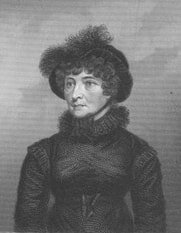 Hester Thrale Piozzi (1741-1821) Compendium or investigation?
As you probably already guessed, I have some quibbles with the framing of this book. The subtitle, "A Rare Book Collector's Quest to Find the Women Writers Who Shaped a Legend," sets up the idea that Romney had to delve to find the truth, or as she repeatedly puts it, she had to conduct an "investigation." This implies that it was no easy matter to track down "clues" to find the women writers who influenced Austen. But while this is a fun conceit for a book, the facts are not hard to find, especially not for a professional rare book collector with above-average research skills and a liberal arts education. In addition to her own study of original source materials, Romney drew on masses of scholarship about influences on Austen's writing. The breadcrumbs she followed are actually a well-trodden path.
The idea of the quest and the detective hunt ties in to the feminist school of scholarship which contends that female writers have not merely been neglected, they've been erased because they are women. Romney had heard of Hester Thrale Piozzi (no doubt because of her association with Dr. Johnson), but she hadn't heard of Frances Burney. So she concluded that there must have been a conspiracy to erase Burney from literary history.
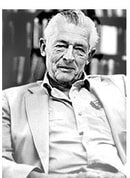 Ian Watt (1917–1999) The number one bad guy in this scenario, the man blamed for shaping the critical consensus against female writers, is Ian Watt, author of the influential
The Rise of the Novel
(1957). Of female authors, he wrote: “The majority of eighteenth-century novels were actually written by women, but this had long remained a purely quantitative assertion of dominance." Most of the novels churned out during this period were written to “meet the reading public’s uncritical demand for easy vicarious indulgence in sentiment and romance.” He added that Burney was an exception who rose above mediocrity. He didn't discuss Edgeworth.
Ian Watt (1917–1999) The number one bad guy in this scenario, the man blamed for shaping the critical consensus against female writers, is Ian Watt, author of the influential
The Rise of the Novel
(1957). Of female authors, he wrote: “The majority of eighteenth-century novels were actually written by women, but this had long remained a purely quantitative assertion of dominance." Most of the novels churned out during this period were written to “meet the reading public’s uncritical demand for easy vicarious indulgence in sentiment and romance.” He added that Burney was an exception who rose above mediocrity. He didn't discuss Edgeworth. But that was 70 years ago. Feminist scholar Dale Spender went to bat for the ladies forty years ago in Mothers of the Novel: 100 Good Women Writers Before Jane Austen (Pandora Press, 1986) and since then feminist theory has been a dominant voice in literary criticism, to the point where I am more than a little bored with the ire and the indignation. And anyway, feminist scholarship is not focused on making the case for why these female authors belong in the canon on the basis of literary merit, but is focused on whether these female authors were proto-feminists or not. Thus, Romney asserts that female authors of the era were subtly protesting the legal status of married women. But I'll leave that quibble for another day. To be fair, I am not a young woman to whom these old grievances are new revelations.
Romney reiterates the feminist view of literary history even though she discovered first-hand that the best-sellers of the past don't suit modern tastes--which might provide another explanation, apart from chauvinism, for why they are not widely read today. Many an 18th century heroine was an insipid doormat by our standards. Romney found Hannah More unreadable and Elisabeth Inchbald too moralizing. Anne Radcliffe's long descriptions of scenery were tedious, and the quality of Charlotte Smith's work suffered because she had to churn out novels to feed her family.
My quibbles aside, Jane Austen's Bookshelf provides a lot of information between its covers, delivered in an entertaining fashion.
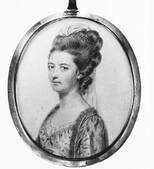 Charlotte Lennox (1729-1804) When you're ready for a deeper dive
If you enjoy your Austen in novel form or movie form or mini-series form, that's fine. I am not saying you have to take a deeper dive. Jane Austen's Bookshelf is for the people who want to take a deeper dive. This book could well inspire you to explore the authors that Austen read. In addition you could consult Romney's bibliography for more scholarly reading.
Website of the Frances Burney Society
Website of the Edgeworth Society
Previous Link Fair heroines and feckless heroes


No comments have been added yet.


