How Two Koreans Sparked a Church
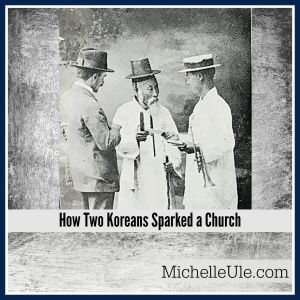
When two Koreans showed up at the Tokyo Bible Institute in 1904, everyone was puzzled.
“They were dressed in white robes, white pantaloons tied at the ankles, and with black horse-hair cage-like tophats through which their topknots could poke out,” wrote a thirteen-year-old boy.
Students and leaders of OMS–the Oriental Missionary Society–didn’t understand what the men were saying.
What language were they speaking?
Their clothing didn’t look Japanese.
OMS missionary Ernest Kilbourne looked puzzled until one man grinned and pointed at the cross. “Hallelujah!”
Then Kilbourne understood. “Amen!”
Yes.
And that was the beginning of the Korean Holiness Church.
It started with Juji Nakada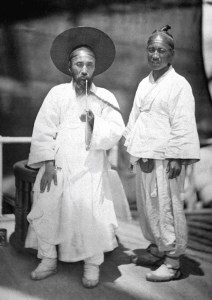
OMS founder Juji Nakada secured permission from the Japanese army during the 1904-1905 Russo-Japanese War to visit troops in Korea.
He rode horseback through the north toward Manchuria, stopping along the way to preach whenever he could.
Two Koreans, Chung Bin and Ki Sang-jun, heard him preach about “the glorious experience of sanctification” and were inspired by Nakada’s words.
But what to do? Nakada rode away.
Eventually, they met a Korean doctor who knew Nakada. After listening to them, he suggested they visit the Tokyo Bible Institute to learn more about the Gospel.
So, they went.
What happened to the Koreans when they arrived?Kilbourne’s son, Bud wrote about the meeting:
Through the use of Chinese characters, the written literary language known by most of the educated of that area of the Orient, the Japanese and Koreans made themselves understood.
Chung and Kim applied themselves to the language and within a few months a third Korean joined them, Li Jang-ha.
Bridge Across the Century, volume one, page 150
The third Korean, Li, was a musician and he spent all his spare time translating hymns into Korean.
Three years later, their training was complete; they returned to Korea with a Korean hymnal, many Holiness books translated into their language, and a dream.
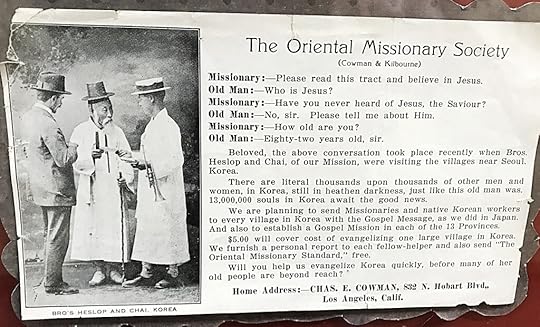
OMS founders Charles Cowman and Ernest Kilbourne joined them.
All five men were interested in one thing: setting up a Bible school in Korea.
Why a Bible School?The OMS, like other missionary societies, saw their role as starting a Bible school, teaching those who lived in a country how to share the gospel, and then leaving.
That was their goal from the start. Those native to a culture and a nation are better equipped than Westerners to share the truth of Jesus Christ.
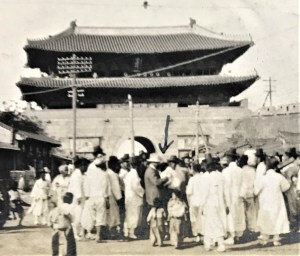 Charles Cowman preaching in Seoul (OMS archives)
But Charles Cowman’s desire to share the good news of Jesus began long before he arrived in Japan, much less when he returned to the nation in 1904 and discovered three Korean students at the Bible Training Institute.
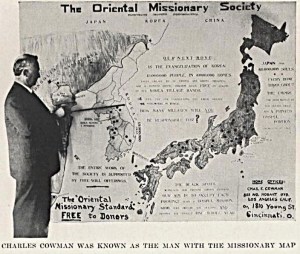
He had a map of Asia on the wall of his home. On it, he’d written in red letters the nations for which he prayed. One was Korea.
With three men in the school, Cowman and Kilbourne saw the beginning of an important ministry.
“It is part of the original contract to do the will of God as far as He shall make it known,” Cowman said. “I accept this new requirement.”
Off they went in 1907, carrying tracts translated into Korean with them.
Within six months of finding a suitable building near Seoul, 270 people inquired about attending the new Bible school.
Establishing a Korean school and ministrySix months later, OMS had to find a bigger building. Large churches provided them with space for evening meetings.
Chung, Kim, and Li now taught Bible classes in the mornings and evenings with about 40-50 people in attendance.
Soon, they added “noon-day prayer meetings,” and then an hour-long prayer meeting at night.
Revival soon sprang up, described by Canadian Presbyterian missionary in North China Jonathan Goforth as “the light in the distance.”
When he visited Seoul to see what else was happening:
he marched across the land waving a banner, “Not by might, nor by power, but by my spirit,’ saith the Lord,” and the great North China revival began as well.
Bridge Across the Century, p 152
Fifty years later, members of the Korean Holiness Church had increased more than ten times the Korean growth rate.
You can learn more here.
Tweetables
What a surprise! 2 Koreans in 1904 Tokyo. Click to Tweet
How the Korean Holiness Church began in Japan. Click to Tweet
The post How Two Koreans Sparked a Church appeared first on Michelle Ule, Author.