
THEN BE CONTENT WITH SILENCE
“The only really effective apologia for Christianity comes down to two arguments, namely the saints the Church has produced, and the art which has grown in her womb.”
–Cardinal Ratzinger
The day after Christmas, I crept in the cold up Fifth Avenue to the Met to catch the exhibit “Siena: The Rise of Painting 1300-1350.”
Spectacular. Simone Martini was one of the featured artists.
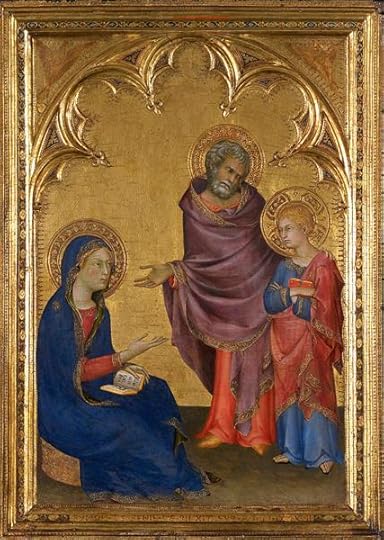 CHRIST DISCOVERED IN THE TEMPLE
SIMONE MARTINI, 1342
“DID YOU NOT KNOW I HAD TO BE ABOUT MY FATHE’RS BUSINESS?”
Beauty in and of itself doesn’t make us good, but it makes me, for one, want to be good.
I can’t possibly describe the joy, the treasure, of staying around the corner from St. Vincent Ferrer church. As a rule, I dislike taking photos in churches, but here’s one someone else took: a triforium (who knew?: a gallery or arcade above the arches of the nave, choir, and transepts of a church) view.
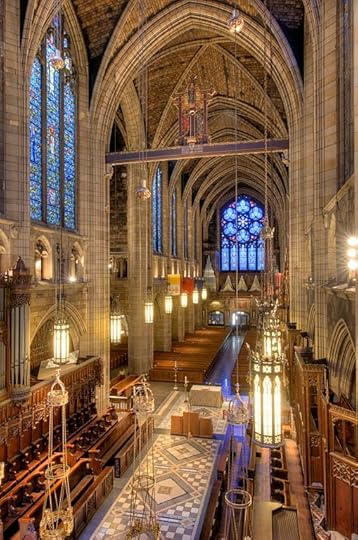 ST. VINCENT FERRER CHURCH, UPPER EAST SIDE, MANHATTAN
also I just relized their website has even better pix, but you get the idea
I attended the Christmas Day noon Mozart Mass there, and all through the Octave of Christmas their 6 pm daily Mass is sung. Today, Saturday, the Feast of the Holy Innocents, was celebrated at the 8 am.
The church is open from 7 am to 7 pm, so you can duck in there ANY TIME and outside of Mass times, there will be maybe 5 or 10 or 20 people tops scattered throughout this giant sanctuary with tons of gorgeous side chapels (St. Martin de Porres, St. T of Lisieux, and many more).
Also, daily Confessionis offered at 5:15 before the Rosary, Evening Prayer, then the 6 pm Mass. You walk up a set of steepish stone steps off Lexington Ave and inside is the faint smell of wax, incense, furniture polish, flowers, and at this time of year, evergreen boughs…Really, there is nowhere else on earth I belong than spaces like this, no matter how humble, no matter how grand…
Meanwhile, Fr. Donald Haggerty continues to provide rich daily sustenance and challenge:
“There can be strong, even profound, desires for God experienced in prayer, but what value to they have if they do not urge us to a more sacrificial life?”, for example, from Contemplative Enigmas.
He continues: “Contemplatives are often unknown figures in settings of social familiarity, and this includes communiities of religous life…[They] seem usually to show little need or interest in cultivating the contours and edges of a public personality in order to make it appealing to others. Even less are they protective and guarded toward something within themselves that might be walled-in and impregnable…In the best cases, they simply live their days in the shadows of self-forgetful obscurity. They are reaching a certain truth about the human person, while not aware of it, for exterior personality cannot be identified with the actual truth of self. These contemplative souls do not fight this discrepancy or seek to resolve it in some manner. There is no need to overcome this discordance, but only the need to live with it.”
Hmmmmmmmmmm.
He goes on to quote a passage from Thomas Merton from The Inner Experience: Notes on Contemplation:
“The true contemplative is a lover of sobriety and obscurity. He prefers all that is quiet, humble, unassuming…HIs inclination is to that which seems to be nothing, which tells him little or nothing, which promises him nothing. Only one who can remain at peace in emptiness, without projects or vanities, without speeches to justify his own apparent uselessness, can be safe from the fatal appeal of those spiritual impulses that move him to assert himself and ‘be something’ in the eyes of other men…He is quite content to be considered an idiot, if necessary, and in this he has a long tradition behind him.”
And back to Fr. Haggerty: “The true contemplatives seem always to find their corner, their niche, their way of living a hidden offering to God that ignores the external obstacle.”
Meanwhile, through the good Bishop Erik Varden, I’ve just learned of the late Scottish poet George Mackay Brown.
Mackay once wrote to a friend: “One feels desperate with solitude often; then it is salutary to know that one is not alone, but is involved with mankind. And that means, as I understand it, that whenever you are brave, enduring, uncomplaining, then the whole world of suffering is helped and soothed somehow. This is sacrifice, and fulfilment and renewal: an incalculable leavening.”
In a sense, he observed, “everyone is the writer’s concern. The whole of humanity is his family and he must participate in their joys and ennuis and sufferings, otherwise what he does would be as meaningless as an endless game of patience.”
Brown grew up poor, suffered from TB and ill health from his youth, and drank.
“Death, critics say, is a theme that nags through my work: the end, the darkness, the silence. So it must be with every serious artist, but still I think art strikes out in the end for life, quickening, joy. The good things that we enjoy under the sun have no meaning unless they are surrounded by the mysterious fecund sleep.”
His last published vserse, “A Work for Poets,” reads:
To have carved on the days of our vanity
A sun
A star
A cornstalk
Also a few marks
From an ancient forgotten time
A child may read
That not far from the stone
A well
Might open for wayfarers
Here is a work for poets —
Carve the runes
Then be content with silence


