Did Charles Hooten’s “Immaterialities; Or, Can Such Things Be?” Pave the Way for Catherine Crowe’s The Night-Side of Nature?
Catherine Crowe’s The Night-Side of Nature; Or, Ghosts and Ghost-Seers was published in 1848 — and became remarkably popular. Not surprisingly, there were plenty of reviews of it upon publication, but over time, it also served a standard reference work in other works about ghosts. It even became mentioned in both fiction and poetry! I haven’t been able to trace all of the editions, but here are a few:
London: T.C. Newby, 1848: Vol. 1 and Vol. 2. London: T.C. Newby, 1849: Vol. 1 [includes Crowe’s “Preface to the Second Edition”] and Vol. 2.New York: J.S. Redfield, 1850. 1853.London: G. Routlege and Co., 1852 [includes Crowe’s “Preface to the Third Edition”]. 1857 [designated “New Edition”]. 1866. 1882. 1904.New York: W.J. Widdleton, 1868.Philadelphia: Henry T. Coates, 1901 [“New Edition”].I recently came upon a magazine series, written by Charles Hooten and published in 1846, that might have served as inspiration for Crowe. If not inspiration, it shows that Crowe was a part of an emerging trend, one of interweaving allegedly true ghost reports with argument that such phenomena should be approached with an open mind instead of the automatic skepticism that had dominated the decades before.
Hooten’s series is titled “Immaterialities; Or, Can Such Things Be?” It was published in Ainsworth’s Magazine:
“Chap. I,” Ainsworth’s 9 (1846) pp. 206-213;“Chap. II,” Ainsworth’s 9 (1846) pp. 297-303;“Chap. III,” Ainsworth’s 9 (1846) pp. 449-454; and“Concluding Chapter,” Ainsworth’s 10 (1846) pp. 49-54.Hooten opens by bemoaning the loss of enchantment to the “utilitarianism and matter-of-fact tendency of the times.” With an odd streak of nostalgia for more fearful times, he laments:
A man may watch in a church, or a graveyard, every hour of the night, and see no ghost, because every body knows there are no ghosts to be seen. The magic has departed from midnight, and the bones of the dead are now scarcely less dreaded by man or maid than are those similar relics of animal mortality which grin upon a dish in the larder. One cannot even hire a haunted house at any lower rent than a similar house that is not haunted....This kind of expository prose frames a series of ghost tales or, perhaps I should say, weird ones. Many of the narratives involve events that took place centuries earlier. His first, for instance, is taken from the letters of “James Howell, one of the clerks of the Privy Council, in Charles the First’s reign,” so this must have been in the first half of the 1600s. Granted, it’s a neat story — but it’s an old one.
The next story is set in dated 1701. Not much better. But the third is said to have happened in 1829, so within the living memories of most of Hooten’s readers. There’s mention of “the celebrated establishment for drawing in Charlotte Street, Bloomsbury,” in London, and according to this advertisement in an 1841 Art magazine, at least that part of the story is true.
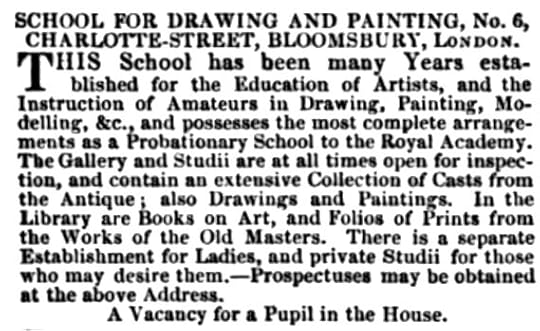 From the September 1, 1841, issue of The Art Union.
Unfortunately, some of Hooten’s arguments come off as rather silly and “stretched.” For instance, he suggests that sustaining a belief in ghosts can provide a check on immoral — or, at least, naughty — behavior:
Who dare venture to say what crimes have not been prevented by the salutary and healthy belief in ghosts? What mischievous kissings between amorous footmen and susceptible maids in obscure parts of mysterious old manor houses, have not been happily averted by the dread of some too shapely ancestorial shadow, or the fearful sound of a long-departed knight tramping unquietly along the darkened corridor?No snogging amongst the staff, if you please!
At the same time, Hooten admits that “we are totally in the dark” regarding ghosts, and so he shares his stories to provide evidence without drawing a grand theory from it. This is probably the real value of the piece today. The four chapters serve as a wonderful source of “true” tales about hauntings from the Victorian and pre-Victorian period.
Take, for instance, the tale found in the last chapter. It’s among the very earliest I’ve found addressing the haunted spot where Elizabeth Shepherd was murdered in 1817. A stone monument was placed at the spot, one that’s still there and still evokes ghost stories! I’m always fascinated when such haunted sites persist across the centuries. Rarely do the manifestations remain consistent, which suggests specters like to shake it up from time to time.
Those interested in Victorian ghost stories might enjoy wandering through Hooten’s long article.
— Tim