Child Workers in Britain's Coal Mines
 A child miner in 1842.In 1842, a Children's Employment Commission was set up to discover the true facts about child labour in Britain's coal mines.
 We do not know precisely how manychildren worked underground in the middle of the nineteenth century. The commission only established the proportionof children and young people to adults, which varied according to district. For example, over one-third of the workforce was under eighteen in the Durham, Northumberland, Glamorgan andDerbyshire mines.
 Wellcome Collection. Child workers 'hurrying'.
 The age when children first entered the pit depended on thethickness of the coal seams, family poverty, and local custom. Children asyoung as four were recorded. On averagegirls and boys began working underground when they were eight or nine yearsold.
The youngest children were 'trappers'. They opened and closed the ‘trap-doors’ which regulated air-flow through the pit. The trappers sat alone for hours in the dark,unless they had a candle. Six-year-oldSusan Reece, a trapper in a South Wales pit,said she ‘didn’t much like the work’.
Older children moved coal for the ‘getter’ or ‘hewer’ from thecoal-face to the bottom of the mine-shaft. Thin seams (only twenty inches high) could only be worked by using childrento drag or push the loads of coal, sometimes up a steep slope. This was called‘hurrying’ or ‘putting’.
Children hauled tubs of coal using agirdle or belt and chain, which they paid for out oftheir wages. The belt blistered and cut the children’s skin; theirbodies became stunted from prolonged stooping.
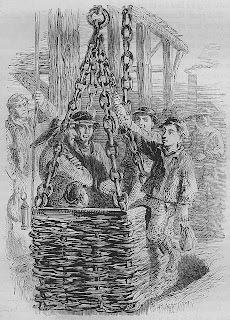 Descending into the pit, 1870s.In some pits, young boys were ‘engineers’; they controlled the engine which wound parties of workers up and down themine-shaft. They had to stop the basket or tubcarrying the people at exactly the right moment. If not, the tub and itspassengers continued up and over the overhead pulley, injuring them or dashingthem into the mine-shaft below.
In east Scotland, women and girls of all ages carried coal ontheir backs to the surface via a succession of steep, rickety ladders. The loads they carried were incredibly heavy. Some fathers ruptured themselves as they lifted aload onto their daughter’s back.
Women and children also worked above ground at thepit-brow in many areas.
Coal mines were (and still are) very dangerous places to work in. Explosions from gases like fire-damp were commonplace; and there were thousands of run-of-the-mill accidents, like being run over by a coal waggon, or a roof collapse. In 1838, there were 349 fatalities in English collieries; over one-third of those killed were under eighteen.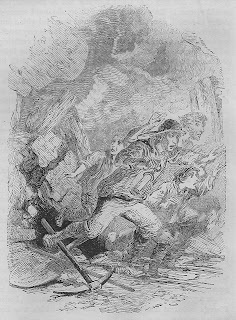 An explosion in a coal mine, 1870s.
The Mines Reform Act of 1842 banned allwomen and girls from the pits. The minimum age for boys enteringthe pit was lowered to ten, but they could be engine-men as young as fifteen. However, it proved difficult to enforce the Act. Boys under ten were found working below ground overten years after the Mines Reform Act.
 Oldest and youngest miners in a colliery, c.1906.