A Quick Guide to Internet Horror!
My newest book, Dial-Up and Die, is going strong and in honor of its release, I thought I’d give you a breakdown of the relatively new genre it sits in. I say ‘relatively’ because somehow it’s been a quarter of a century since the millennium which roughly coincided with the popularization of the internet. Sure, the net has been around in some form or another since the 1970s, but it wasn’t until the late-90s that regular folks started getting it in their homes. In a few short years, we were all connected and, while the tremendous benefits in communication were clear, there was a lot of unease about this new technology and what it might unleash.
Horror has always been a genre that has kept its finger on the pulse of cultural concerns and social change and the internet boom provided fodder for horror stories almost as soon as people started surfing websites and sending emails. The anonymity of the internet and the lack of control over who is seeing your online actions opened up a world of online stalkers, creepy chain letters and eerie urban legends. The somewhat lawless nature of the internet also led to several ‘shock sites’ such as Rotten.com which posted disturbing images of dead celebrities and other things that felt almost illegal to look at. You never knew what dark corner you might turn in those early days of the internet.
As today, it was hard to tell what was real and what was fake and the line between reality and fiction became increasingly blurred. ‘Internet horror’ (for want of a better word) is a sub genre of horror fiction in which the internet is either used as a way of telling the story, or features as the subject. The term ‘cyberhorror’ has also been used for stories in which the online world is a source of fear.
And it started way back in the ’90s. An early website called Fright.com posted several horror stories including one in 1997 called the E-Leech which purported to be an online journal of a hacker who learns of an alien entity which has infected the computers of the Jet Propulsion Lab and is intent on replicating itself. An interesting example of early internet horror, the E-Leech is now only viewable via the Wayback Machine (here’s a link to a snapshot from 2000 if you’re interested). While the E-Leech was clearly a work of fiction, a movie from 1999 utilized the internet for its marketing in a way that had never been done before and convinced many that it was the real deal.
The Blair Witch Project, a faux documentary shot by three film students who allegedly vanished in the woods of Maryland while researching local folklore concerning a witch, was a massive hit thanks in no small part to its marketing. Its interactive website built on the movie’s mythology, featuring fake police reports, interviews and photos while the actors were listed as ‘missing, presumed dead’ on IMDB for the first year of the movie’s release. Many people thought The Blair Witch Project was real which added to its terrifying reputation.
 The original Blair Witch Project website from 1999 expanded on the movie’s mythology and convinced many that it was the real deal.
By the early 2000s, the internet had become a digital campfire of urban legends which became known as ‘creepypastas’. It was an amateur movement of short stories and images that began to circulate on forums like 4chan.org and Reddit, purporting to be real tales of terror with a focus on the gruesome and the supernatural. As their etymological root (‘copy-paste’) suggests, creepypastas are passed on, but morph and mutate with every telling. One of the earliest examples was an online journal by ‘Ted the Caver‘ which allegedly chronicles the exploration of a series of caves which seem to house a supernatural entity. In his final post, Ted writes that he is bringing a gun with him on his next foray into the caves and the blog has not been updated since 2001. Other famous creepypastas include Jeff the Killer about a disfigured boy-turned-serial killer and Russian Sleep Experiment which tells of a Soviet-era experiment gone horribly wrong.
Many creepypastas were technology-based including the large sub genre of ‘haunted video games’ like Ben Drowned which concerns an N64 video game cartridge possessed by the spirit of a dead child. Stories like Candle Cove and Funnymouth utilized the language of the internet itself to tell their creepy tales, presenting them as chat room sessions and were all the more effective for it. Perhaps the most infamous figure to emerge from the creepypasta phenomenon was Slender Man; a tall, pale and faceless figure of menace featured in several viral images, stories and video clips. Although an entirely fictional creation by one Victor Surge (real name Eric Knudsen) who contributed a Photoshopped image in a contest on the forum, Something Awful, Slender Man generated genuine fear, most tragically in the case of two Wisconsin girls who, in 2014, stabbed their friend nineteen times in order to appease him; a case which brought creepypastas into the media spotlight and led to much debate about what kids were exposed to online.
The effectiveness of the Slender Man urban legend can be attributed to the way it transcends media. As well as images and short stories, he has appeared in games and videos, most famously in the 2009 webseries Marble Hornets. Platforms like YouTube have allowed creators to upload long-running series of low-budget horror usually in the found footage format akin to the The Blair Witch Project. Creepypastas that began as short stories have been elaborated on in lengthy series like The Backrooms (2022) which hints at an unnerving extradimensional space of empty rooms that play on the liminal space aesthetic. Petscop (2017) takes the ‘haunted video game’ trope to the next level in the form of a playthrough of a lost PlayStation game, and is initially indistinguishable from the hordes of similar ‘Let’s Play’ videos on YouTube.
 One of the original ‘Slender Man’ images (look closely) created by Victor Surge for a Photoshop contest in 2009.
Even the former social media giant, Twitter, was utilized for telling stories. In 2017, the creepy Dear David story unfolded, post by post, as writer and illustrator Adam Ellis chronicled the haunting of his apartment by the ghost of a dead child. As well as text, the story included video, audio and images and can be read as one long story, showcasing the internet’s dexterity in delivering horror in new ways.
Although the internet revolutionized our world and proved a new and hospitable ground for horror fiction, older mediums have thankfully remained popular and movies and books have continued to terrify, taking inspiration from internet horror. Early examples of horror movies that capitalized on the fears of the internet include Pulse (2001); a Japanese horror movie in which ghosts invade the world of the living via the internet and FearDotCom (2002); a cop thriller about a series of deaths linked to a disturbing website. The social media boom of the 2010s opened up a whole new world of fears connected to hacking, stalking, cyber bullying and identity theft and movies dutifully delivered on our fears, giving us a new form of visual storytelling called ‘screenlife’. An offshoot of the found footage genre, movies like The Den (2013), Unfriended (2014) and Host (2020) all take place on the screen of a computer, tablet or phone, utilizing webcams, video calls and instant messaging to tell their stories in real time.
Books have long used the ‘found footage’ concept of horror with the epistolary novel usually taking the form of letters, diary entries and newspaper articles. Bram Stoker’s Dracula is an early example of this, but in the post-internet age, several novels and short stories have used the language of the internet to terrify, purporting to be collections of chat room conversations, texts and emails, reminiscent of creepypastas like Ted the Caver and Candle Cove. An early one was 2004’s The Sluts by Dennis Cooper which was told as online postings and emails in the gay escort scene. Then there is Eric LaRocca’s 2021 novella Things Have Gotten Worse Since We Last Spoke which details a disturbing online relationship between two women. But cyberhorror doesn’t always have to be epistolary. Books like Adam Cesare’s Influencer, Jason Arnopp’s The Last Days of Jack Sparks and Todd Keisling’s Scanlines are all written in the more traditional sense, but deal with threats posed by social media and online urban legends.
For a ‘relatively’ new genre, internet horror has certainly changed in the past twenty-five years; a testament to the fast-changing nature of the internet itself. When the first creepypastas began to appear online, nobody had ever heard of social media and now it’s nearly impossible to write a cyberhorror story without social media being a part of it. The internet has changed and so too have our fears and concerns surrounding it. Cyberhorror has a lot to offer, both in the various mediums of the internet and in the social reactions to the ever-changing cyber world. Perhaps because it is so tied to technology, we can be confident that internet horror will continue to evolve as the technology itself evolves, creating new mediums, new points of discussion and new fears.
 Unfriended (2014) updates the ghost story by using the internet and themes of cyber bullying to tell its story in real time, showing events entirely on a computer screen.
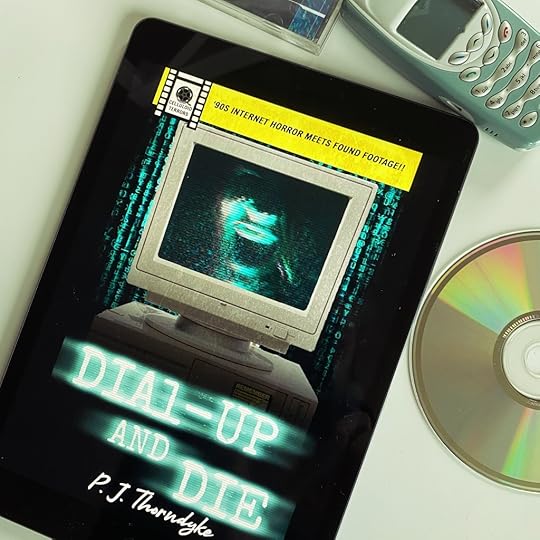
 If cyberhorror seems like your bag, then you could do worse than dip your toe in the genre with my own humble contribution; Dial-Up and Die: Internet Horror Meets Found Footage!. Set in 1999, it is an epistolary novel told through emails, chat room conversations, online journals and newspaper reports relating to the mysterious deaths of a group of teenagers. It’s available from Godless.com as well as most other platforms.